Exam Season
- A comparison

 Preview · 3 of 11
Objective & content
Should exams be replaced by work done during the year? This 45-minute discussion lesson for lycée pupils follows one path: the pupils first, then a story, then the world, then what the class thinks. The story is Hugo, 17, who lives in Bordeaux and takes the bac in June. All year his grades are good, because he works a little every week, but in exams his mind goes blank: in the mock bac in February he got 8 out of 20 in philosophy, when he usually gets 13. Since March he has revised until one in the morning with his phone next to him, and he has stopped playing the drums with his band. His friend Sarah is the opposite: she does very little all year, revises hard for two weeks and loves exam day. Then the English teacher asks: if the bac were only the work done during the year, who would win (a short story written for this lesson, with an open ending)? Then the class reads four facts: since 2021, 40% of the French bac comes from marks in the last two years and 60% from final exams; A levels in England are marked mostly by final exams; in Bavaria, two thirds of the Abitur comes from marks in the last two years; and in 2021, because of Covid, teachers in England gave the A level grades. By the end, pupils can talk about exam season and how it makes people feel, give and defend an opinion on exams and work during the year, and agree on rules for a fair final mark.
Documents to download (2)
- Pupil sheet In your teacher account
- Discussion lesson (slides) In your teacher account
Pedagogical guide
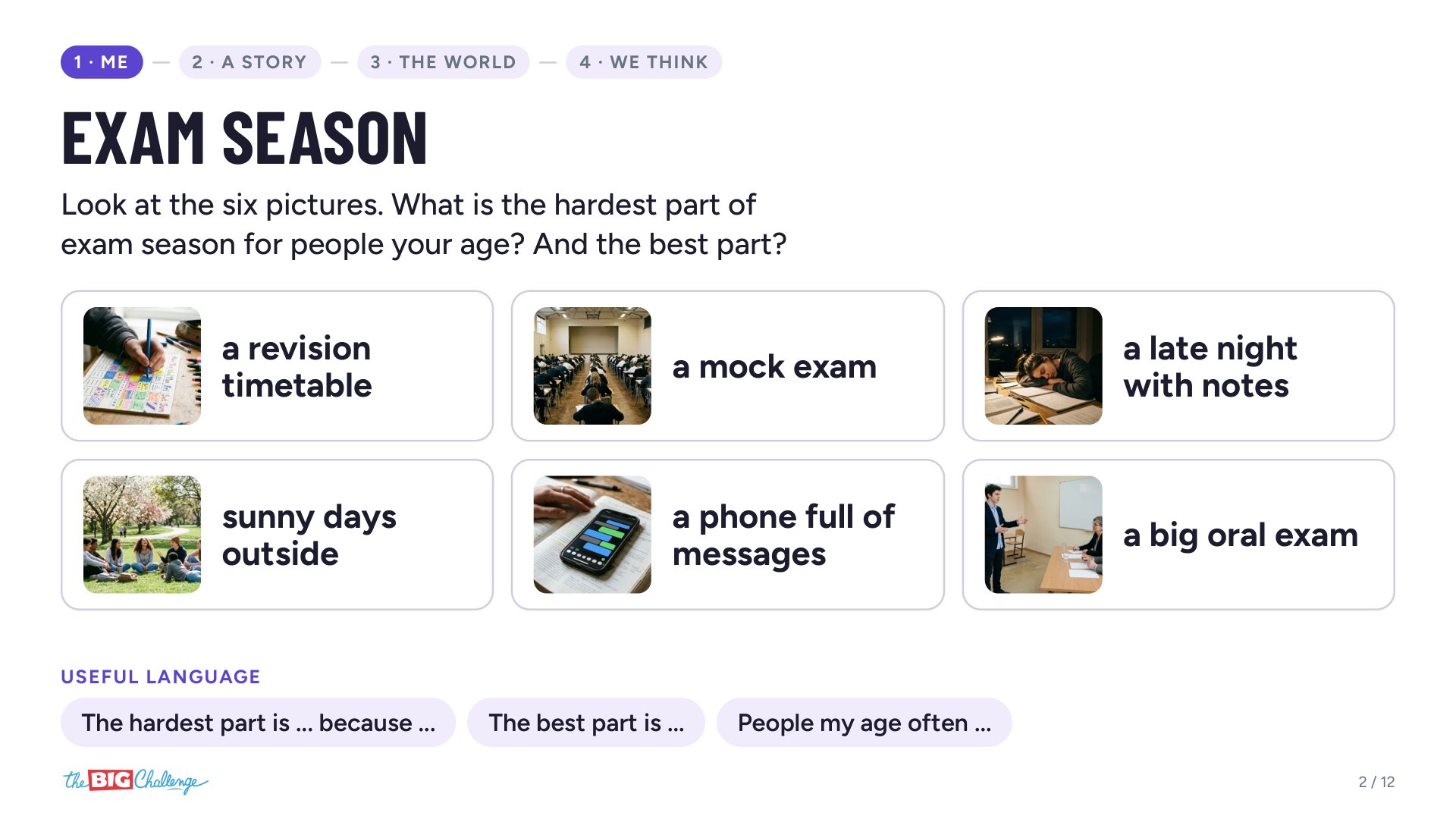
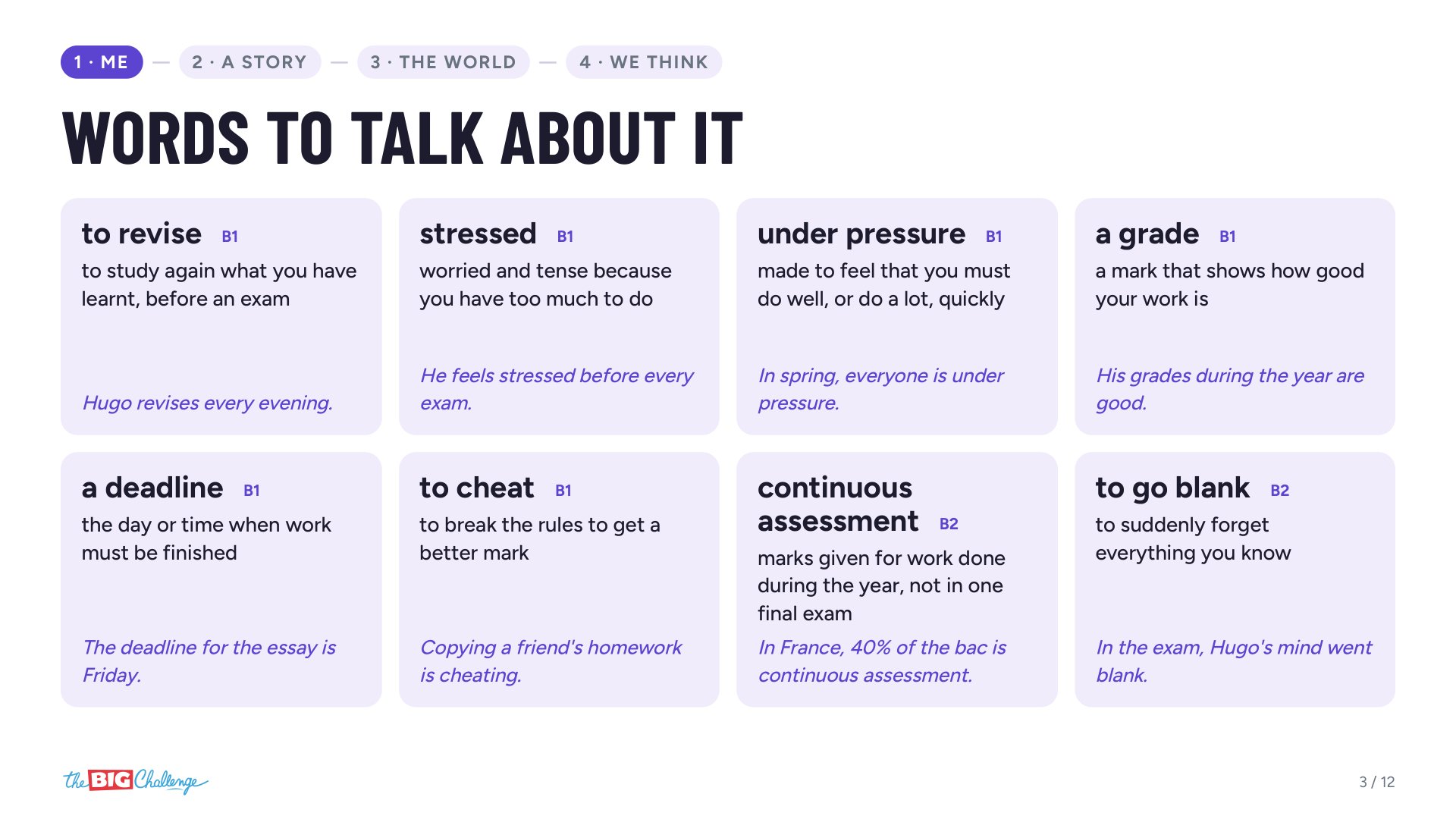
Every slide asks the class to do something: say what is the hardest and the best part of exam season for people their age, learn eight words (to revise, stressed, under pressure, a grade, a deadline, to cheat, and for stronger pupils continuous assessment and to go blank), choose three feeling words for Hugo in March and for Sarah on exam day, read four facts, say which of four invented voices they agree with, choose three things that help people revise, fill in three boxes (final exams, work during the year, a mix of both), stand on a line from 1 to 5 and write five group rules for a fair final mark. The words come before the talking, and each question has a B1 version for everyone and a B2 one for stronger pupils. The pupil sheet follows the slides, so every pupil leaves with something written. The language in use is the present perfect with "since" (Since March, he has revised ...), the second conditional (If the bac were only ..., who would win?), "should" for rules and advice, superlatives for comparing (the fairest, the least stressful), and words for giving reasons (because, so, although). The facts come from Eurydice, gov.uk (Ofqual) and the Bavarian school regulations (gesetze-bayern.de), with the sources on the slide. The four voices are invented opinions and are labelled as such. Marks and stress are personal: the tasks ask about people their age, Hugo and Sarah, never a pupil's own marks or feelings, and the lesson gives no medical advice.
Suggested procedure45 min
- 2 min
Show the cover and read the big question: "Should exams be replaced by work done during the year?" No answers yet.
- 8 min
Exam season: pairs choose the hardest and the best part of exam season for people their age, and a few report back. Then read the eight words and their examples together.
- 8 min
Hugo's last spring and How do they feel?: read the story together and check the four facts (why does Hugo do well during the year but badly in exams?), then each pupil chooses three words for Hugo in March and three for Sarah on exam day.
- 10 min
Final exams in three countries and Four opinions: read the four facts (which system is closest to the French bac? Which surprises you?), then the bubbles aloud; pairs choose the voice they agree with most.
- 11 min
What helps people revise?, Exams or work during the year? and Where do you stand?: pupils choose three ideas, fill in the three boxes with a partner, then stand on the line from 1 to 5. Come back to the big question.
- 6 min
Our fair final mark: groups write five rules on the sheet (how much for exams, how to stop cheating, what happens after one bad day). Two or three groups read theirs aloud and the class compares.
Adaptations
- SupportKeep the word slide on screen during the story and the voices, and accept one-sentence answers built on the useful language. Groups can write three rules instead of five.
- ExtensionAsk stronger pairs the B2 question on the voices slide ("Which opinion would Hugo choose? And Sarah?"), and have them argue for a place on the line from 1 to 5 that is not their own.
🔒 Restricted content
This resource requires a subscription to be viewed.
Unlock the resourceIncluded in the subscription