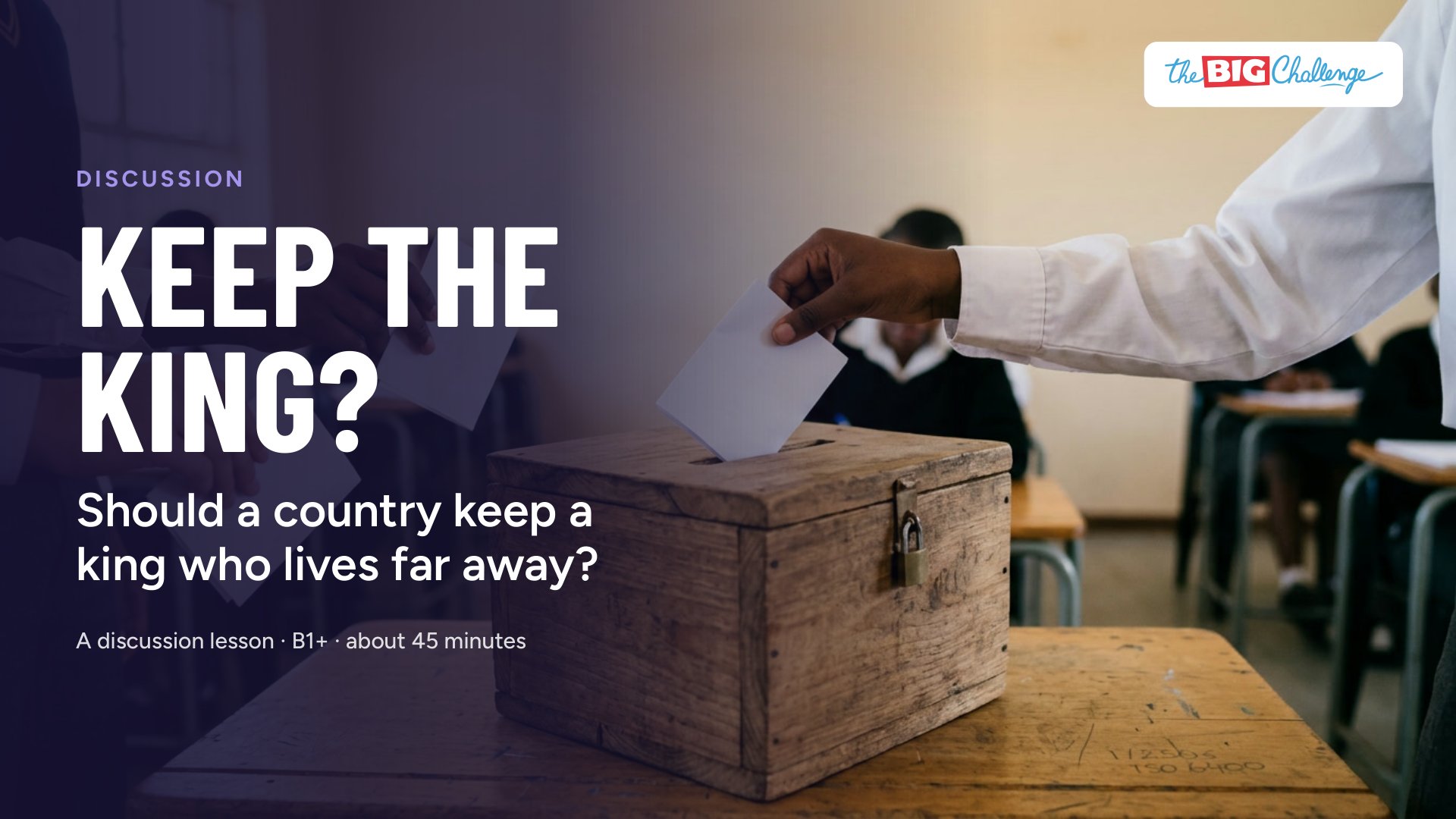
Keep the King?
- A comparison
 Preview · 3 of 11
Objective & content
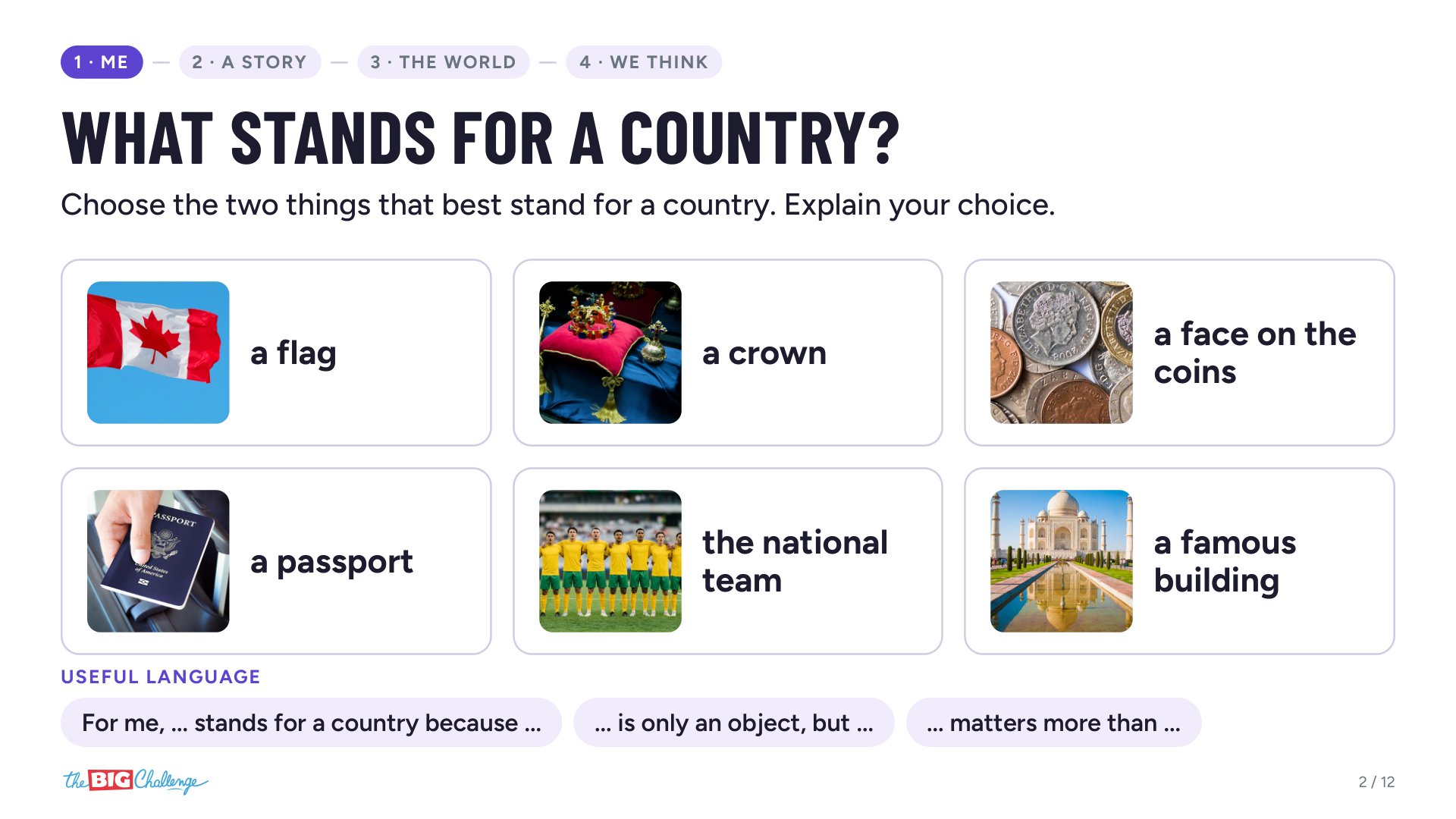
Should a country keep a king who lives far away? This 45-minute discussion lesson follows one path: the pupils first, then a story, then the world, then what the class thinks. It starts with what stands for a country: a flag, a crown, a face on the coins, a passport, a national team, a famous building. The story, written for this lesson, is Tia, 16, in Kingston, Jamaica, whose history class holds its own vote. Tia wants a president, because her ancestors were brought to the island as slaves under the British crown. Her grandmother, who waved a little flag for the Queen in 1966, does not trust politicians, and a boy in the class says that a new head of state will not repair one road. The class votes 14 to 12 for a president, and Tia walks home unsure. Then the real cases: Canada, where the King opened parliament in 2025; Barbados, a republic since 2021; Australia, which voted to keep the Queen in 1999. By the end, pupils can say what a head of state is for, weigh history, cost and pride, defend an opinion and answer someone who disagrees.
Documents to download (2)
- Pupil sheet In your teacher account
- Discussion lesson (slides) In your teacher account
Pedagogical guide
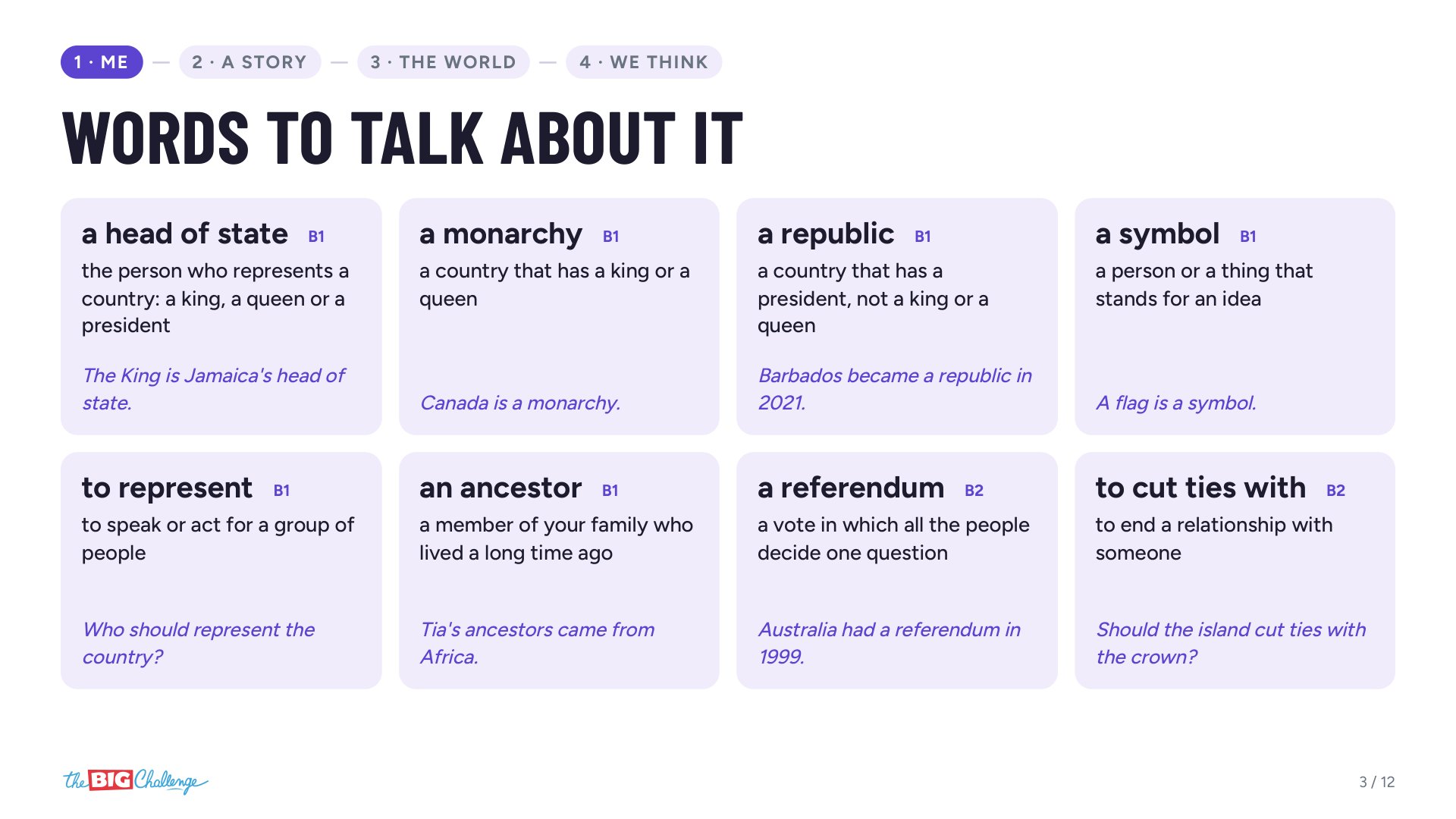
Every slide asks the class to do something: choose what stands for a country, learn eight words, pick feeling words for Tia, read three real cases, say which of four invented voices they agree with, choose which symbols a new republic should change first, compare history, cost and pride in three boxes, stand on a line from 1 to 5, and write a reply to Tia. The words come before the talking, and each question has a B1 version for everyone and a B2 one for stronger pupils. The lesson takes no side: every position in it has a real argument, and the story ends on a doubt, not on a winner. Slavery is named once, as Tia's reason; the teacher notes give the facts if pupils ask. The class vote is invented: Jamaica has not voted on the question, so check the news before the lesson. The four voices are invented opinions and are labelled as such. Pictures of people were made for this lesson; the photos of objects and places are real.
Suggested procedure45 min
- 2 min
Show the cover and read the big question. No answers yet.
- 8 min
What stands for a country?: pairs choose two cards and say why. Then read the eight words and their examples.
- 9 min
Tia's vote: read the story and check the four facts (what is Tia's reason, and her grandmother's?), then choose feeling words.
- 10 min
One king, three answers, and Four opinions: why might Canada and Barbados see the same king differently? Pairs choose the voice they agree with most.
- 11 min
A new republic, the three boxes and "Where do you stand?": pupils choose three symbols to change, compare history, cost and pride, then stand on the line. Come back to the big question.
- 5 min
Dear Tia: pupils write a short reply, with what they would do in her place.
Adaptations
- SupportKeep the word slide on screen during the story and the voices, and accept one-sentence answers built on the useful language.
- ExtensionPupils find out who the head of state of their own country is and how he or she is chosen, and compare it with Jamaica in five sentences.
🔒 Restricted content
This resource requires a subscription to be viewed.
Unlock the resourceIncluded in the subscription