Black Friday
- A comparison
 Preview · 3 of 11
Objective & content
Is Black Friday a good thing? This 45-minute discussion lesson follows one path: the pupils first, then a story, then the world, then what the class thinks. The story is Leo, 14, who lives in Leeds. He has saved £80 to buy his neighbour's old guitar, but on Black Friday a message appears on his phone: headphones, "Was £150, now £75! Only 2 left!", with a clock counting down. He clicks "Buy now". The headphones sound amazing, but on Tuesday somebody else wants the guitar, and Leo cannot afford both. He has 14 days to send the headphones back and get a refund (a short story written for this lesson, with an open ending). Then the class reads four facts: Black Friday is the day after Thanksgiving in the USA; in the UK, a consumer group followed 175 prices for a year and 83% of the "deals" had been the same price or cheaper at another time; in France, hundreds of brands said no to Black Friday in 2019; in the UK, France and Germany, you have 14 days to send back something you bought online. By the end, pupils can talk about the good and bad sides of sales, give and defend an opinion, and give advice in a short written reply.
Pedagogical guide
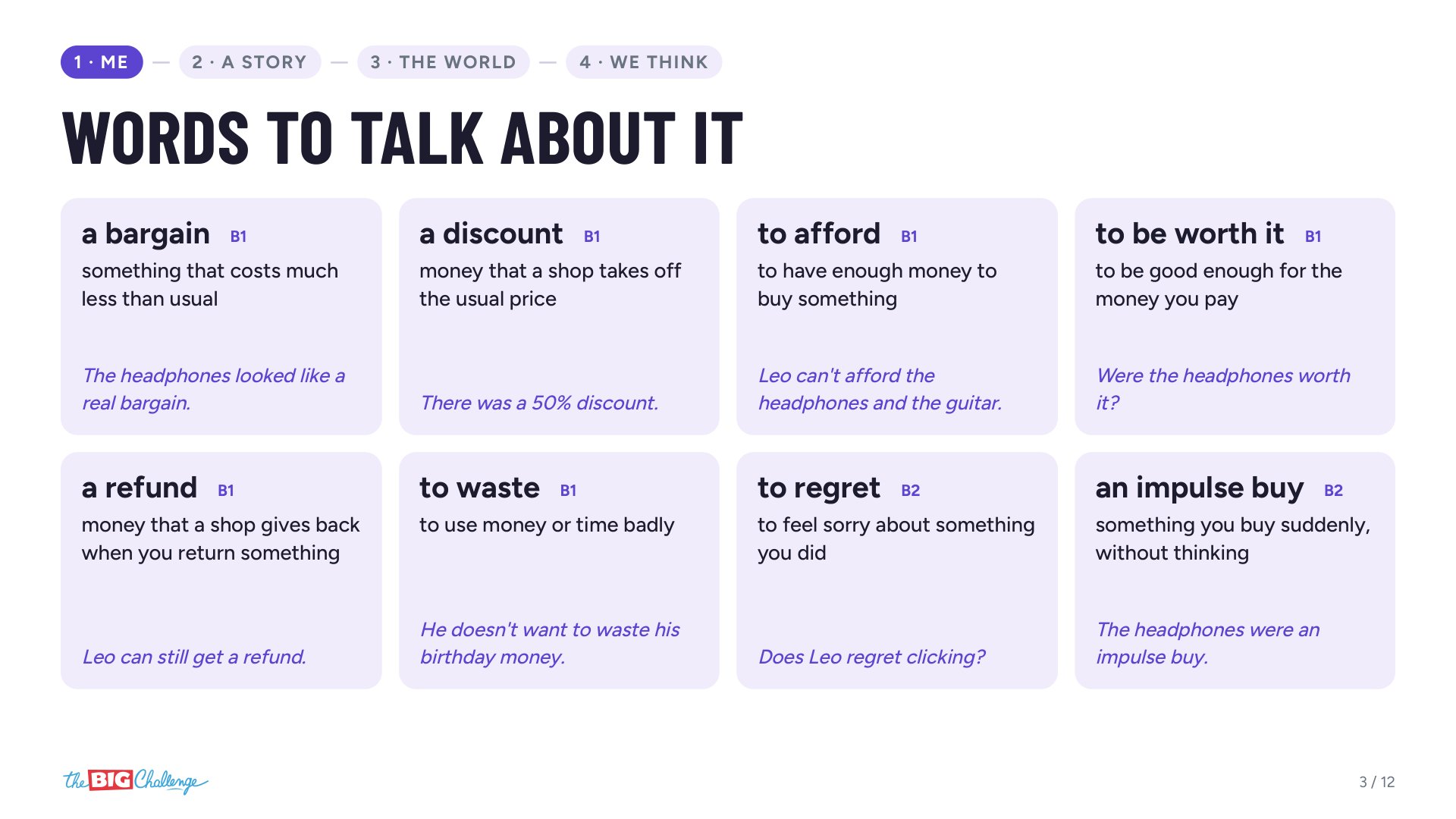
Every slide asks the class to do something: choose what they would and would never buy at half price, learn eight words (bargain, discount, afford, worth it, refund, waste, regret, impulse buy), choose three feeling words for Leo when he clicked and on Tuesday, read four facts, say which of four invented voices they agree with, choose the three best things to do before they click, fill in three boxes (shoppers, shops, the planet), stand on a line from 1 to 5 and write a reply to Leo. The words come before the talking, and each question has a B1 version for everyone and a B2 one for stronger pupils. The pupil sheet follows the slides, so every pupil leaves with something written. The language in use is the past simple and past perfect for the story, "would" for imagined choices (I'd buy ..., I'd never buy ...), "should" and "should have", and the second conditional for advice (If I were you, I'd ...). The facts come from a UK consumer organisation (Which?), a French collective (Make Friday Green Again) and EU and UK consumer law, with the sources on the slide. The four voices are invented opinions and are labelled as such. Money is a private subject: the cards ask what pupils would choose if everything was half price, never what they own or what their family spends.
Suggested procedure45 min
- 2 min
Show the cover and read the big question: "Is Black Friday a good thing?" No answers yet.
- 8 min
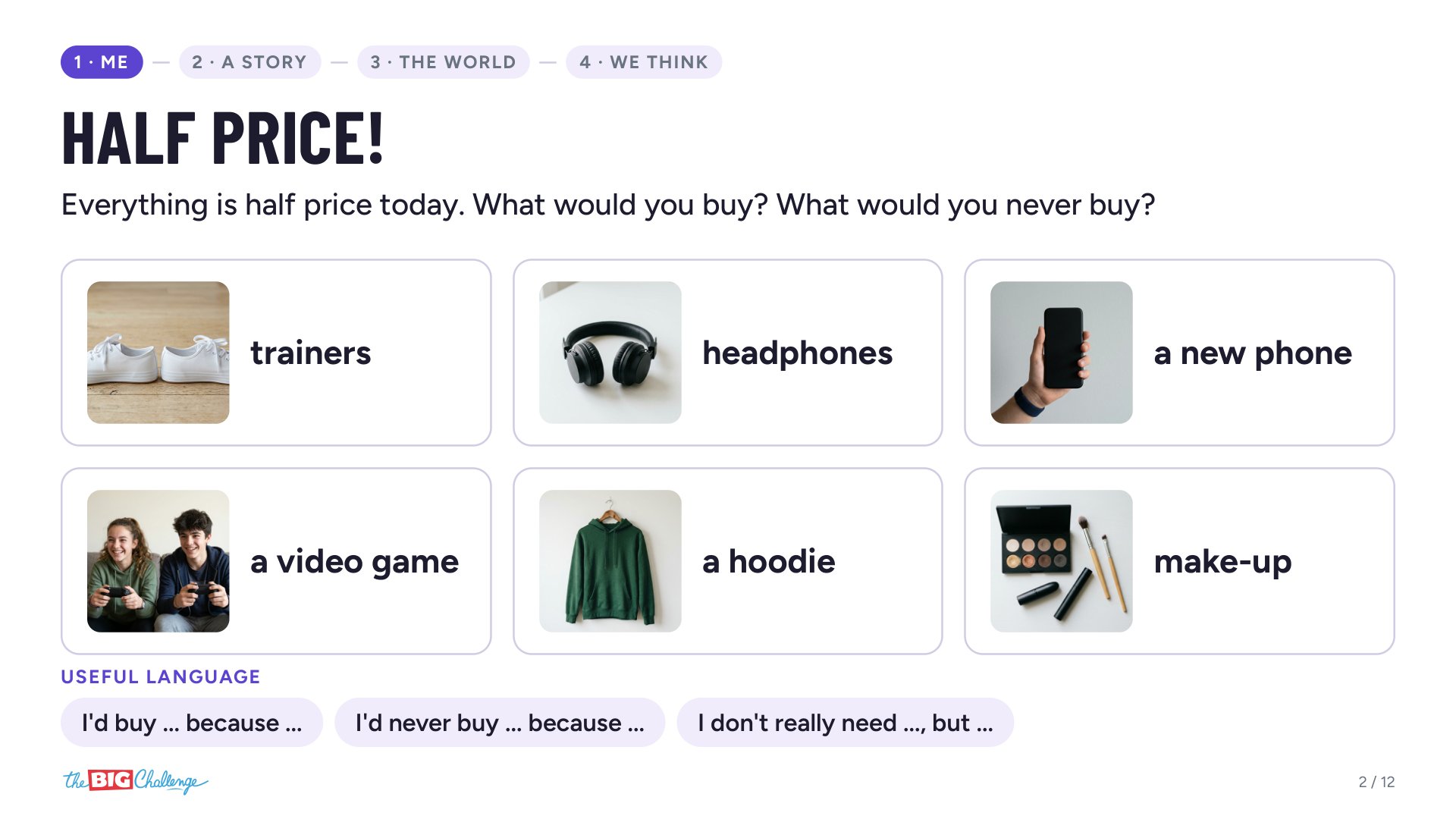
Half price! Pairs choose one thing they would buy and one they would never buy, and say why. Then read the eight words and their examples together.
- 8 min
Leo's bargain: read the story and check the four facts, then each pupil chooses three feeling words for the moment Leo clicked and for Tuesday.
- 10 min
Black Friday around the world and Four opinions: read the four facts (which one surprises you most?), then the bubbles aloud; pairs choose the voice they agree with most.
- 11 min
Before you click, Shoppers, shops, the planet and Where do you stand?: pupils choose three things, fill in the three boxes with a partner, then stand on the line from 1 to 5. Come back to the big question.
- 6 min
Dear Leo: pupils write a short reply with one piece of advice and a reason ("If I were you, I'd ..."). Two or three read theirs aloud.
Adaptations
- SupportKeep the word slide on screen during the story and the voices, and accept one-sentence answers built on the useful language. Pupils can number their three things instead of writing them.
- ExtensionAsk stronger pairs the B2 question on the voices slide ("Should Leo keep the headphones? What would you advise?"), and have them argue for a place on the line from 1 to 5 that is not their own.