Social Media at 13
- A comparison
 Preview · 3 of 11
Objective & content
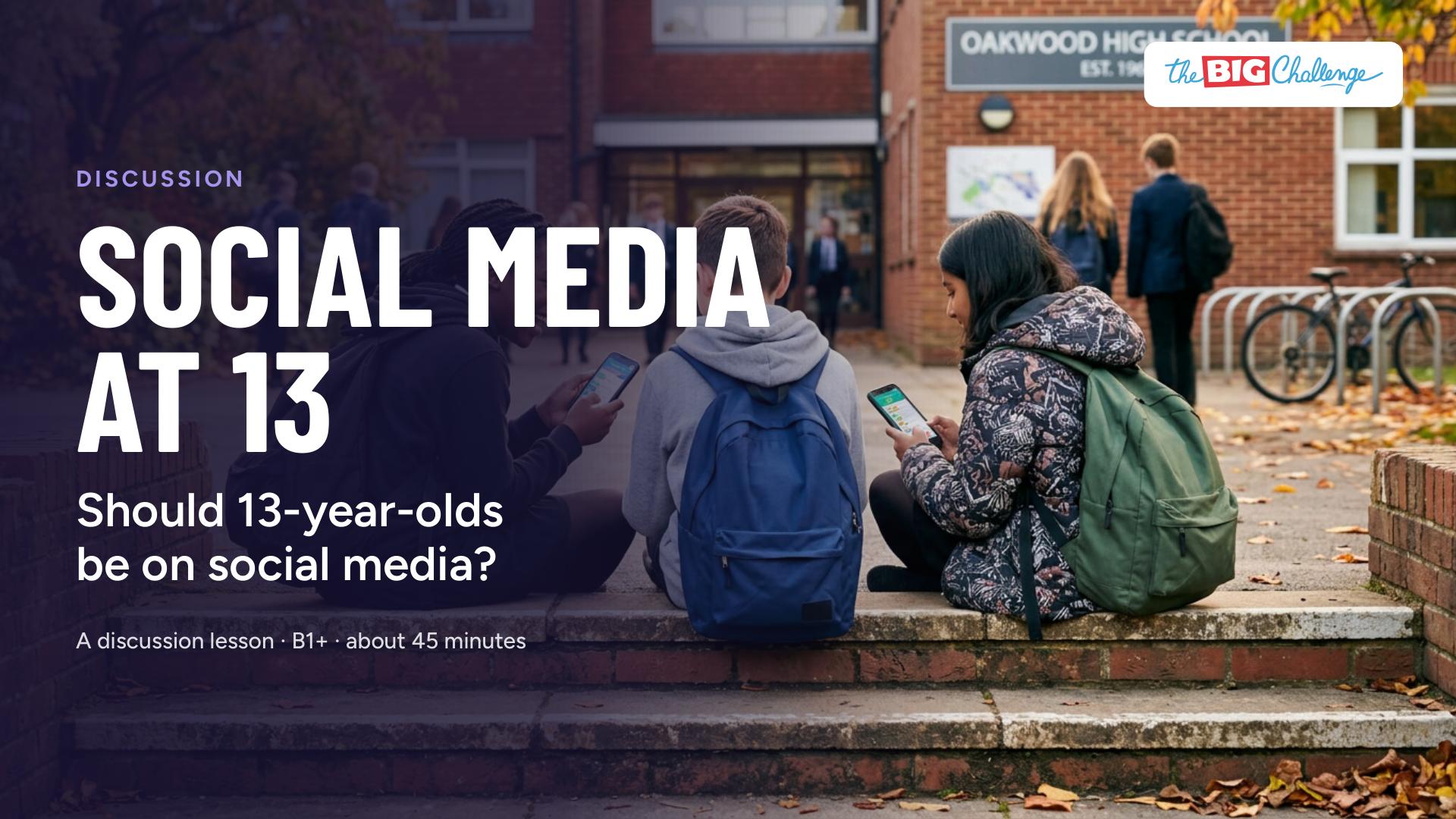
Should 13-year-olds be on social media? This 45-minute discussion lesson follows one path: the pupils first, then a story, then the world, then what the class thinks. The story is Lukas, 13, who lives in Hamburg: on his birthday his parents let him open his first account, with two rules, a private profile and no phone in his bedroom at night. His first clay animation gets 40 likes and he joins his class's group chat; then a mean comment under his new film hurts him, and that night he takes his phone to bed and scrolls until 1 a.m. (a short story written for this lesson). Then the class looks at the real rules: a ban for under-16s in Australia since December 2025; a ban for under-15s voted in France in July 2026, then struck down by the Constitutional Council in August; a ban for under-16s announced in the UK for 2027; and no ban in Germany, where experts advised clear limits instead. By the end, pupils can talk about the good and bad sides of social media at their age, compare rules, defend an opinion and give advice in a short written reply.
Documents to download (2)
- Pupil sheet In your teacher account
- Discussion lesson (slides) In your teacher account
Pedagogical guide
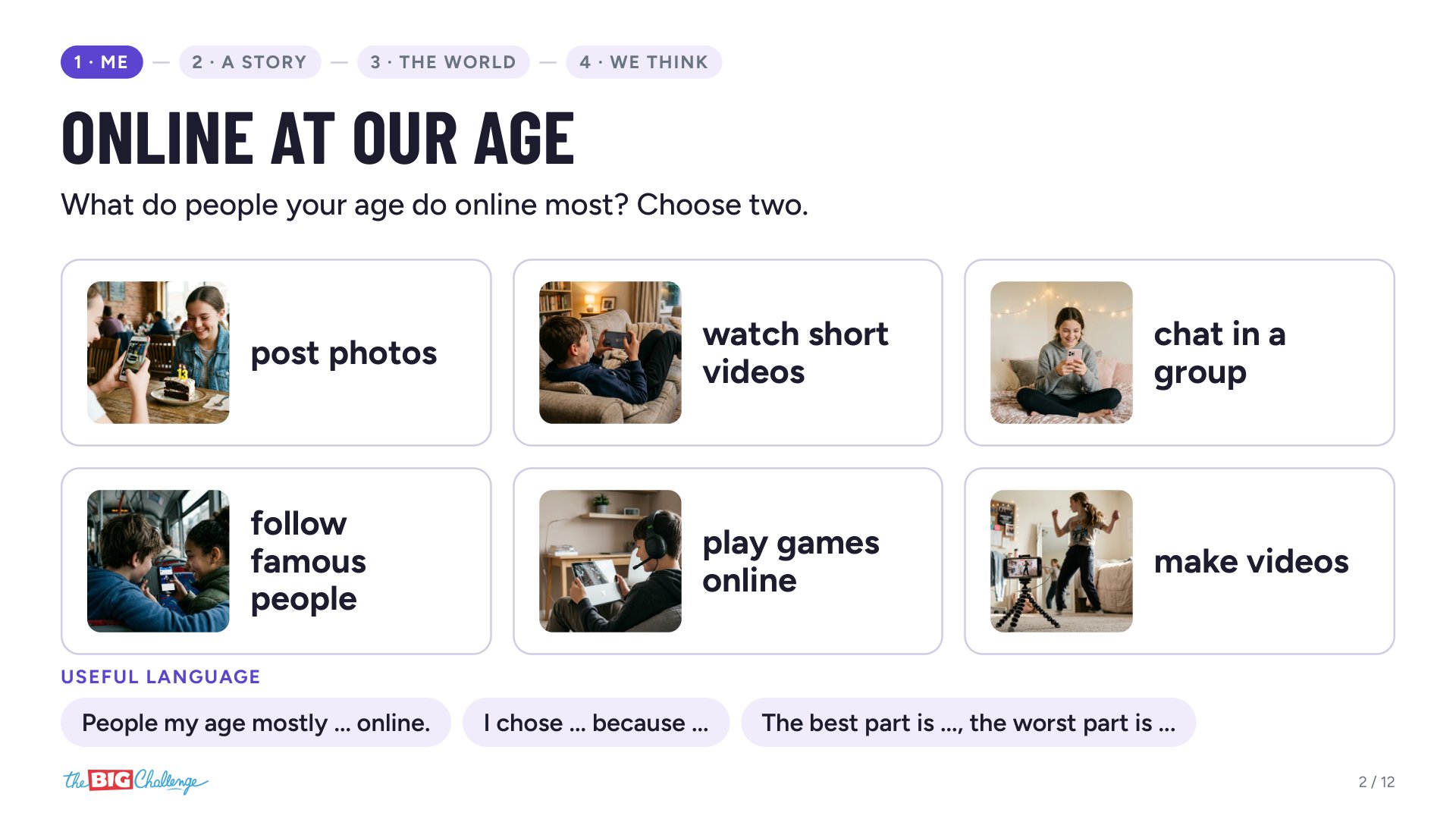
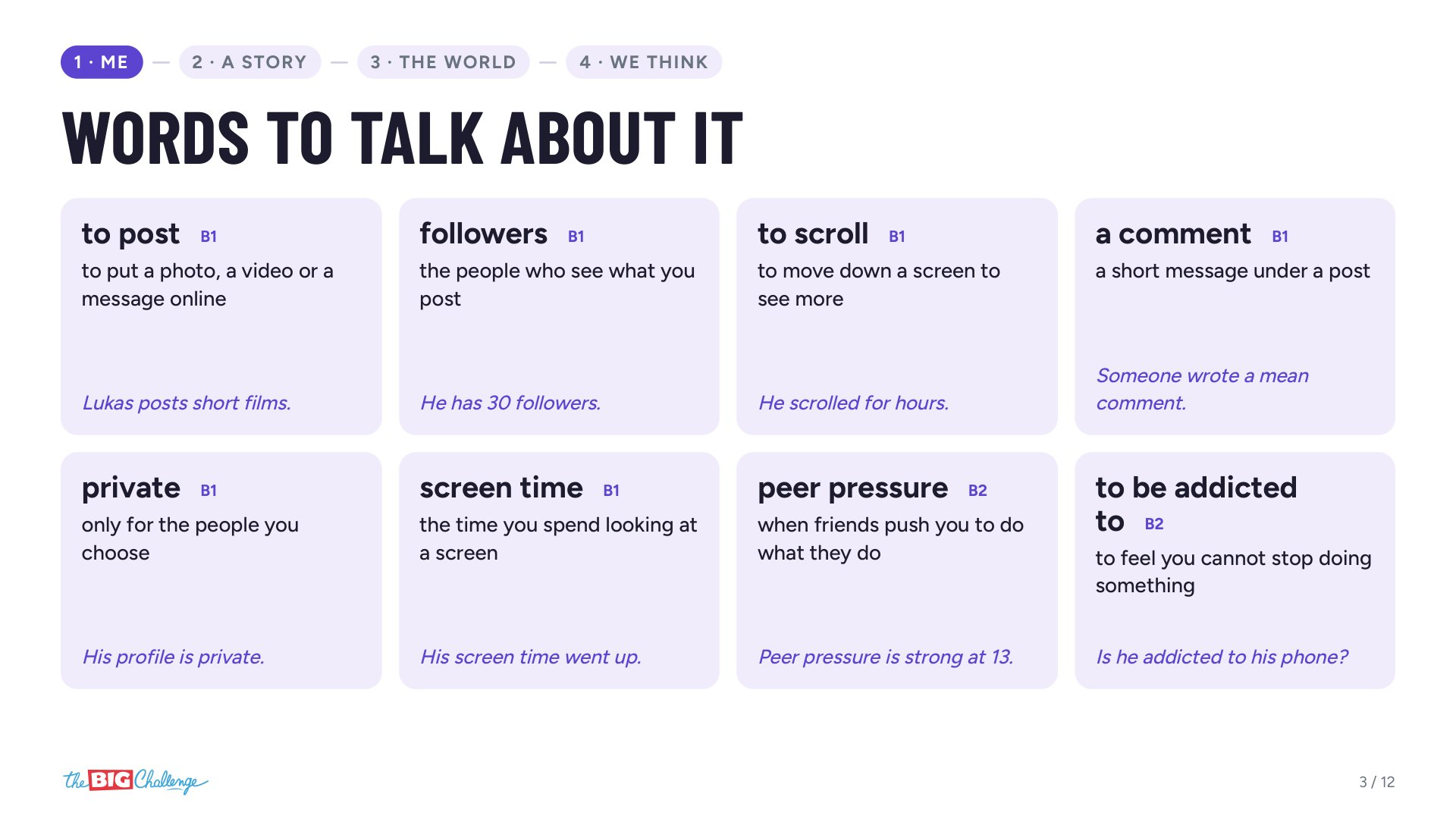
Every slide asks the class to do something: choose what people their age do online, learn eight words, pick feeling words for Lukas after his first film and after the comment, read the rules of four countries, say which of four invented voices they agree with, choose three fair rules for a first account, compare friends, safety and time in three boxes, stand on a line from 1 to 5, and write a reply to Lukas. The words come before the talking, and each question has a B1 version for everyone and a B2 one for stronger pupils. The pupil sheet follows the slides, so every pupil leaves with something written. The rules come from the Australian eSafety Commissioner, franceinfo, the UK government and the German expert commission on children and social media; they date from November 2026 and change fast, so the teacher notes ask you to check the news first. The four voices are invented opinions and are labelled as such. Nobody has to say whether they have an account or what they post: the cards ask about people their age. The mean comment is the hardest moment of the lesson, on purpose; if a pupil seems upset or talks about online bullying, follow your school's usual procedure.
Suggested procedure45 min
- 2 min
Show the cover and read the big question: "Should 13-year-olds be on social media?" No answers yet.
- 8 min
Online at our age: pairs choose two cards and say why. Then read the eight words and their examples together.
- 8 min
Lukas's first account: read the story and check the four facts (which rule did Lukas break?), then choose feeling words for after his first film and after the comment.
- 10 min
What are the rules? and Four opinions: read the four countries (which is strictest? why did the French court say no?), then the bubbles aloud; pairs choose the voice they agree with most.
- 11 min
Rules for a first account, then the three boxes and "Where do you stand?": pupils choose three rules, compare friends, safety and time, then stand on the line from 1 to 5. Come back to the big question.
- 6 min
Dear Lukas: pupils write a short reply with one piece of advice and a reason ("If I were you, I'd ...").
Adaptations
- SupportKeep the word slide on screen during the story and the voices, and accept one-sentence answers built on the useful language. Pupils can number their three rules instead of writing them.
- ExtensionAsk stronger pairs the B2 question on the voices slide ("What should Lukas do now? What would you advise?"), and have them argue for a place on the line from 1 to 5 that is not their own.
🔒 Restricted content
This resource requires a subscription to be viewed.
Unlock the resourceIncluded in the subscription