Is Homework Useful?
- A comparison
 Preview · 3 of 11
Objective & content
Should homework be banned? This 45-minute discussion lesson for lycée and upper collège pupils follows one path: the pupils first, then a story, then the world, then what the class thinks. The story is Malik, 15, who lives in Toulouse and is in his last year at collège, with the brevet in June. Most evenings he has about an hour and a half of homework, and on Wednesdays, when he plays at the chess club, it waits until late. His sister Lina, 9, never gets written homework: she only reads, or learns a poem or her times tables. His cousin Felix goes to an all-day school in Cologne, with study time, so he rarely has written homework. On Friday the English teacher asks: "Should homework be banned?" The class cheers; Malik thinks of the chess tournament he missed, but also of the maths that finally made sense, and says nothing (a short story written for this lesson, with an open ending). Then the class reads four facts: in France, since 1956, primary pupils get no written homework, only reading and learning, and collèges offer free homework help at school; in England, each head teacher decides on homework; in Germany, in North Rhine-Westphalia, homework should take 75 minutes a day at most, with none at weekends, and all-day schools use study time instead; and research finds that homework helps, more in secondary than in primary school, and that quality matters more than quantity. By the end, pupils can talk about homework and what helps people learn from it, give and defend an opinion on banning homework, and tell a true headline about research from a misleading one.
Documents to download (2)
- Pupil sheet In your teacher account
- Discussion lesson (slides) In your teacher account
Pedagogical guide
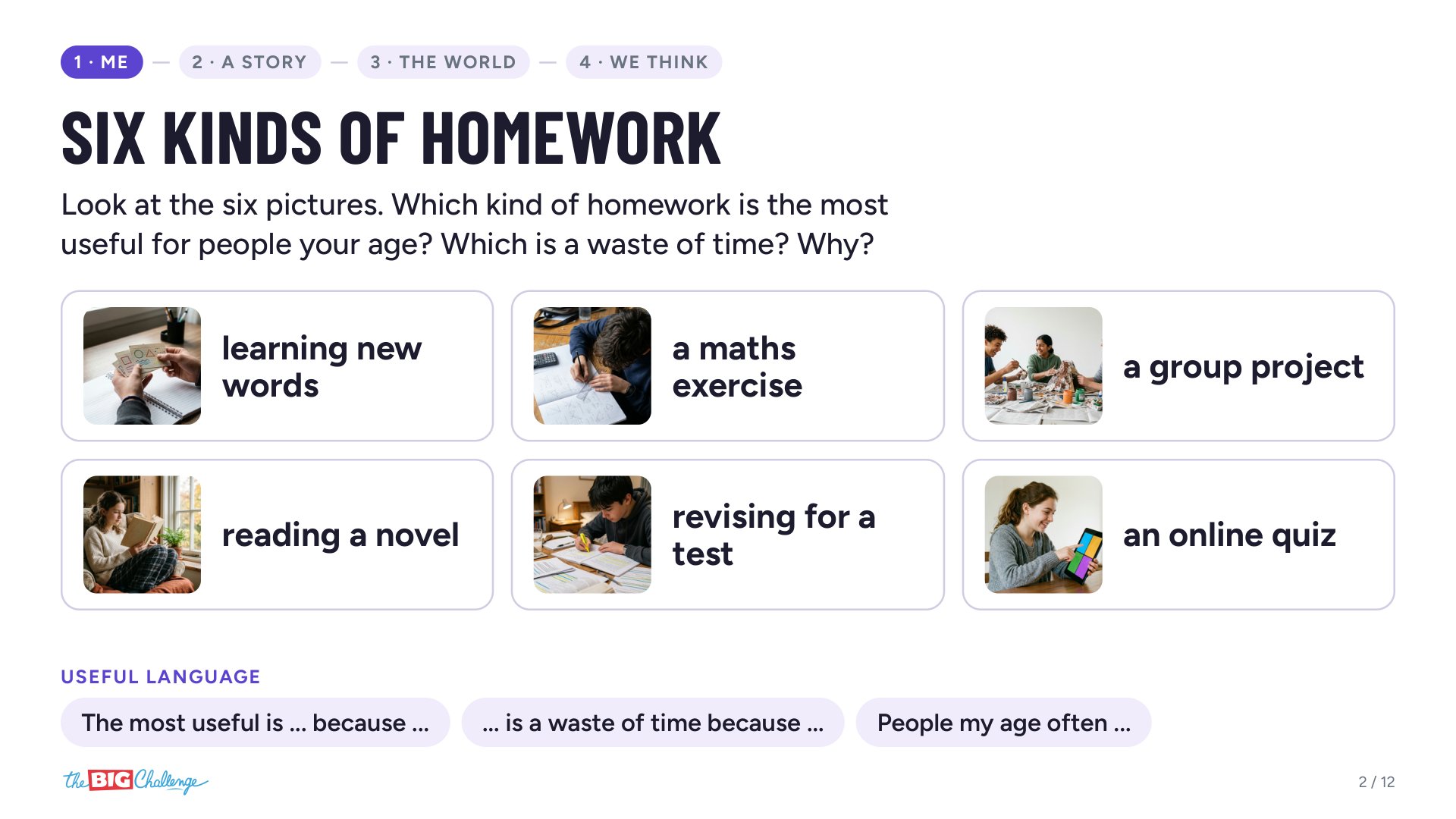
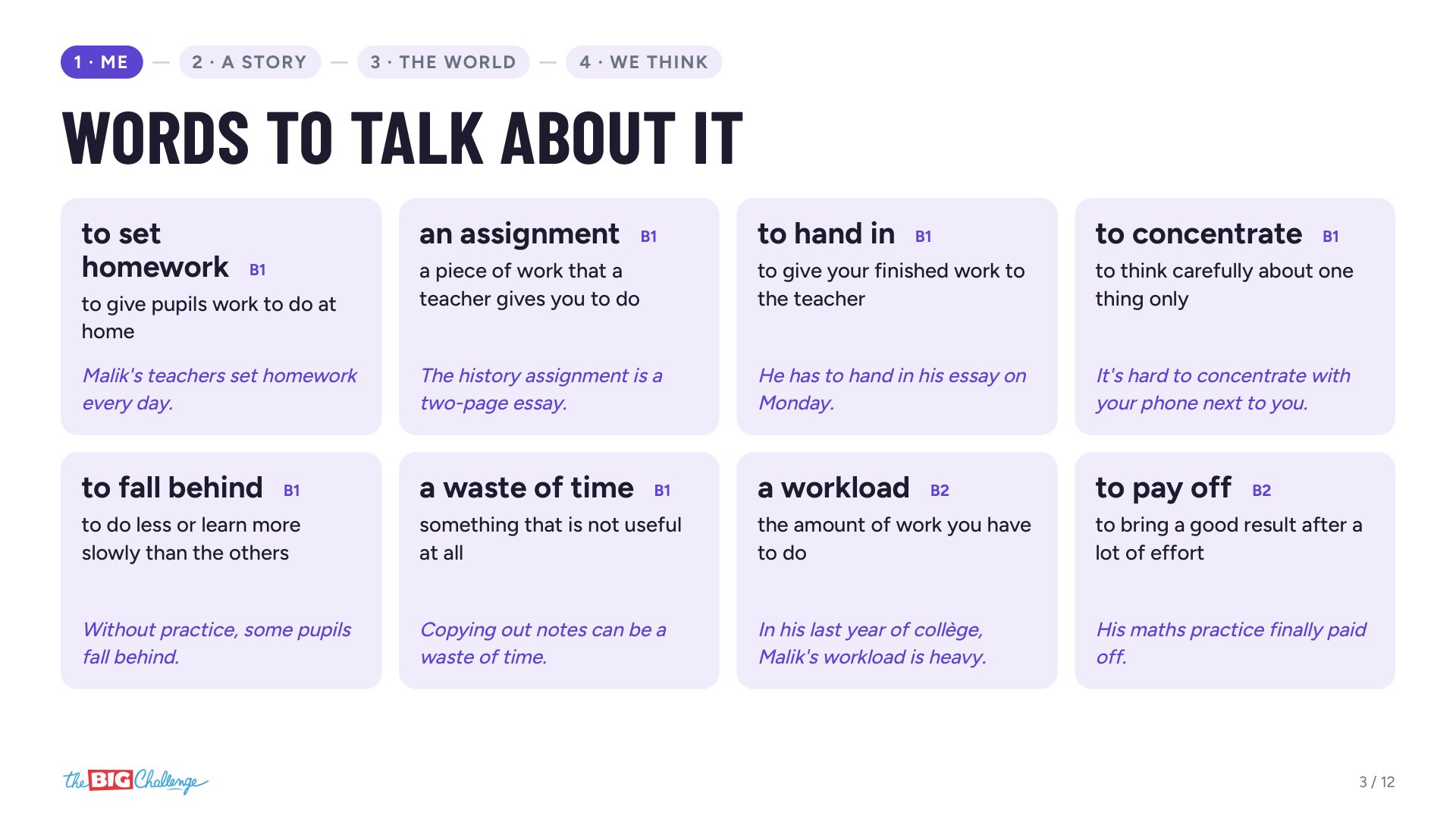
Every slide asks the class to do something: say which of six kinds of homework is the most useful for people their age and which is a waste of time, learn eight words (to set homework, an assignment, to hand in, to concentrate, to fall behind, a waste of time, and for stronger pupils a workload and to pay off), choose three feeling words for Malik on a Wednesday night and three for when the class cheers, read four facts, say which of four invented voices they agree with, choose three things that help people get the most out of homework, fill in three boxes (homework at home, study time at school, no written homework), stand on a line from 1 to 5 and, in pairs, write a true and a misleading headline from four research findings, then say why the second one misleads. The words come before the talking, and each question has a B1 version for everyone and a B2 one for stronger pupils. The pupil sheet follows the slides, so every pupil leaves with something written. The language in use is the present simple for routines, the past perfect (the tournament he had missed), the second conditional (If there were no homework, I'd ...), "should", comparing (the fairest) and words for giving reasons (because, so, although). The facts come from the Assemblée nationale, the Department for Education, the North Rhine-Westphalia school ministry (schulministerium.nrw) and the Education Endowment Foundation (2021), with the sources on the slide. The teacher notes make clear that the French rule of no written homework is for primary school only: most collèges and lycées in France set homework at home, and Devoirs faits adds free supervised homework time at school. The four voices are invented opinions and are labelled as such. Homework touches home: the tasks ask about people their age and about Malik, never where a pupil works, who helps them or how long they spend.
Suggested procedure45 min
- 2 min
Show the cover and read the big question: "Should homework be banned?" No answers yet.
- 8 min
Six kinds of homework: pairs choose the most useful kind and the biggest waste of time for people their age, and a few report back. Then read the eight words and their examples together.
- 8 min
Malik's evenings and How does Malik feel?: read the story together and check the four facts (why does Malik say nothing?), then each pupil chooses three words for a Wednesday night and three for Friday.
- 10 min
Homework in three countries and Four opinions: read the four facts (which rule surprises you?), then the bubbles aloud; pairs choose the voice they agree with most.
- 11 min
What makes homework work?, Homework, study time, or neither? and Where do you stand?: pupils choose three ideas, fill in the three boxes with a partner, then stand on the line from 1 to 5. Come back to the big question.
- 6 min
True or misleading?: pairs read what the research found and write a true headline and a misleading one. The class says what the misleading headline leaves out.
Adaptations
- SupportKeep the word slide on screen during the story and the voices, and accept one-sentence answers built on the useful language. Pairs can write the true headline only and say with the sentence frames what a misleading one would leave out.
- ExtensionAsk stronger pairs the B2 question on the voices slide ("Which voice is closest to Malik? And to Felix?"), and have them argue for a place on the line from 1 to 5 that is not their own.
🔒 Restricted content
This resource requires a subscription to be viewed.
Unlock the resourceIncluded in the subscription