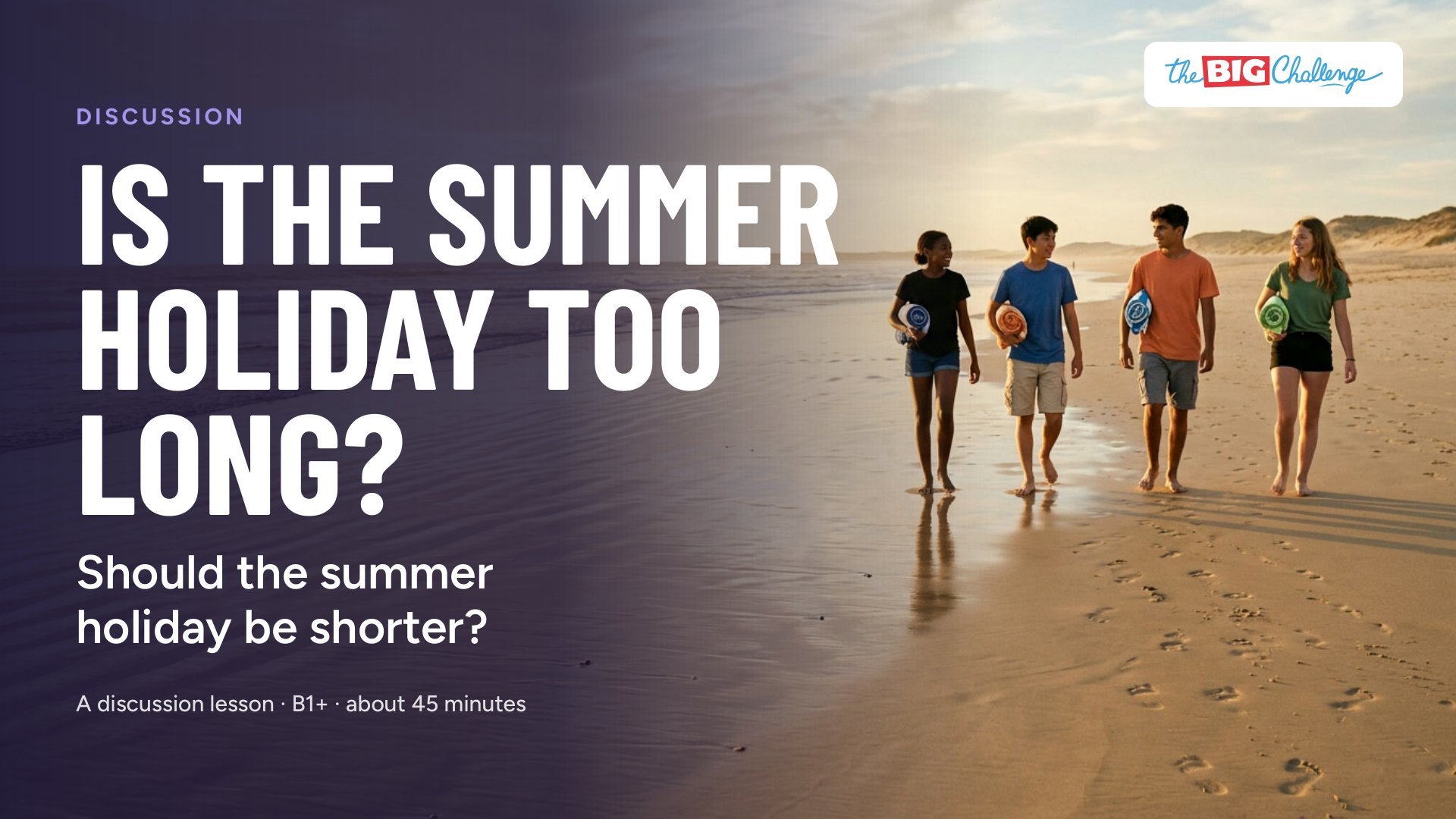
Is the Summer Holiday Too Long?
- A comparison
 Preview · 3 of 11
Objective & content
Should the summer holiday be shorter? This 45-minute discussion lesson for lycée and upper collège pupils follows one path: the pupils first, then a story, then the world, then what the class thinks. The story is Manon, 16, who lives in La Rochelle, on the west coast of France, and has two months off in summer. In July she works every morning at an ice-cream kiosk and goes sea kayaking with her club in the afternoons; in August she stays with her grandparents for three weeks, reads six novels and never opens a schoolbook. On the first day back, her maths teacher gives a short test, and Manon has forgotten half of what she knew in June. That evening, the radio says the minister wants a shorter summer, with shorter school days, and Manon is not sure what she thinks (a short story written for this lesson, with an open ending). Then the class reads four facts: in France the summer lasts about two months, from 3 July to 2 September in 2027, and a shorter summer is discussed, but nothing is decided; in England it lasts about six weeks, with three one-week half-terms in the year, and in 2026 the head of the school inspectors called for a debate on shorter holidays; in Germany it lasts at least six weeks, staggered by Land, from 28 June in Hesse to 13 September in Bavaria in 2027; and research, mostly in the USA, finds that pupils learn more slowly in summer, while how much they forget is not clear. By the end, pupils can talk about the summer holiday and what it means for people their age, give and defend an opinion on a shorter summer, and pitch a school calendar of their own.
Documents to download (2)
- Pupil sheet In your teacher account
- Discussion lesson (slides) In your teacher account
Pedagogical guide
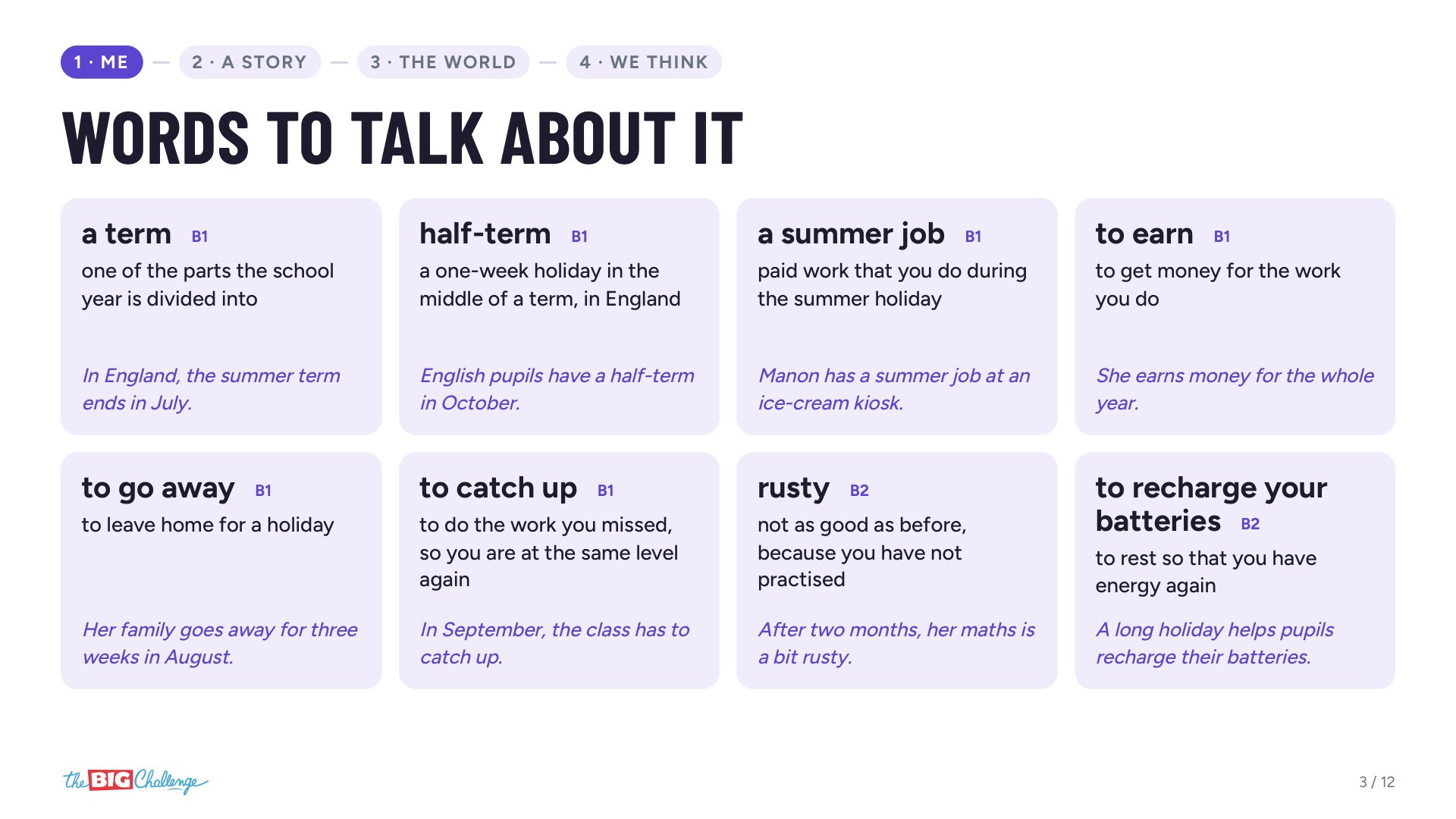
Every slide asks the class to do something: say what is the best part of the summer holiday for people their age and what goes on too long, learn eight words (a term, half-term, a summer job, to earn, to go away, to catch up, and for stronger pupils rusty and to recharge your batteries), choose three feeling words for Manon in July and August and three for after the test, read four facts, say which of four invented voices they agree with, choose three things people can do in summer so they are not rusty in September, fill in three boxes (two months of summer, six weeks of summer, less summer with shorter days), stand on a line from 1 to 5 and, in groups, pitch a school calendar in 30 seconds before the class votes. The words come before the talking, and each question has a B1 version for everyone and a B2 one for stronger pupils. The pupil sheet follows the slides, so every pupil leaves with something written. The language in use is the past simple and the past perfect (Manon had forgotten ...), the second conditional (With a shorter summer, I'd earn less), comparatives (shorter, longer, more fun than) and words for giving reasons (because, so, in exchange, although). The facts come from service-public.gouv.fr, The Week, the KMK (kmk.org) and Education Next (2019), with the sources on the slide; the teacher notes add where the French debate stands, and say plainly that the research on summer learning loss disagrees. The four voices are invented opinions and are labelled as such. Summers are not the same for every family: the tasks ask about people their age and about Manon, never where a pupil goes, what a family can afford or whether a pupil works.
Suggested procedure45 min
- 2 min
Show the cover and read the big question: "Should the summer holiday be shorter?" No answers yet.
- 8 min
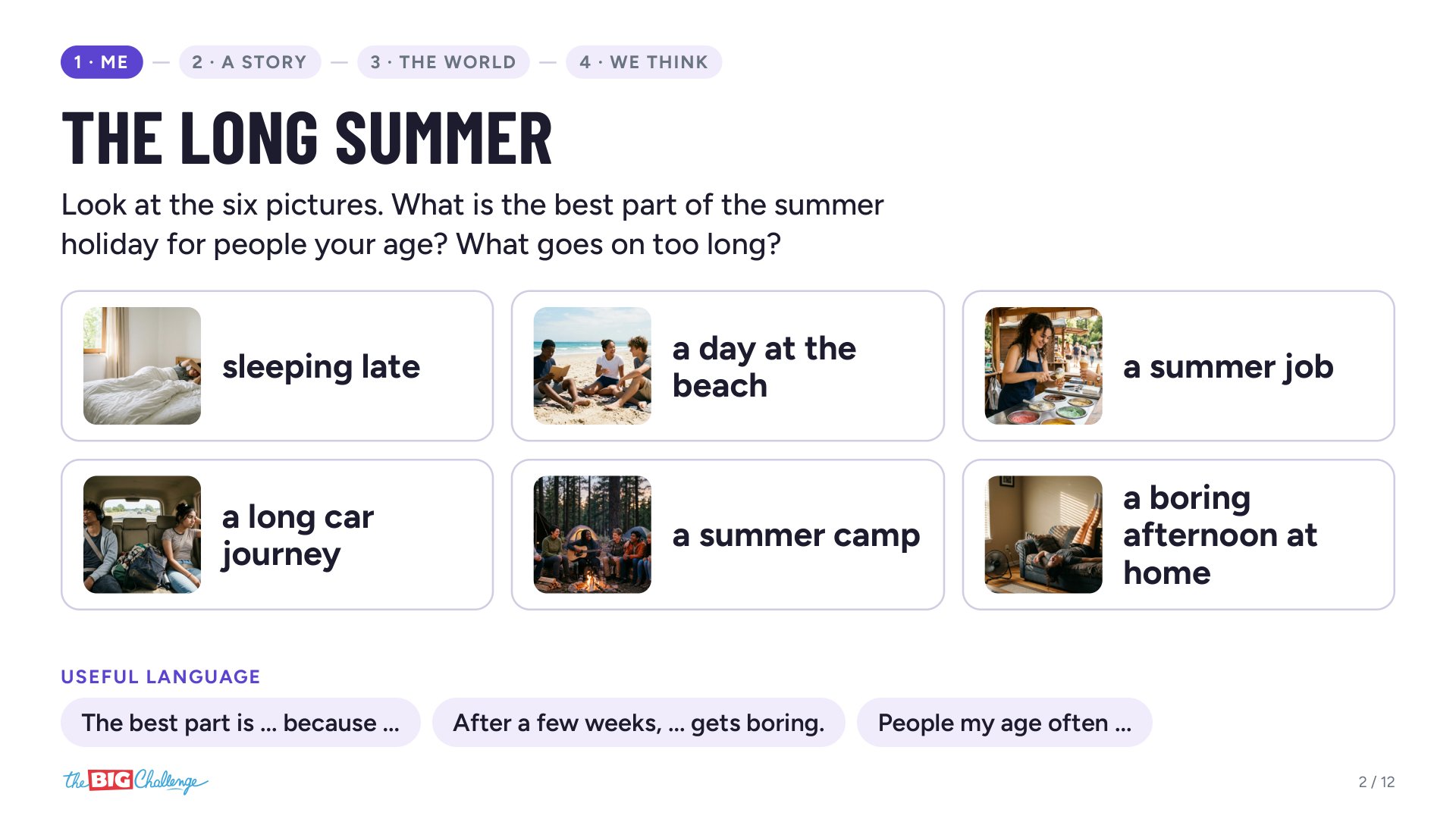
The long summer: pairs choose the best part of the summer for people their age and the part that goes on too long, and a few report back. Then read the eight words and their examples together.
- 8 min
Manon's long summer and How did Manon feel?: read the story together and check the four facts (why did Manon do badly in the test?), then each pupil chooses three words for her summer and three for the test.
- 10 min
Summer holidays in three countries and Four opinions: read the four facts (which country has it right?), then the bubbles aloud; pairs choose the voice they agree with most.
- 11 min
A summer that keeps your brain busy, Two months, six weeks, or shorter days? and Where do you stand?: pupils choose three ideas, fill in the three boxes with a partner, then stand on the line from 1 to 5. Come back to the big question.
- 6 min
Our school year: groups decide how many weeks of summer, when the school day ends and who wins with their plan, then pitch it in 30 seconds. The class votes, never for its own plan.
Adaptations
- SupportKeep the word slide on screen during the story and the voices, and accept one-sentence answers built on the useful language. Groups can pitch with the sentence frames on the slide and give two reasons instead of three.
- ExtensionAsk stronger pairs the B2 question on the voices slide ("What would Manon say to each of them?"), and have them argue for a place on the line from 1 to 5 that is not their own.
🔒 Restricted content
This resource requires a subscription to be viewed.
Unlock the resourceIncluded in the subscription