Say sorry?
- A comparison
 Preview · 3 of 11
Objective & content
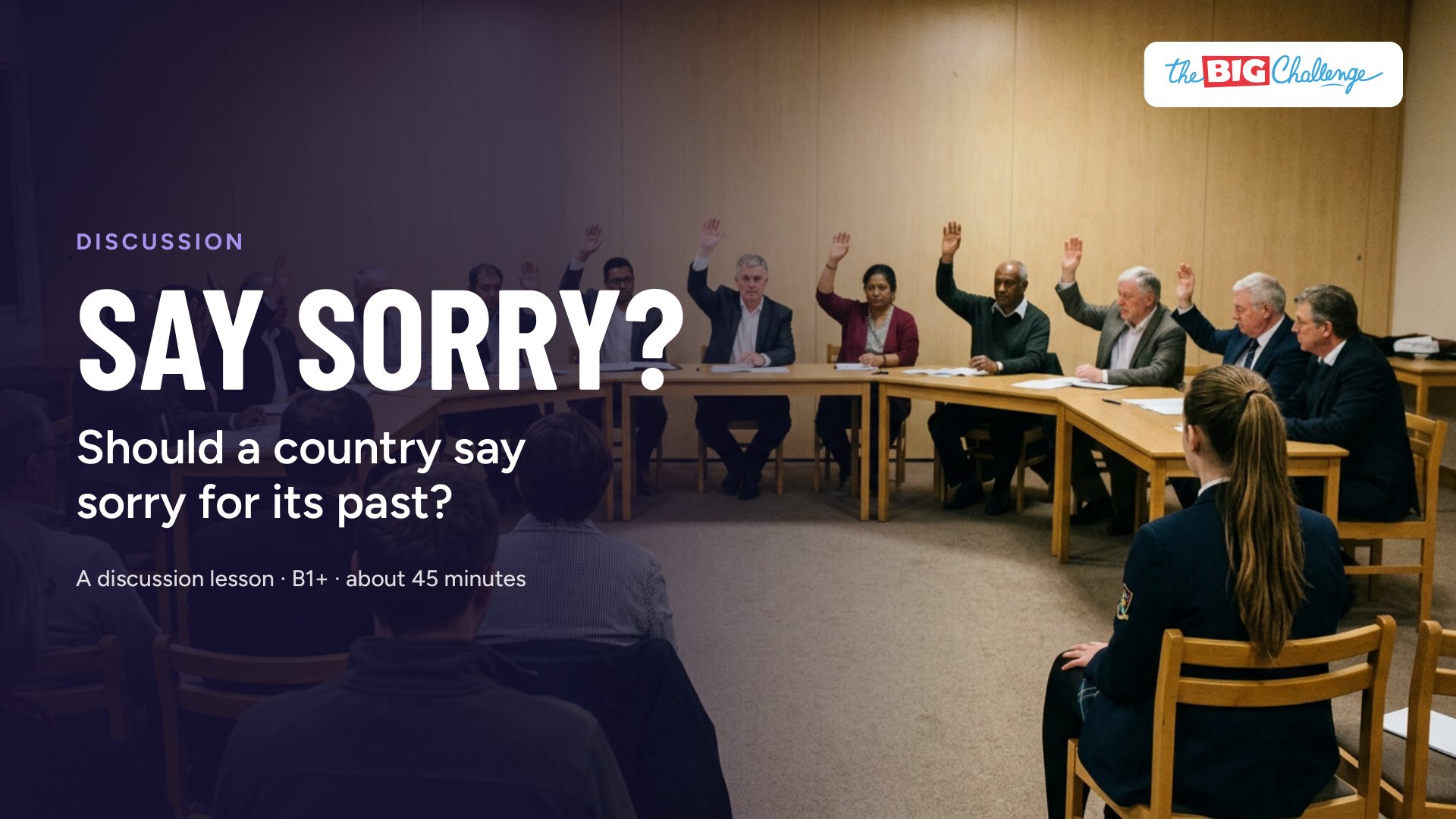
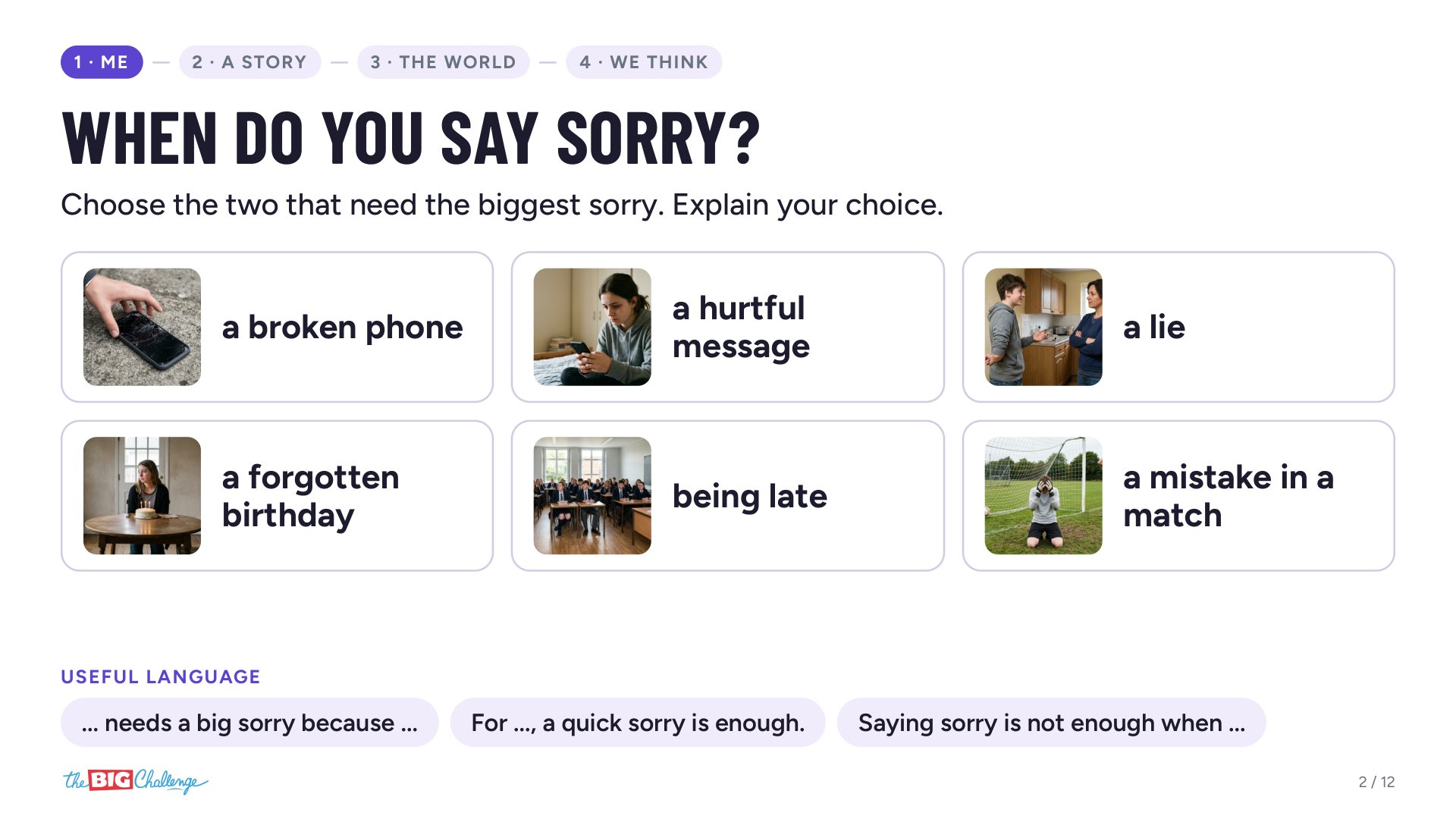
Should a country say sorry for its past? This 45-minute discussion lesson follows one path: the pupils first, then a story, then the world, then what the class thinks. It starts with everyday apologies: a broken phone, a hurtful message, a lie, a forgotten birthday, being late, a mistake in a match. The story, written for this lesson, is Lucy, 16, in an English port town whose ships carried enslaved Africans two hundred years ago. Tonight the town council votes on an apology. Her friend Jack whispers that he wasn't alive then, so why should he say sorry? An old man at the back says that words cost nothing and asks what the town will actually do. The apology passes 31 votes to 9, and Lucy walks home thinking about his question. Then the real cases: the United States, which said sorry by law in 1988 and paid each survivor of the wartime camps $20,000; Australia, whose Prime Minister said "I am sorry" to the Stolen Generations in 2008; the United Kingdom, whose Prime Minister spoke of "deep sorrow" for the slave trade in 2006, without a full apology. By the end, pupils can say what an apology is for, weigh words, money and change, defend an opinion and answer someone who disagrees.
Documents to download (2)
- Pupil sheet In your teacher account
- Discussion lesson (slides) In your teacher account
Pedagogical guide
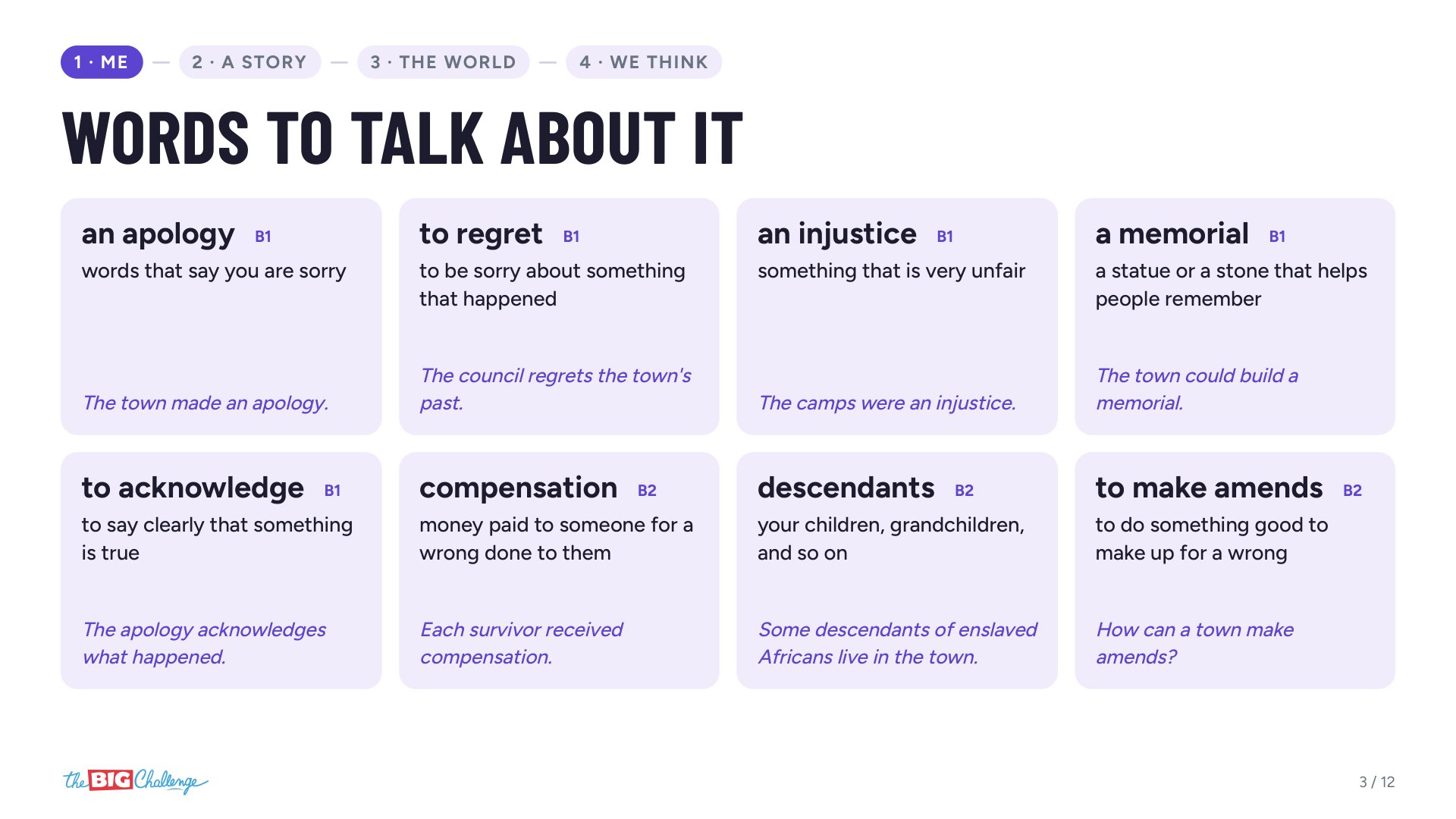
Every slide asks the class to do something: choose which everyday mistakes need the biggest sorry, learn eight words, pick feeling words for Lucy, read three real cases, say which of four invented voices they agree with, choose three things a good apology should do, compare words, money and change in three boxes, stand on a line from 1 to 5, and write a reply to Lucy. The words come before the talking, and each question has a B1 version for everyone and a B2 one for stronger pupils. The lesson takes no side: the story ends on Lucy's doubt, not on an answer. The slave trade, the US camps and the Stolen Generations are named as facts, without detail. Pupils whose families are touched by these histories may speak if they wish; never ask them to. The town is invented; the precedent is real (Liverpool City Council apologised for the city's role in the slave trade in 1999). The four voices are invented opinions and are labelled as such. Pictures of people were made for this lesson; the photos of objects and places are real.
Suggested procedure45 min
- 2 min
Show the cover and read the big question. No answers yet.
- 8 min
When do you say sorry?: pairs choose the two cards that need the biggest sorry and say why. Then read the eight words and their examples.
- 9 min
The town says sorry: read the story and check the three facts (what is Jack's reason? what does the old man want?), then choose feeling words for Lucy.
- 10 min
Three countries, three answers, and Four opinions: which country did the most, and is money part of a sorry? Pairs choose the voice they agree with most.
- 11 min
A good apology, the three boxes and "Where do you stand?": pupils choose three things an apology should do, compare words, money and change, then stand on the line. Come back to the big question.
- 5 min
Dear Lucy: pupils write a short reply, with one thing the town could do now.
Adaptations
- SupportKeep the word slide on screen during the story and the voices, and accept one-sentence answers built on the useful language.
- ExtensionPupils find one apology made by a government or a city, and say in five sentences what it said and what it did.
🔒 Restricted content
This resource requires a subscription to be viewed.
Unlock the resourceIncluded in the subscription