Too good to be true
- A comparison
 Preview · 3 of 11
Objective & content
How do you know you can trust someone online? This 45-minute discussion lesson follows one path: the pupils first, then two stories about a dream offer from a stranger, then what the class thinks. The first story is Stella, 16, who posts her songs online and gets a message from a talent agent she has never met (Golden Bay). The second is Leo, 12, a gamer whose new online friend offers him three free skins: a short story written for this lesson, as is Dana's message to Stella on slide 4. By the end, pupils can talk about trust, strangers and warning signs, compare two stories, give an opinion and write a short checklist of advice for a friend.
Documents to download (2)
- Pupil sheet In your teacher account
- Colour version In your teacher account
Pedagogical guide
Every slide asks the class to do something: choose two picture cards, read four characters' words and say who they agree with, pick three feeling words, compare Leo and Stella in three boxes, choose three things to do about a message from a stranger, stand on a line from 1 to 5, write a five-point checklist in pairs. The words come before the talking, and each question has an A2 version for everyone and a B1 one for stronger pupils. The pupil sheet follows the slides, so every pupil leaves with something written. This is an online-safety lesson, so it needs care. Pupils never share their own accounts or passwords, not even as an example, and nobody is asked to show a real message: the questions are always about Stella, Leo or an imagined message. Leo's story ends open, so pupils decide what he should do. If someone online asks a pupil for a secret, a password or a photo, or if a pupil has been tricked, they tell a trusted adult: it is never their fault. If a pupil tells you about a real contact, follow your school's safeguarding procedure.
Suggested procedure45 min
- 2 min
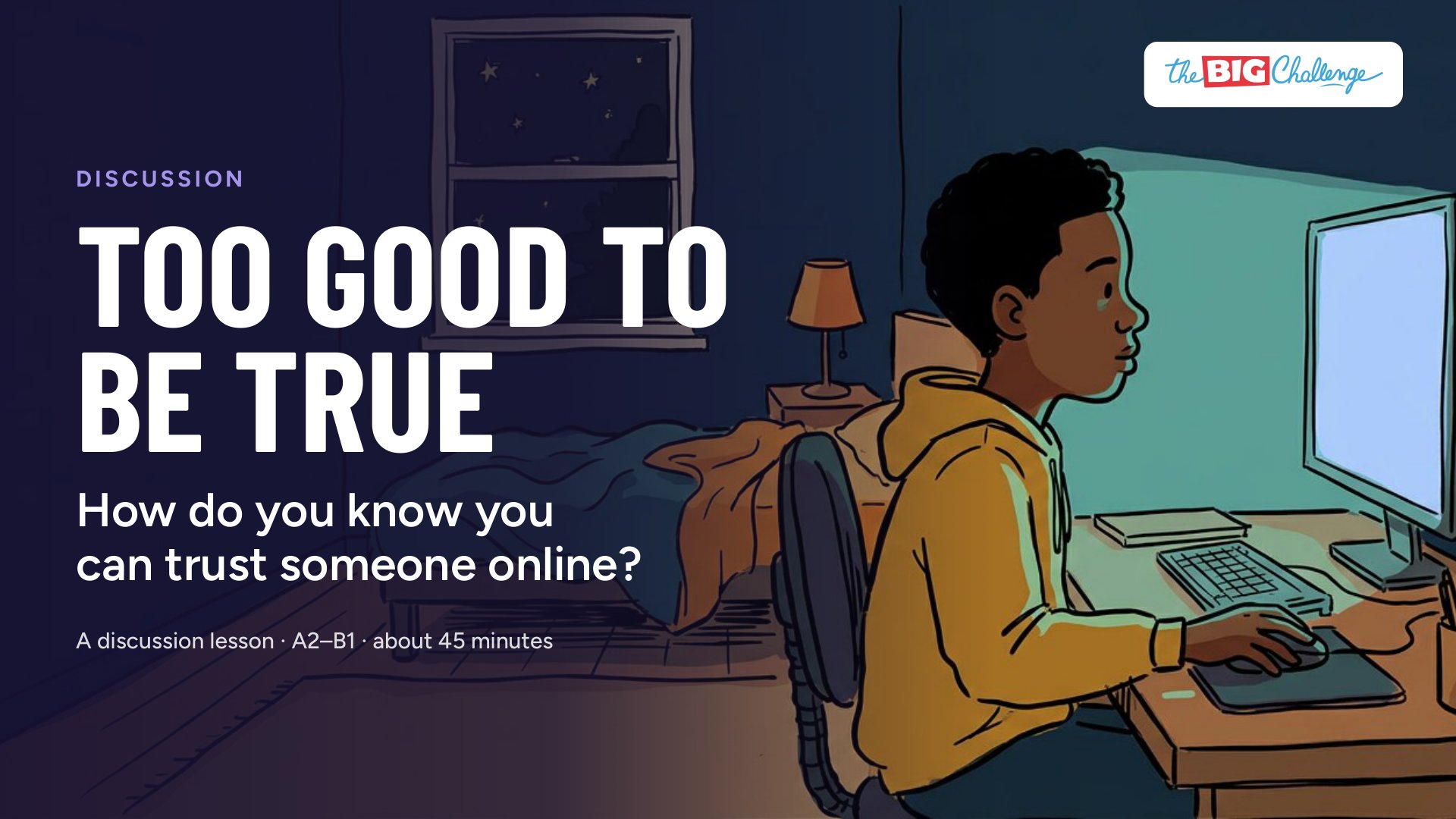
Show the cover and read the big question: "How do you know you can trust someone online?" No answers yet: you come back to it at the end.
- 7 min
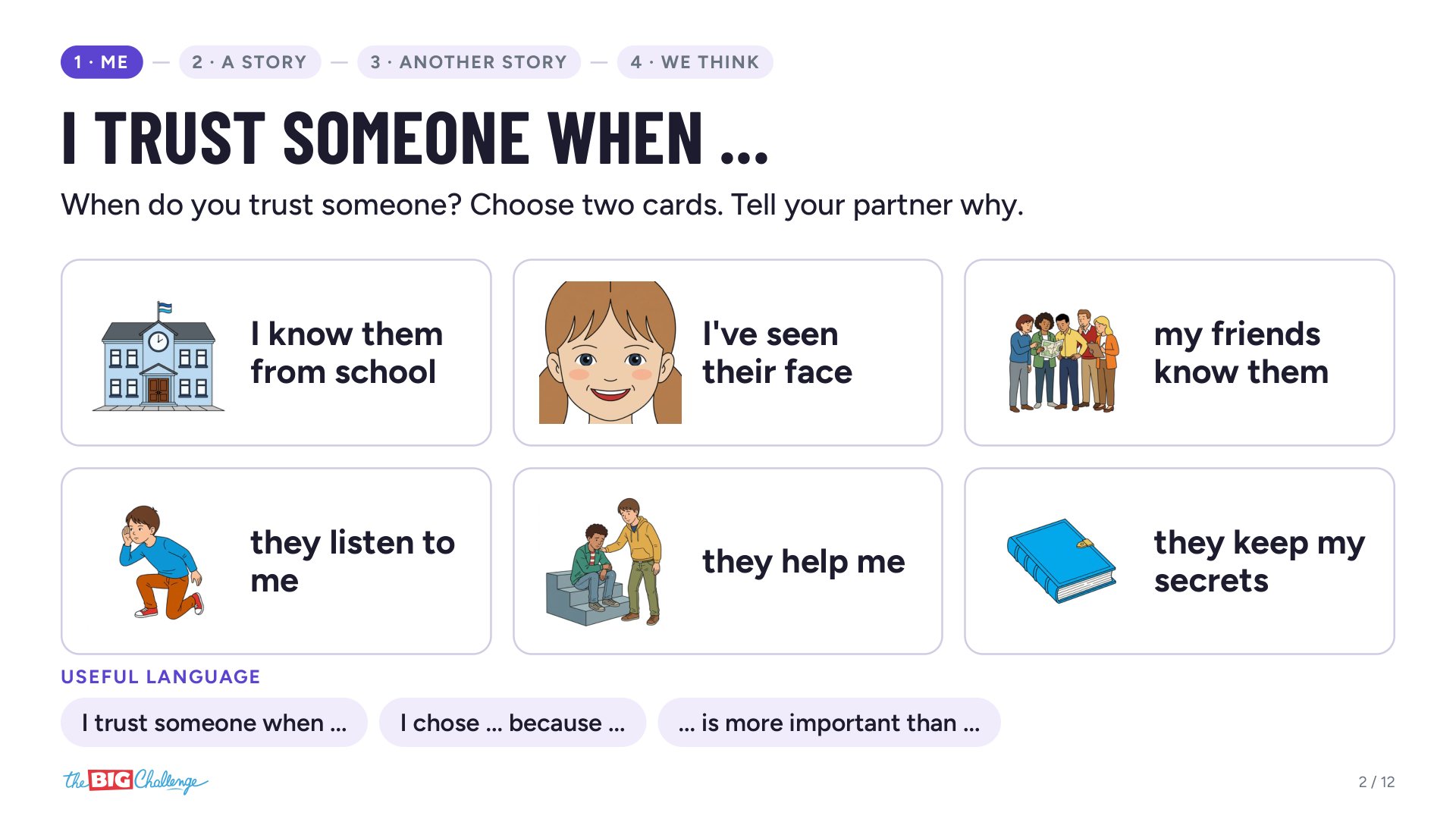
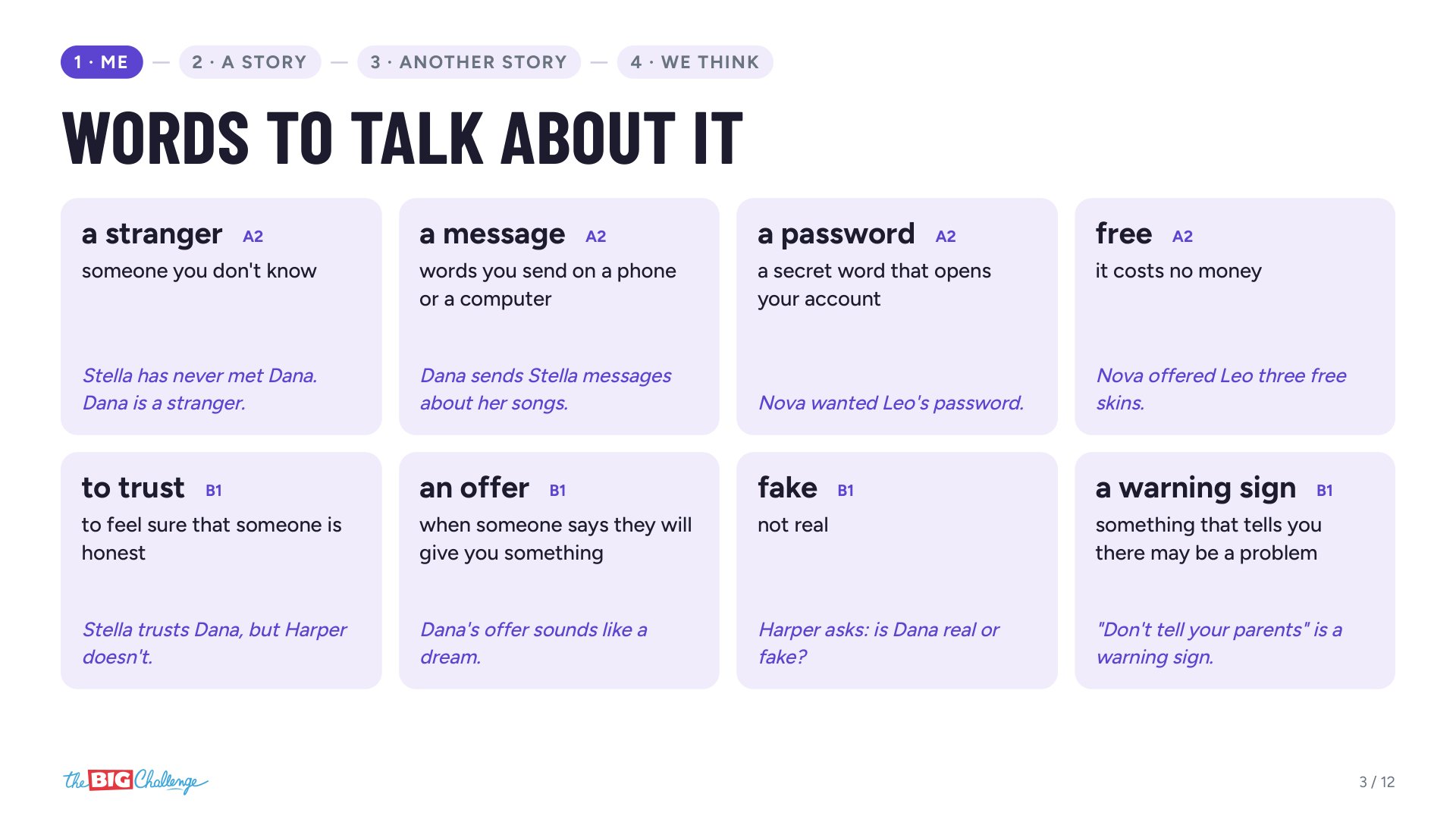
I trust someone when ...: pairs choose two cards each and say why. Then read the eight words and their examples together; the class repeats.
- 10 min
Stella's dream message and the four voices: read the three lines and Dana's message, then the bubbles aloud; pairs choose the voice they agree with most. Do not say who Dana really is: nobody knows.
- 13 min
Leo's offer: read the story and check the four facts, choose three feeling words, then compare Leo and Stella in the three boxes on the pupil sheet. Collect the warning signs on the board.
- 8 min
A message from a stranger, then "Where do you stand?": pupils choose three things alone, explain to a partner, then stand on the line from 1 to 5. Come back to the big question.
- 5 min
Spot the trick: pairs write the five-point checklist on the pupil sheet, then read their most important point to the class.
Adaptations
- SupportKeep the word slide on screen during the voices and the Leo slides, and accept one-sentence answers built on the useful language. Pupils can draw or number their three choices instead of writing them, and the checklist can be three points instead of five.
- ExtensionAsk stronger pairs the B1 question on the voices slide ("Dana is only a photo and a name. How could Stella check?"), and have them argue for a place on the line from 1 to 5 that is not their own.
🔒 Restricted content
This resource requires a subscription to be viewed.
Unlock the resourceIncluded in the subscriptionTags
- Present simple
- Past simple: regular verbs
- Past simple: irregular verbs
- Should: advice
- Imperatives
- Feelings & emotions
- Friendships & relationships
- Digital world
- Debate & opinion
- US teen life
- Digital citizenship
- Encountering others
- Spoken interaction
- Spoken production
- Writing practice
- Reading comprehension
- Classroom practice
- Differentiation