Votes at 16
- A comparison
 Preview · 3 of 11
Objective & content
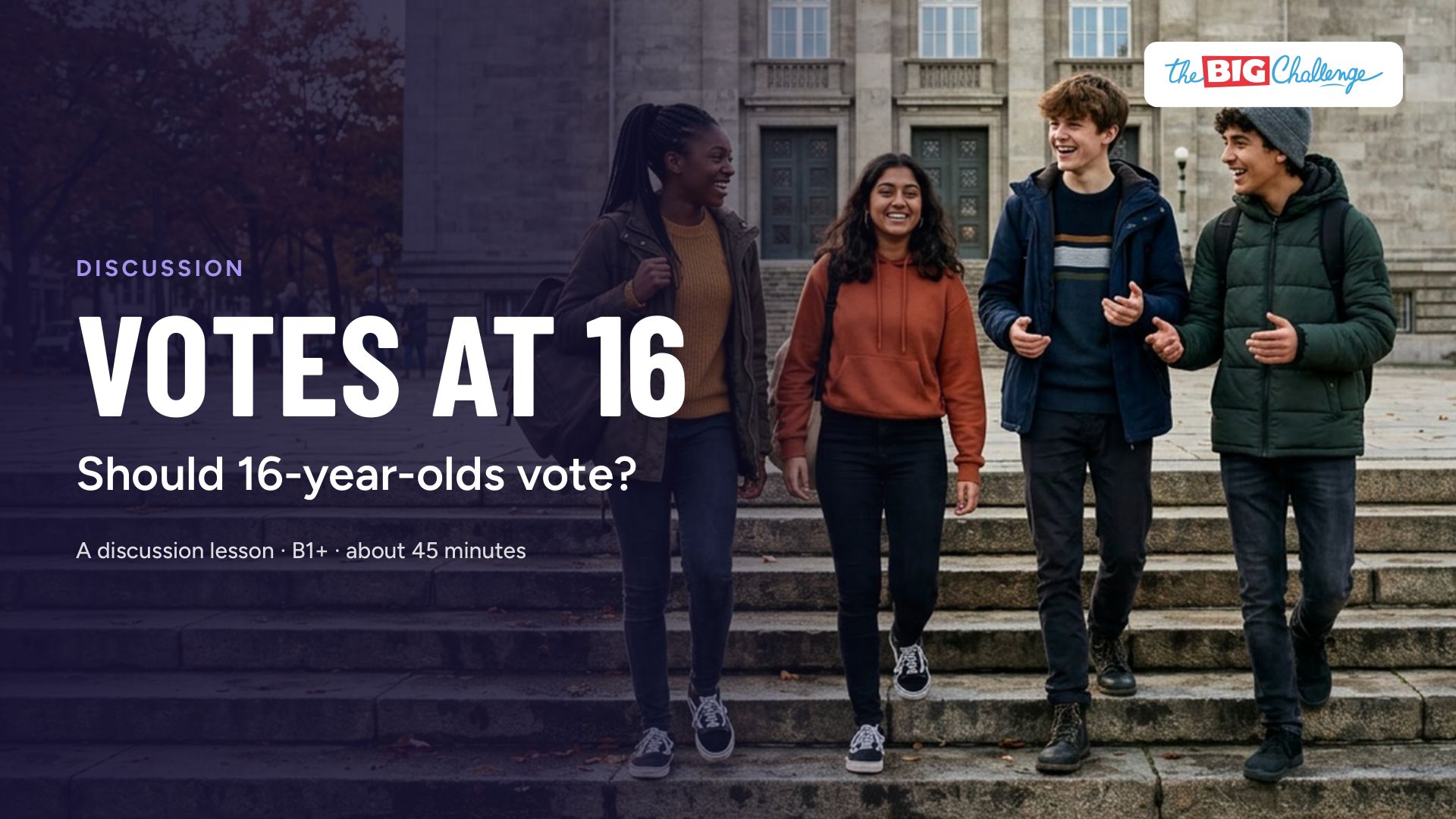
Should 16-year-olds vote? This 45-minute discussion lesson follows one path: the pupils first, then a story, then the world, then what the class thinks. The story is Emre, 16, who lives in Berlin: in September 2026, 16-year-olds could vote in the Berlin election for the first time. His grandmother has never missed an election; his older brother never votes ("It changes nothing"). Emre finds the leaflets hard and in the end chooses on one thing he cares about, his local swimming pool, closed for two years. Outside the polling station his friend asks: "Do you think it made any difference?" (a short story written for this lesson; no real party is named). Then the class looks at the real rules: in the UK you vote at 18, MPs voted for votes at 16 in 2026 and the law is now in the House of Lords, and Scotland and Wales already let 16-year-olds vote in their own elections; in France you vote at 18 and nothing is changing; in Germany it is 18 for the national parliament but 16 for European elections and in seven states, Berlin since 2026. By the end, pupils can talk about when young people are ready to decide, compare countries, defend an opinion and give advice in a short written reply.
Documents to download (2)
- Pupil sheet In your teacher account
- Discussion lesson (slides) In your teacher account
Pedagogical guide
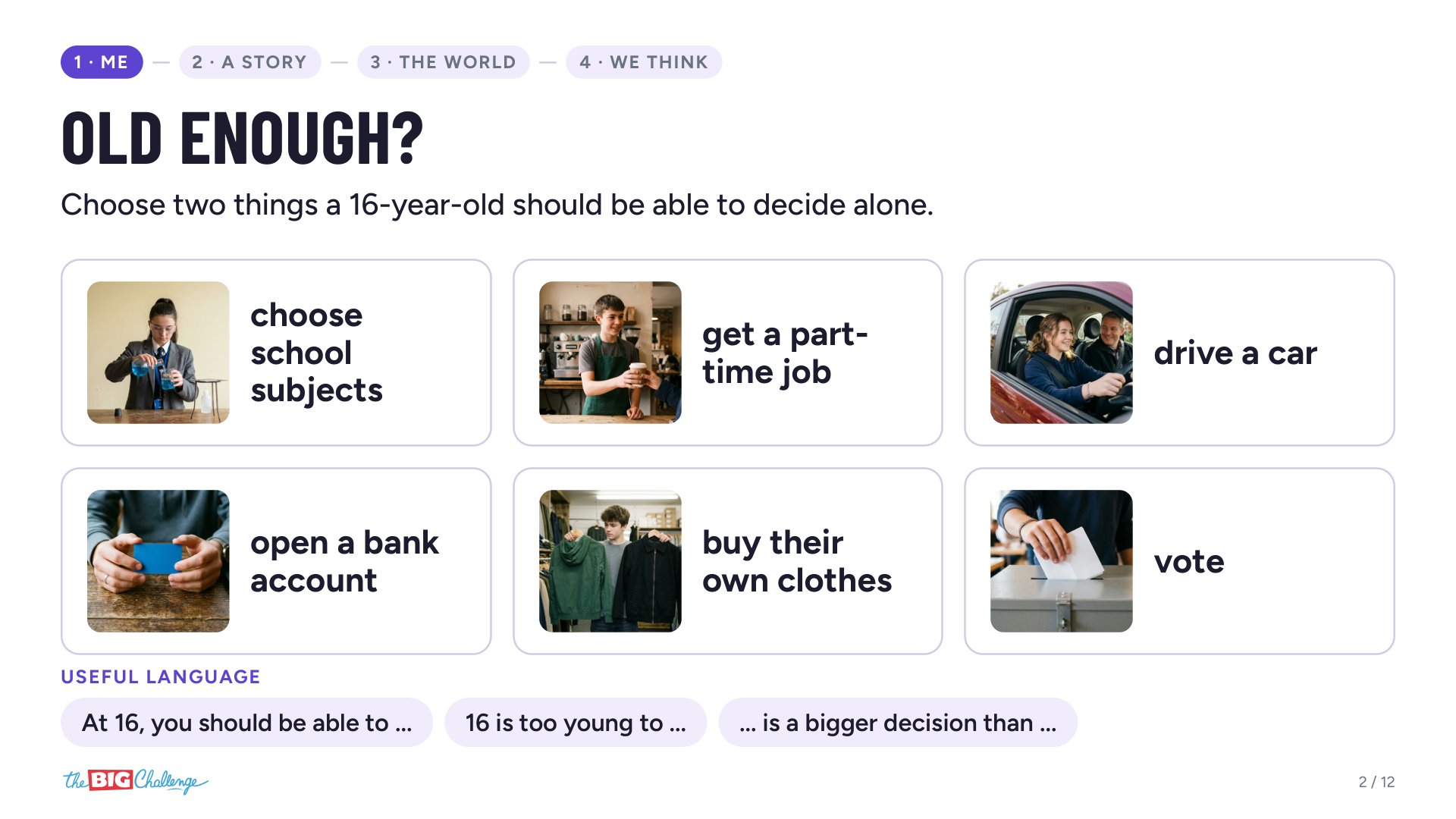
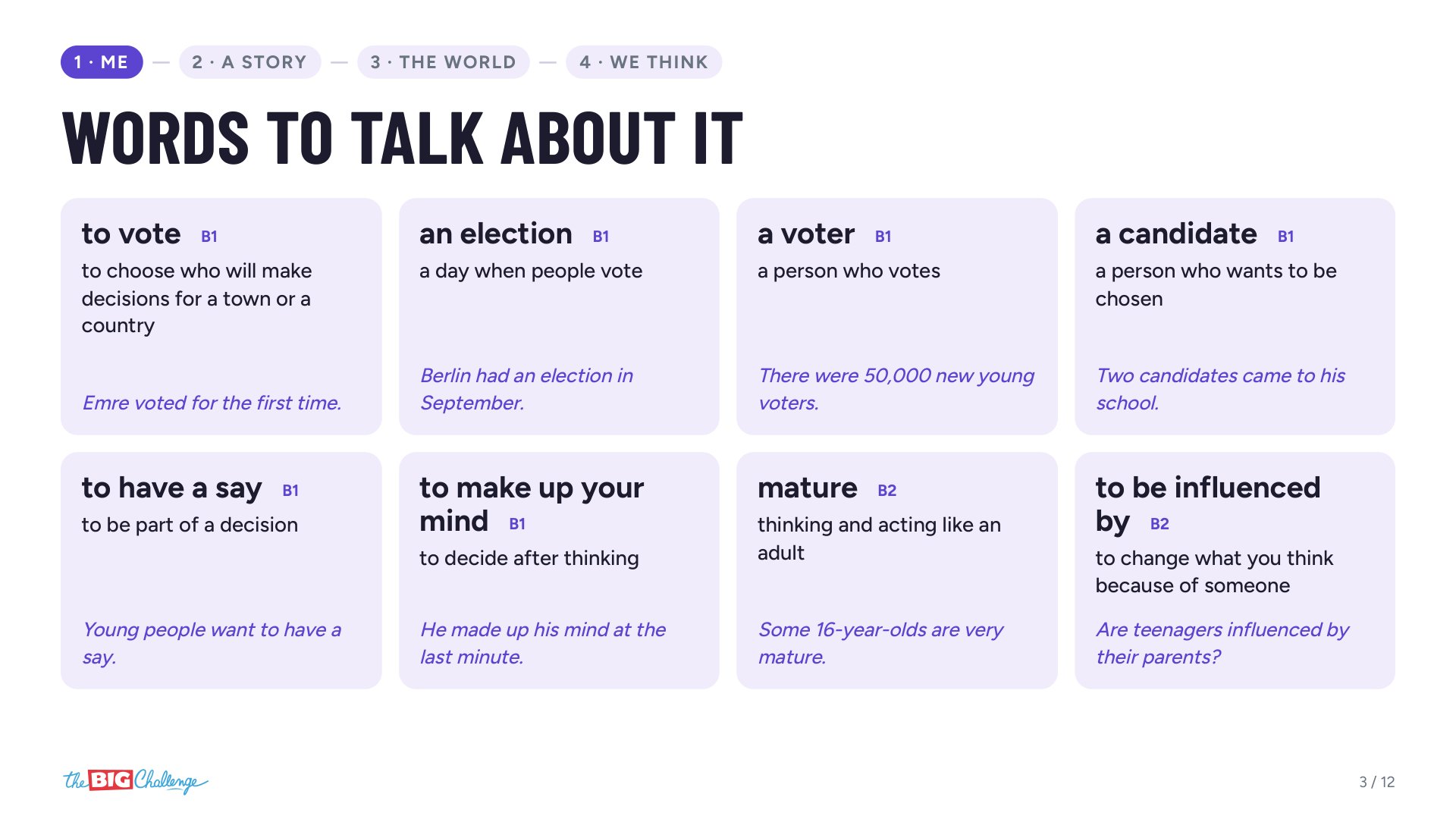
Every slide asks the class to do something: choose what a 16-year-old should be able to decide alone, learn eight words, pick feeling words for Emre with the leaflets and on election day, read the rules of three countries, say which of four invented voices they agree with, choose three things that would help young people vote well, compare knowledge, maturity and fairness in three boxes, stand on a line from 1 to 5, and write a reply to Emre. The words come before the talking, and each question has a B1 version for everyone and a B2 one for stronger pupils. The pupil sheet follows the slides, so every pupil leaves with something written. The facts come from UK Parliament, the UK government, the German Federal Agency for Civic Education (bpb) and the city of Berlin; they date from November 2026, and the UK law may have moved on, so the teacher notes ask you to check the news first. The four voices are invented opinions and are labelled as such. The lesson is about the age of voting, not about who to vote for: never ask pupils how they or their families vote, or which party they like, and stay neutral yourself; if a pupil names a party, bring the talk back to the question of age.
Suggested procedure45 min
- 2 min
Show the cover and read the big question: "Should 16-year-olds vote?" No answers yet.
- 8 min
Old enough?: pairs choose two cards and say why. Then read the eight words and their examples together.
- 8 min
Emre's first vote: read the story and check the four facts (who is right, his grandmother or his brother?), then choose feeling words for the leaflets and for election day.
- 10 min
Voting age in three countries and Four opinions: read the three countries (which gives young people the most say?), then the bubbles aloud; pairs choose the voice they agree with most.
- 11 min
Ready to vote, then the three boxes and "Where do you stand?": pupils choose three things, compare knowledge, maturity and fairness, then stand on the line from 1 to 5. Come back to the big question.
- 6 min
Dear Emre: pupils write a short reply with one piece of advice and a reason ("If I were you, I'd ...").
Adaptations
- SupportKeep the word slide on screen during the story and the voices, and accept one-sentence answers built on the useful language. Pupils can number their three things instead of writing them.
- ExtensionAsk stronger pairs the B2 question on the voices slide ("Is 16 too young, or is 18 too old? What is the right age, and why?"), and have them argue for a place on the line from 1 to 5 that is not their own.
🔒 Restricted content
This resource requires a subscription to be viewed.
Unlock the resourceIncluded in the subscription