Should you still live with your parents at 25?
- A comparison
- A debate

 Preview · 3 of 11
Objective & content
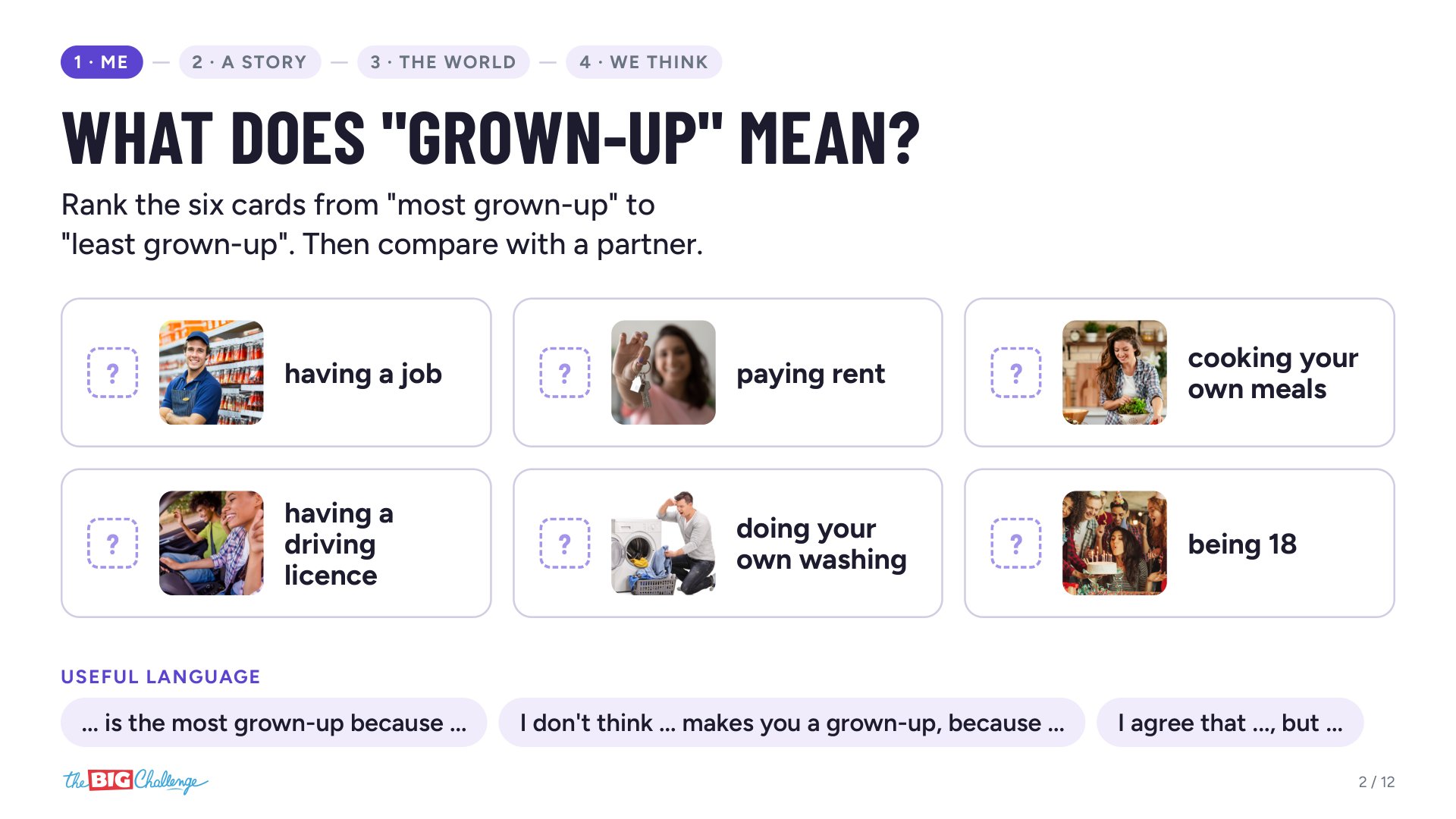
Should you still live with your parents at 25? This 55-minute B1+ discussion lesson follows one path: the pupils first, then a story, then the world, then what the class thinks. It starts with what makes someone a grown-up: having a job, paying rent, cooking your own meals, having a driving licence, doing your own washing, being 18. The story, written for this lesson, is Daniel, 24, from Chicago, who finished university two years ago, works in a bookshop and wants to be a teacher. When his landlord puts the rent up, he moves back into his old bedroom, posters still on the wall. His parents are happy to see him; his sister Rosie, 16, is not, because she had just turned his room into her music room. Then the real facts: in July 2020, 52% of Americans aged 18 to 29 lived with their parents, the highest since 1940; most young adults who live with a parent say it helps their finances, and most pay something towards the household; and in Europe young people leave home at about 22 in Sweden, 24 in France and Germany and 30 in Italy and Spain. By the end, pupils can agree and disagree, imagine a choice with the second conditional, and defend a side in a debate.
Documents to download (2)
- Pupil sheet In your teacher account
- Discussion lesson (slides) In your teacher account
Pedagogical guide
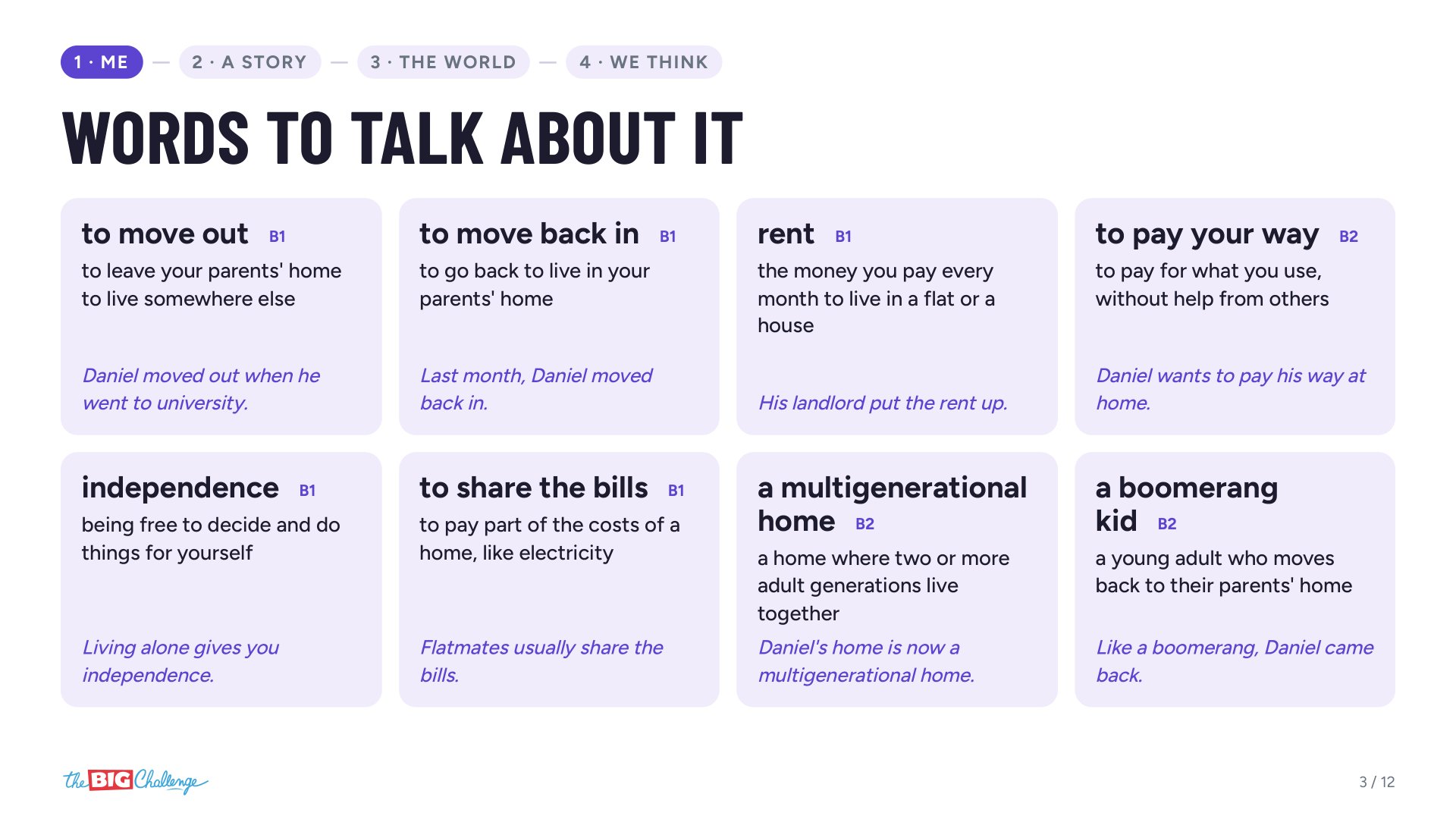
Every slide asks the class to do something: rank six picture cards, learn eight words, answer questions on Daniel's story, choose a feeling word for Daniel, his mother and Rosie, fill in the facts on the sheet, say who they agree with among four invented voices (Daniel's mother, 52; Rosie, 16; Marco, 26, from Rome, who still lives with his parents and saves for a flat; Emma, 23, from Lyon, who left at 19), choose their own plan at 22 (stay at home and save, share a flat with friends, or live alone) and explain it with "If I ..., I would ...", weigh money, freedom and family, stand on a line from 1 to 5 and, last, debate a motion before a class vote: "At 25, you should live on your own." The language help gives agreeing and disagreeing, the second conditional, "although" and "whereas". The lesson takes no side: staying, sharing and leaving all have real reasons, and Daniel's choice stays open. Never ask about pupils' own homes or what their families can afford: the plan is about an imagined life at 22. The story and the four voices are invented and labelled as such; the figures are real and sourced on the teacher slide.
Suggested procedure55 min
- 12 min
Cover, "What does grown-up mean?" and the words.
- 10 min
Daniel's room and "How does everyone feel?".
- 11 min
"Is Daniel unusual?" (pupils fill in the numbers) and the four voices.
- 13 min
"Your plan", the three questions to weigh and "Where do you stand?".
- 9 min
The debate, then the vote. Back to the big question.
Adaptations
- SupportKeep the word slide and the help phrases on screen during the debate, and let each side read its arguments from the sheet.
- ExtensionPupils write Daniel's message to his sister, Rosie, to make peace, in six to eight sentences.
🔒 Restricted content
This resource requires a subscription to be viewed.
Unlock the resourceIncluded in the subscription