Are Christmas Presents a Waste of Money?
- A comparison
 Preview · 3 of 11
Objective & content
Are Christmas presents a waste of money? This 45-minute discussion lesson for lycée and upper collège pupils follows one path: the pupils first, then a story, then the world, then what the class thinks. The story is Greta, 16, who lives in Leipzig, in the east of Germany, and makes bowls and cups at a pottery class every Thursday evening. Last Christmas, her aunt gave her an expensive jumper; Greta never wore it, and in January she sold it online. This year her parents are worried about money, so they suggest a family Secret Santa (Wichteln in German): one present each, 20 euros at most. Greta picked her grandmother's name and is making her a blue bowl, but her little brother Paul, 8, is upset: "Only one present? That's not Christmas!" Greta isn't sure who is right (a short story written for this lesson, with an open ending). Then the class reads four facts on presents nobody wants: in the UK, one adult in five got an unwanted present at Christmas 2024; in France, almost one person in three would resell a present they don't like; in Germany, for presents they don't like, 49% plan to take them back, 38% to give them away and 18% to sell them; and in all three countries a shop doesn't have to take back a present just because you don't like it, while a present bought online can be sent back within 14 days. By the end, pupils can talk about presents, give and defend an opinion on buying them, and agree on a deal with someone who wants something different.
Documents to download (2)
- Pupil sheet In your teacher account
- Discussion lesson (slides) In your teacher account
Pedagogical guide
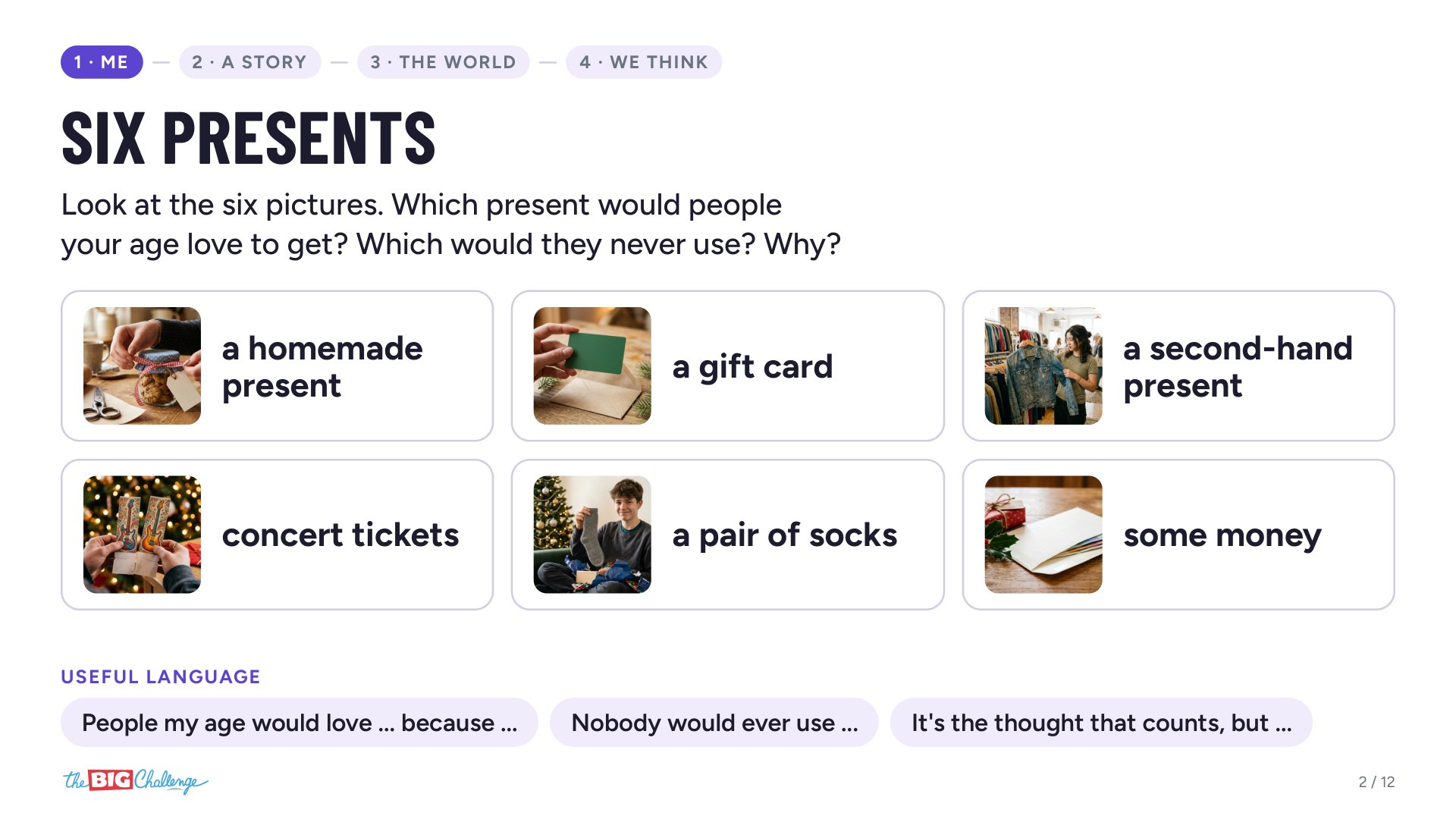
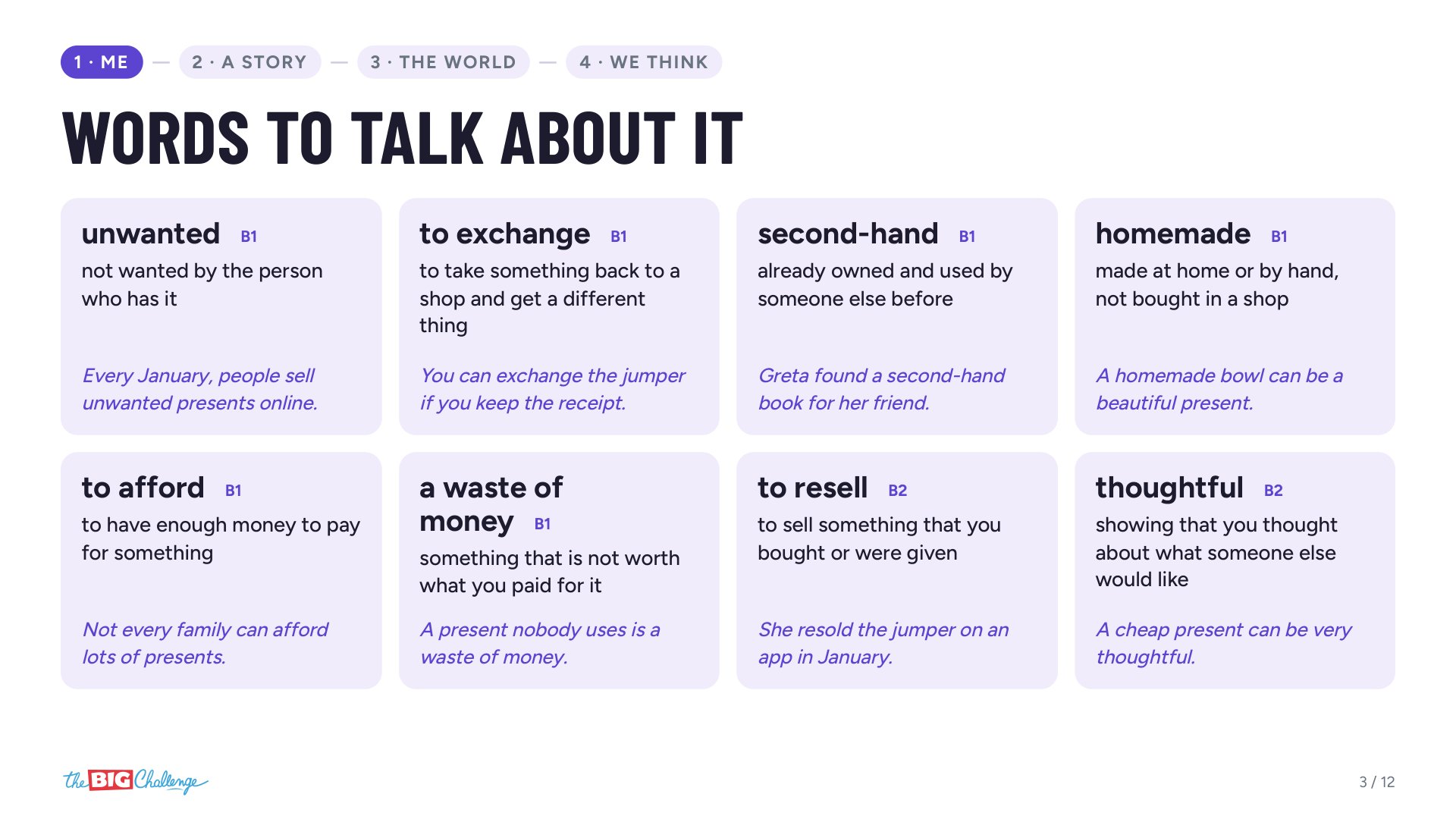
Every slide asks the class to do something: choose, among six presents (a homemade present, a gift card, a second-hand present, concert tickets, a pair of socks, some money), the one people their age would love and the one they would never use; learn eight words (unwanted, to exchange, second-hand, homemade, to afford, a waste of money, and for stronger pupils to resell and thoughtful); choose three feeling words for Greta about the Secret Santa and three for when Paul gets upset; read four facts; say which of four invented voices they agree with; choose three good presents that cost little; fill in three boxes (lots of presents, a Secret Santa, no presents); stand on a line from 1 to 5; and, in pairs, play a role-play card and agree on a family deal. The words come before the talking, and each question has a B1 version for everyone and a B2 one for stronger pupils. The pupil sheet follows the slides, so every pupil leaves with something written. The language in use is the past simple, the present perfect (it has cost her almost nothing), would rather, the second conditional (Without presents, my shop would close), comparatives and instead of. The facts come from Which?, Ipsos bva and Bitkom (2025), and the rules on taking presents back from Citizens Advice, the INC and the Verbraucherzentrale, with the sources on the slide; the teacher notes add more detail on the UK survey. The four voices are invented opinions and are labelled as such. The lesson is about presents, not religion. Presents touch home and money: the tasks ask about people their age, Greta and the role-play characters, never what a pupil got, what a family can afford or whether it celebrates Christmas.
Suggested procedure45 min
- 2 min
Show the cover and read the big question: "Should we stop buying Christmas presents?" No answers yet.
- 8 min
Six presents: pairs choose the present people their age would love and the one nobody would use, and a few report back. Then read the eight words and their examples together.
- 8 min
Greta's Secret Santa and How does Greta feel?: read the story together and check the four facts (why did her parents suggest a Secret Santa? Is Paul wrong?), then each pupil chooses three words for the Secret Santa and three for Paul's reaction.
- 10 min
Presents nobody wants and Four opinions: read the four lines (what surprises you?), then the bubbles aloud; pairs choose the voice they agree with most.
- 11 min
A good present that costs little, Lots of presents, one, or none? and Where do you stand?: pupils choose three ideas, fill in the three boxes with a partner, then stand on the line from 1 to 5. Come back to the big question.
- 6 min
Our family deal: pairs choose a card, talk for two minutes and agree on a deal; two or three pairs tell the class their deal.
Adaptations
- SupportKeep the word slide on screen during the story and the voices, and accept one-sentence answers built on the useful language. In the role-play, pairs can use the sentence frames on the slide and agree on one point only.
- ExtensionAsk stronger pairs the B2 question on the voices slide ("Which voice is closest to Greta's parents? And to Paul?"), and have them argue for a place on the line from 1 to 5 that is not their own.
🔒 Restricted content
This resource requires a subscription to be viewed.
Unlock the resourceIncluded in the subscription