Do New Year's Resolutions Work?
- A comparison
 Preview · 3 of 12
Objective & content
Are New Year's resolutions a waste of time? This 45-minute discussion lesson for lycée and upper collège pupils follows one path: the pupils first, then a story, then the world, then what the class thinks. The story is Callum, 15, who lives in Newcastle, in the north-east of England, and plays the trumpet in a youth brass band on Saturdays. In December, his phone said he spent five hours a day on it, mostly watching videos in bed. On 1 January, he made a resolution: one hour a day, and no phone upstairs at night; he practised the trumpet instead. For two weeks it worked; then his friends planned a cinema trip in their group chat, and he missed it. Now it is 1 February, he has broken his rule three times, and he isn't sure whether his resolution has failed or is working (a short story written for this lesson, with an open ending). Then the class reads what one study found about habits: 96 adults, mostly university students, each tried one new daily habit for 84 days and said every day how automatic it felt; for the 39 people whose results were clear enough, the median time before the habit stopped getting stronger was 66 days, with a range from 18 days to an estimated 254, and missing one day made almost no difference. Four facts follow on resolutions in the UK, France and Germany: in the UK, about one adult in five planned resolutions for 2026, and 38% of those who made them for 2025 say they kept all of them; in France, 12% want less screen time in 2026; in Germany, 41% made resolutions for 2026, and half of 14 to 29-year-olds want to spend less time on their phones. By the end, pupils can talk about resolutions and habits, give and defend an opinion on them, and write a short message to themselves about one habit.
Documents to download (2)
- Pupil sheet In your teacher account
- Discussion lesson (slides) In your teacher account
Pedagogical guide
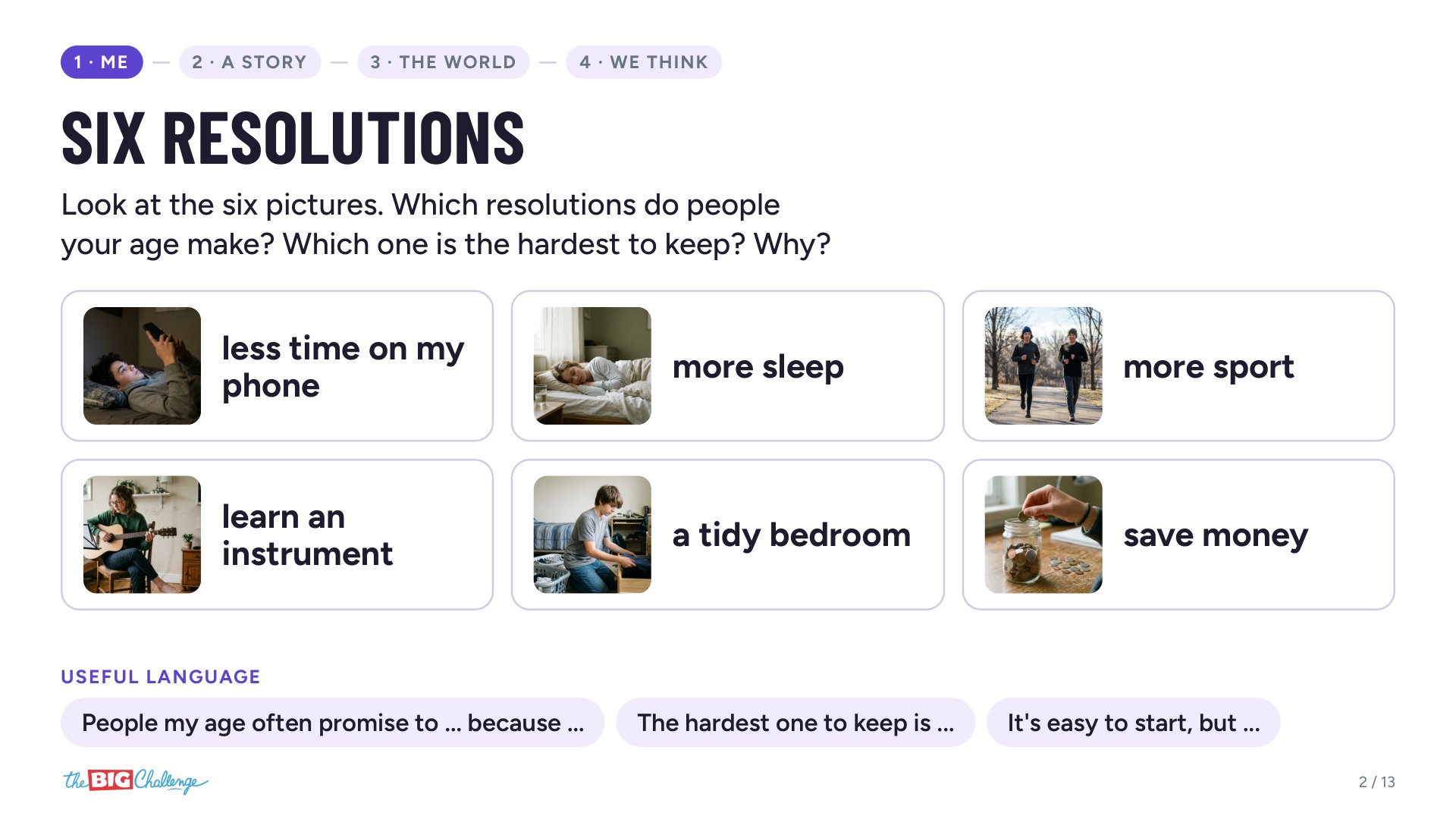
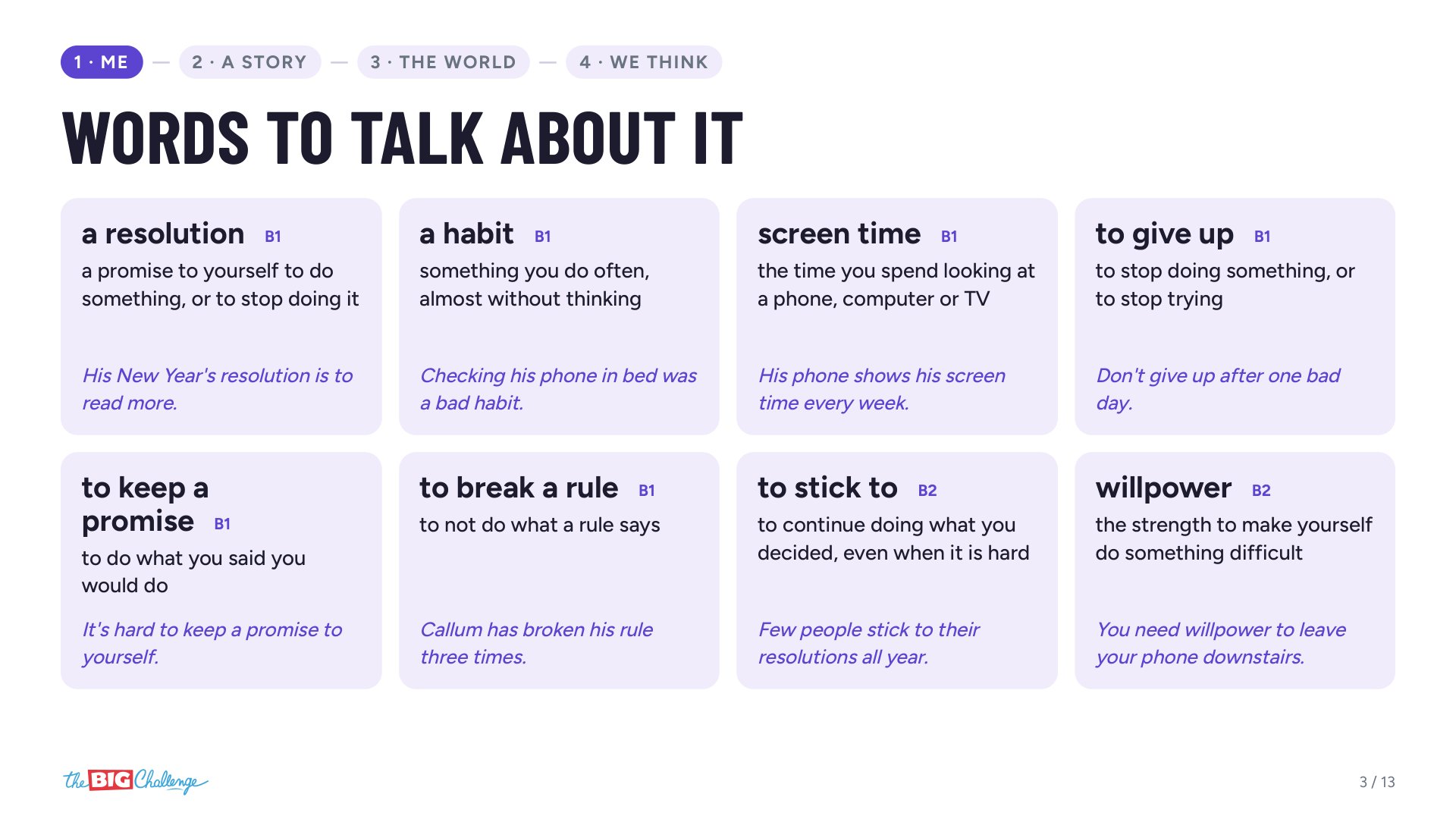
Every slide asks the class to do something: choose, among six resolutions (less time on my phone, more sleep, more sport, learn an instrument, a tidy bedroom, save money), the ones people their age make and the hardest to keep; learn eight words (a resolution, a habit, screen time, to give up, to keep a promise, to break a rule, and for stronger pupils to stick to and willpower); choose three feeling words for Callum in his first two weeks and three for 1 February; read four tiles on the habit study and four lines on the three countries; say which of four invented voices they agree with; choose three tricks to keep a resolution; fill in three boxes (a New Year's resolution, start on any day, no resolutions); stand on a line from 1 to 5; and write a postcard to themselves, "Dear me, next January", about one small habit, when and where they will do it and what they will do after a missed day. The words come before the talking, and each question has a B1 version for everyone and a B2 one for stronger pupils. The pupil sheet follows the slides, so every pupil leaves with something written. The language in use is the past simple, the present perfect (He has broken his rule three times), will for promises (I'll ...), comparatives (It's easier to ... than to ...) and if + present (If I miss a day, I'll ...). The study is Lally and colleagues at University College London, in the European Journal of Social Psychology (2009): the slide says what it measured, how automatic the habit felt to each person, and that 66 days is a median, not a rule for everyone. The country facts come from YouGov, Elabe for BFMTV and DAK with Forsa; the surveys ask different questions, so the countries are not ranked, and the teacher notes add more detail. The four voices are invented opinions and are labelled as such. The lesson leaves weight, food and the body out on purpose, and the tasks ask about people their age, Callum and the voices, never about a pupil's own resolution or screen time.
Suggested procedure45 min
- 2 min
Show the cover and read the big question: "Are New Year's resolutions a waste of time?" No answers yet.
- 8 min
Six resolutions: pairs choose the resolutions people their age make and the hardest to keep, and a few report back. Then read the eight words and their examples together.
- 8 min
Callum's one-hour rule and How does Callum feel?: read the story together and check the four facts (why did he make the rule? Has it failed?), then each pupil chooses three words for the first two weeks and three for 1 February.
- 12 min
How long does a habit take?, Three countries and Four opinions: read the tiles (is 66 days a rule for everyone?), then the four lines (what surprises you?), then the bubbles aloud; pairs choose the voice they agree with most.
- 10 min
Tricks to keep a resolution, January, any day, or never? and Where do you stand?: pupils choose three tricks, fill in the three boxes with a partner, then stand on the line from 1 to 5. Come back to the big question.
- 5 min
Dear me, next January: each pupil writes a postcard to themselves, alone. The postcard is private.
Adaptations
- SupportKeep the word slide on screen during the story and the voices, and accept one-sentence answers built on the useful language. For the postcard, pupils can use the sentence frames on the slide and write about one point only.
- ExtensionAsk stronger pairs the B2 question on the voices slide ("What advice would each of them give Callum?"), and have them use the habit study to answer Callum's question: has his resolution failed, or is it working?
🔒 Restricted content
This resource requires a subscription to be viewed.
Unlock the resourceIncluded in the subscriptionTags
- Past simple: irregular verbs
- Present perfect simple
- Future: will
- Conditionals 0 and 1
- Comparatives: short adjectives
- Teen life
- Digital world
- Daily routine
- Feelings & emotions
- Birthdays & parties
- Debate & opinion
- Festivals and special days
- Spoken interaction
- Spoken production
- Writing practice
- Classroom practice
- Differentiation