AI for Homework
- A comparison
 Preview · 3 of 11
Objective & content
Is using AI for homework cheating? This 45-minute discussion lesson follows one path: the pupils first, then a story, then the world, then what the class thinks. The story is Priya, 14, who lives in Manchester: she has a history essay for Monday and a netball match on Sunday. On Sunday night she writes her plan herself, then asks an AI chatbot to "make it better". On Tuesday her teacher says "Excellent work, Priya!", then asks what "unprecedented" means; the word is in her essay, and she does not know. Had she cheated, or had she just got some help? (a short story written for this lesson; no AI product is named). Then the class looks at the real rules: in England each school makes its own, and for exams and coursework, using AI to write your work counts as cheating; in France, since 2025, pupils can use AI in class from 4e, a little and with the teacher, and pupils in 4e take an online course about AI; in Germany the education ministers agreed in 2024 to teach pupils to use AI carefully, and each state makes its own rules. By the end, pupils can talk about where help ends and cheating begins, compare countries, defend an opinion and give advice in a short written reply.
Documents to download (2)
- Pupil sheet In your teacher account
- Discussion lesson (slides) In your teacher account
Pedagogical guide
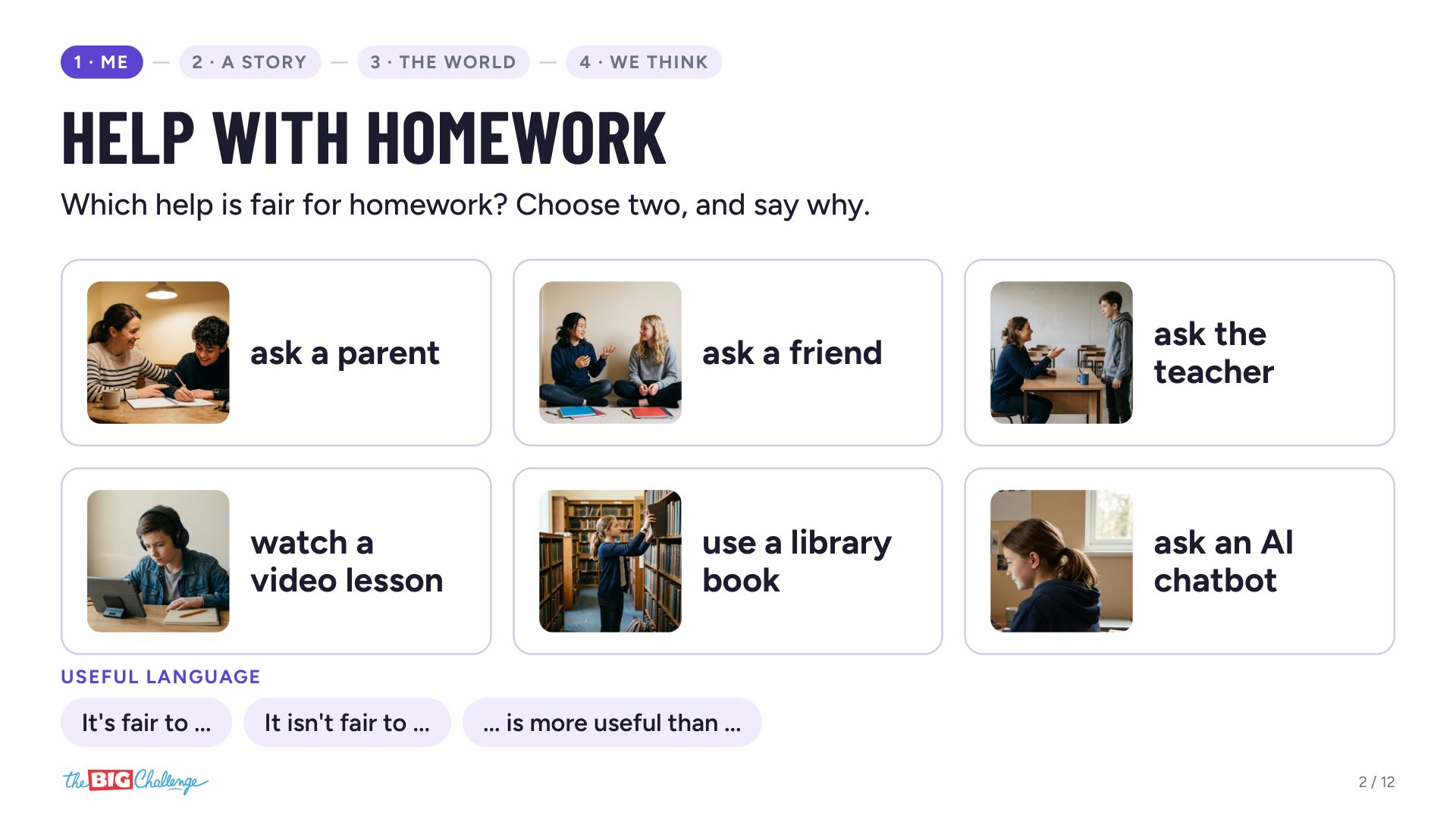
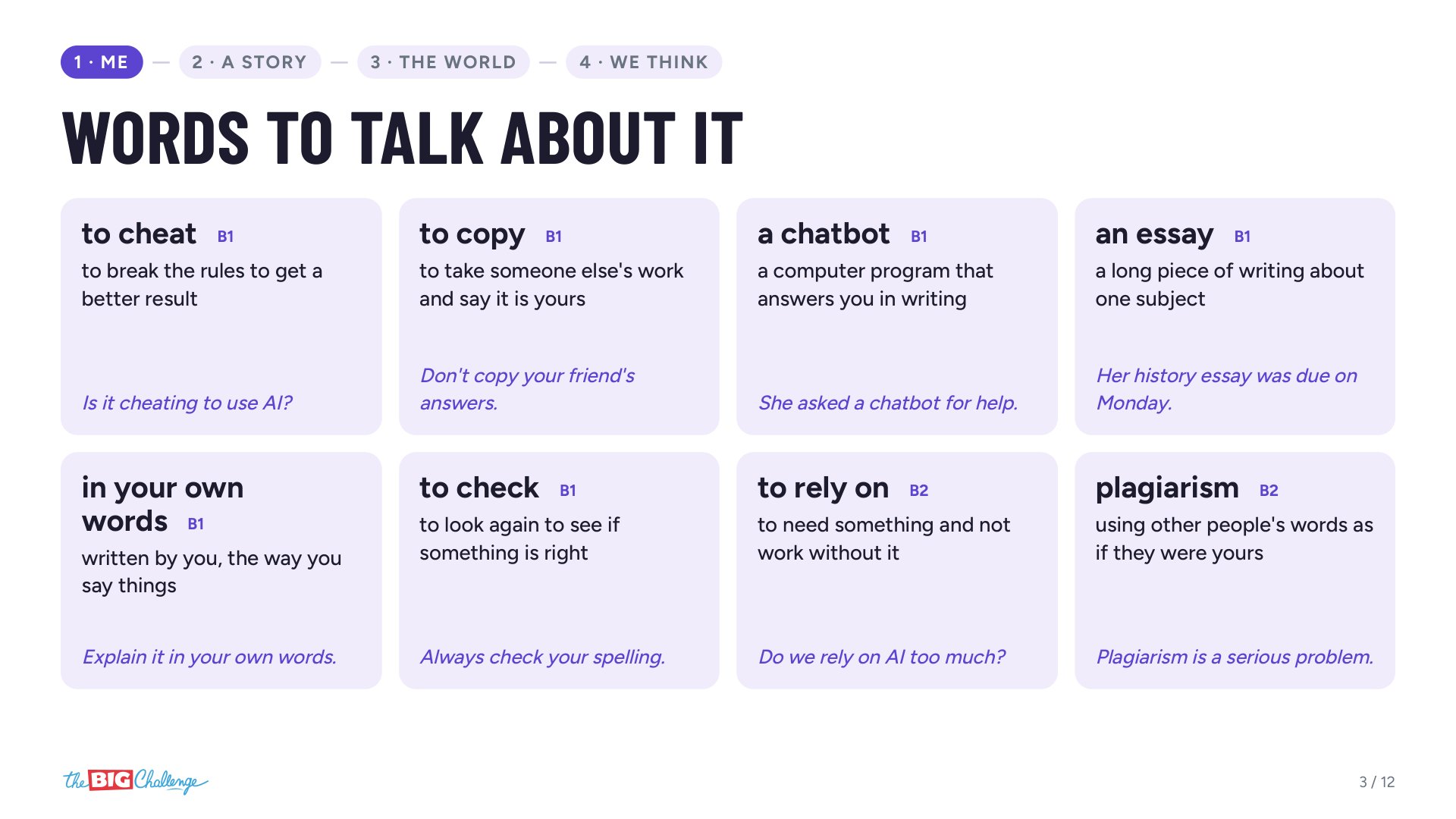
Every slide asks the class to do something: choose which help with homework is fair, learn eight words, pick feeling words for Priya when her teacher praises her and after his question, read the rules of three countries, say which of four invented voices they agree with, choose three fair rules for AI and homework, compare learning, honesty and the future in three boxes, stand on a line from 1 to 5, and write a reply to Priya. The words come before the talking, and each question has a B1 version for everyone and a B2 one for stronger pupils. The pupil sheet follows the slides, so every pupil leaves with something written. The facts come from the UK government, the exam boards (JCQ), the French Ministry of Education and the German education ministers' conference (KMK); they date from November 2026 and change fast, so the teacher notes ask you to check the news first. The four voices are invented opinions and are labelled as such. Never ask pupils what they use for their own homework: the cards ask which help is fair, not what they do. If pupils ask what is allowed in their own school, give them your school's rules first.
Suggested procedure45 min
- 2 min
Show the cover and read the big question: "Is using AI for homework cheating?" No answers yet.
- 8 min
Help with homework: pairs choose two cards and say why they are fair. Then read the eight words and their examples together.
- 8 min
Priya's essay: read the story and check the four facts (which part of the essay was really hers?), then choose feeling words for the praise and for the teacher's question.
- 10 min
AI at school in three countries and Four opinions: read the three countries (which rules are like your school's?), then the bubbles aloud; pairs choose the voice they agree with most.
- 11 min
Fair rules for AI, then the three boxes and "Where do you stand?": pupils choose three rules, compare learning, honesty and the future, then stand on the line from 1 to 5. Come back to the big question.
- 6 min
Dear Priya: pupils write a short reply with one piece of advice and a reason ("If I were you, I'd ...").
Adaptations
- SupportKeep the word slide on screen during the story and the voices, and accept one-sentence answers built on the useful language. Pupils can number their three rules instead of writing them.
- ExtensionAsk stronger pairs the B2 question on the voices slide ("Where is the line between getting help and cheating?"), and have them argue for a place on the line from 1 to 5 that is not their own.
🔒 Restricted content
This resource requires a subscription to be viewed.
Unlock the resourceIncluded in the subscription