Click or march?
- A comparison
 Preview · 3 of 11
Objective & content
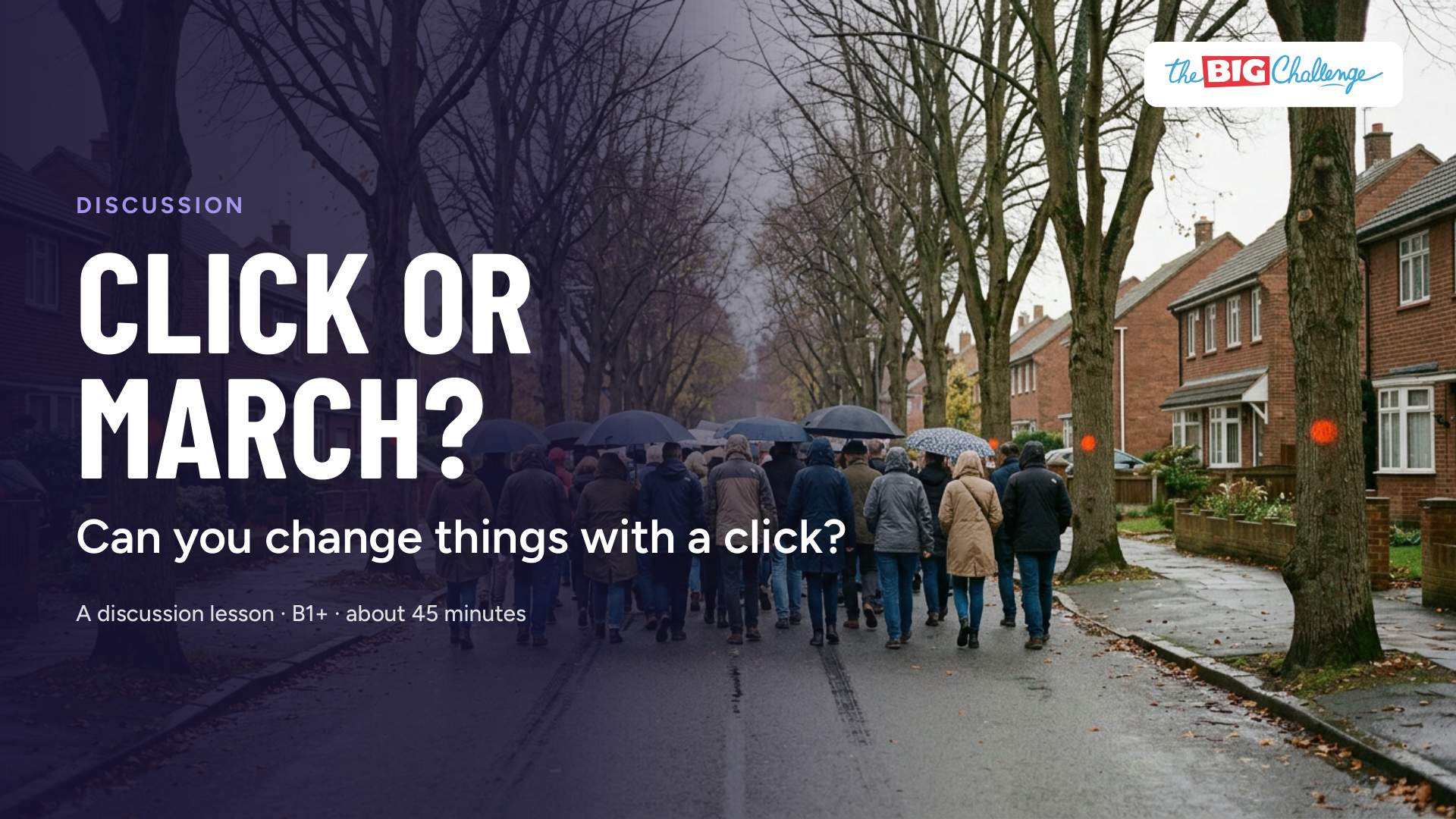
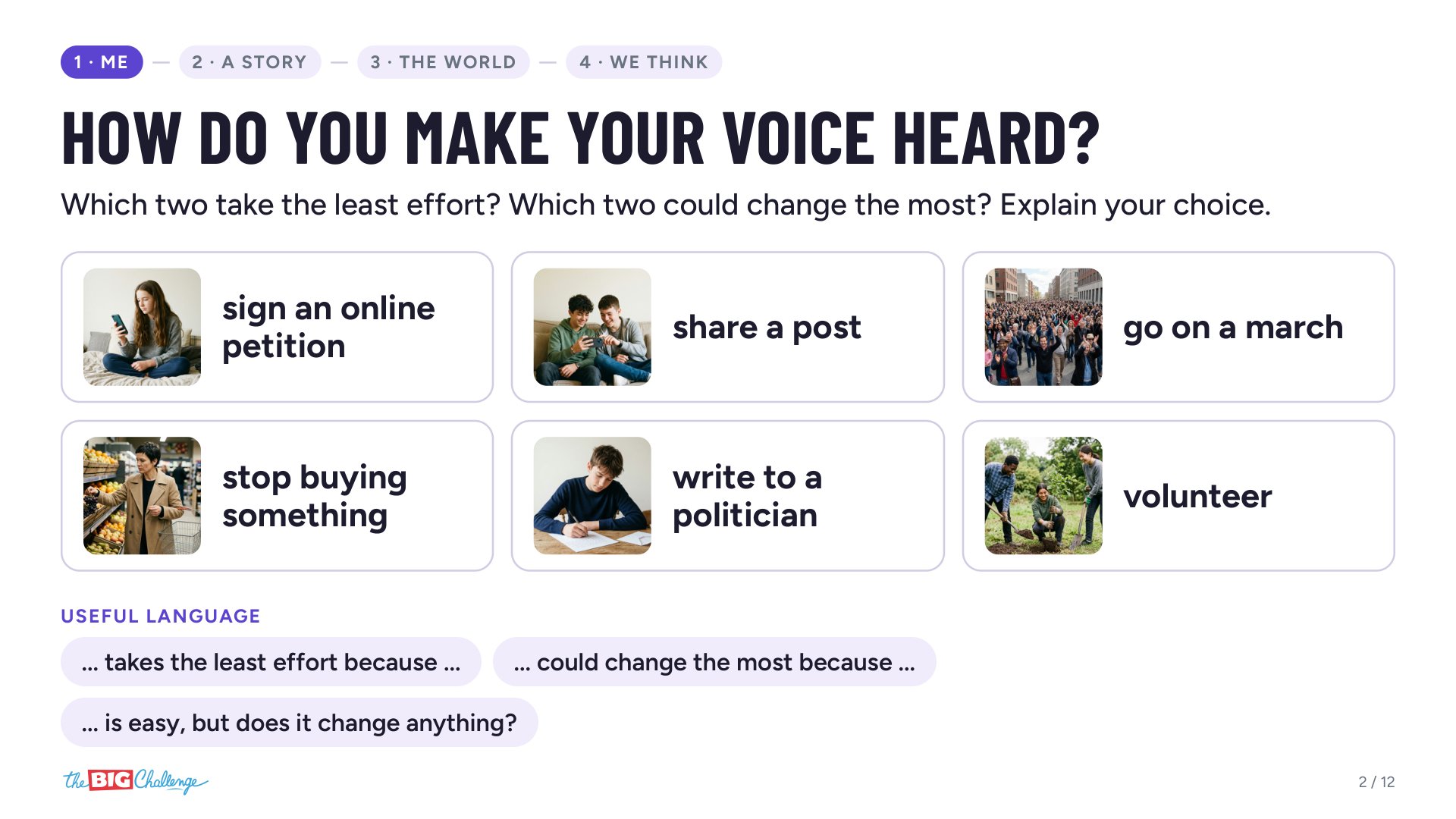
Can you change things with a click? This 45-minute discussion lesson follows one path: the pupils first, then a story, then the world, then what the class thinks. It starts with six ways to make your voice heard: sign an online petition, share a post, go on a march, stop buying something, write to a politician, volunteer. The story, written for this lesson, is Josh, 16: one morning, council workers paint orange marks on the old trees in his street, the trees they plan to cut down. His online petition gets 3,000 signatures by Sunday night. His friend Amira shrugs: "A click costs nothing. Who will actually turn up?" On Saturday, 60 people walk with him to the town hall in the rain, and the council puts off its decision. Josh wonders: was it the clicks or the march? Then three real cases, each ending a different way: the Ice Bucket Challenge of 2014, which raised about $115 million for research into the disease ALS; the London march of 15 February 2003, when between 750,000 and 2 million people marched against a war in Iraq, which began a month later; and the street trees of Sheffield, where about 5,000 trees were cut down until an online group and protests in the street helped stop the cutting in 2018. By the end, pupils can compare ways of campaigning, defend an opinion, answer someone who disagrees and give advice in a short written reply.
Documents to download (2)
- Pupil sheet In your teacher account
- Discussion lesson (slides) In your teacher account
Pedagogical guide
Every slide asks the class to do something: choose the actions that take the least effort and those that could change the most, learn eight words, pick feeling words for Josh, read three real cases, say which of four invented voices they agree with, choose three things a good campaign needs, compare clicks, marches and both in three boxes, stand on a line from 1 to 5, and write a reply to Josh. The words come before the talking, and each question has a B1 version for everyone and a B2 one for stronger pupils. The pupil sheet follows the slides, so every pupil leaves with something written. The lesson takes no side: the story ends on Josh's doubt, and the three cases end three different ways. It is about how people campaign, not about which causes are right, so never ask pupils which side they take on a real cause. The war in Iraq is named as a fact, without detail, and is not debated. The town and the story are invented; the four voices are invented opinions and are labelled as such. Pictures of people were made for this lesson; the three real cases are shown in real, credited photos.
Suggested procedure45 min
- 2 min
Show the cover and read the big question. No answers yet.
- 8 min
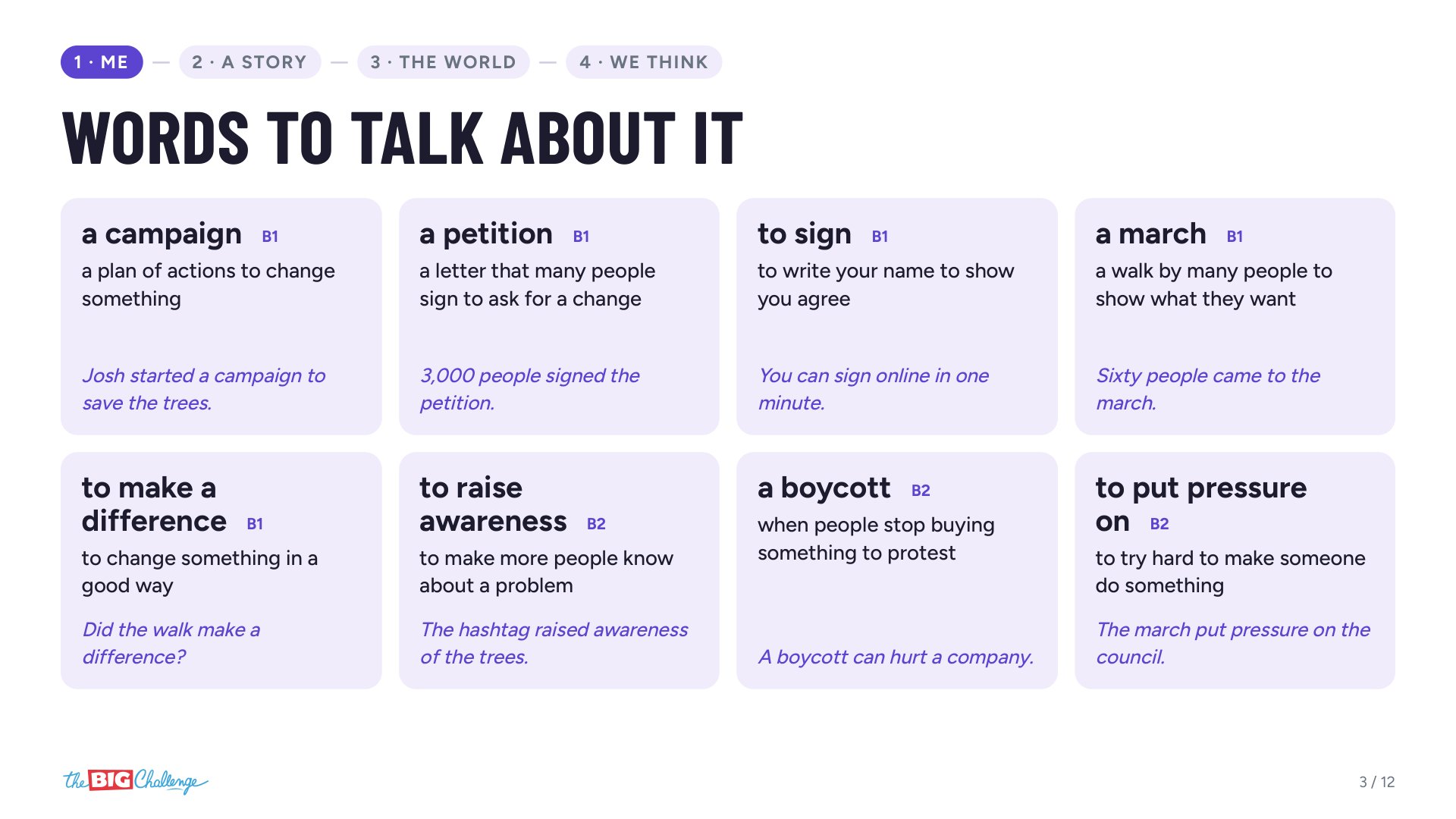
How do you make your voice heard?: pairs choose two cards for each question and say why. Then read the eight words and their examples.
- 9 min
The trees on Josh's street: read the story and check the three facts (what does Amira mean? what did the council do?), then choose feeling words for Josh.
- 10 min
A click, a march, or both?, and Four opinions: which case changed the most, and is money a change? Pairs choose the voice they agree with most.
- 11 min
A good campaign, the three boxes and "Where do you stand?": pupils choose three things a campaign needs, compare clicks, marches and both, then stand on the line. Come back to the big question.
- 5 min
Dear Josh: pupils write a short reply, with one thing he could do next.
Adaptations
- SupportKeep the word slide on screen during the story and the voices, and accept one-sentence answers built on the useful language.
- ExtensionPupils find one campaign from their own country, and say in five sentences what people did and what changed.
🔒 Restricted content
This resource requires a subscription to be viewed.
Unlock the resourceIncluded in the subscription