Winter Blues
- A comparison
 Preview · 3 of 11
Objective & content
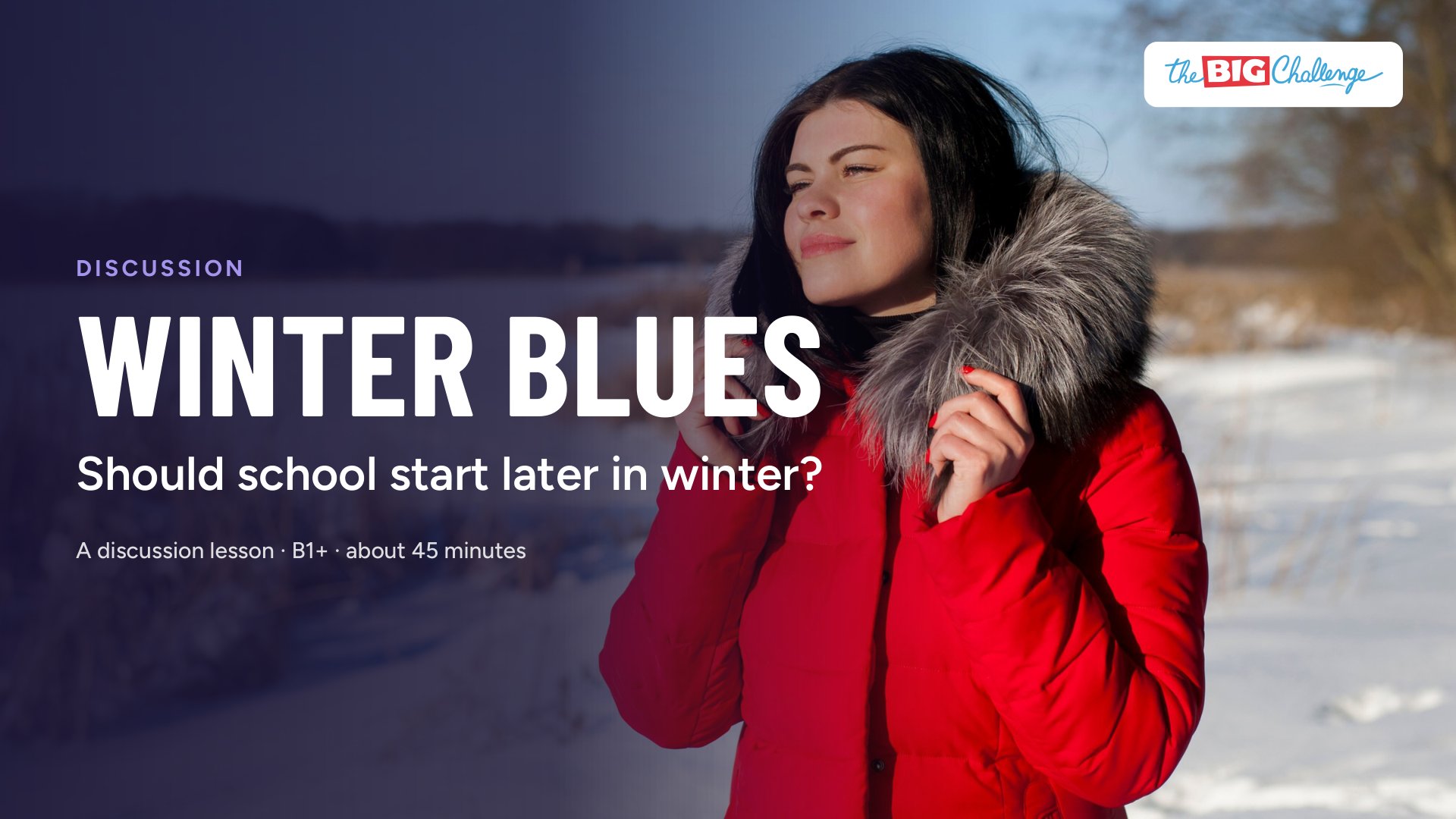
Should school start later in winter? This 45-minute discussion lesson for lycée pupils follows one path: the pupils first, then a story, then the world, then what the class thinks. The story is Camille, 16, who lives in Lille, in the north of France. Her lessons start at 8:00: in December she leaves home at 7:20 in the dark and gets home at 18:00 in the dark again. She used to go climbing twice a week, but since November she has stayed on the sofa with her phone. On Saturday her friend Jade asks her to come climbing, and she laughs all afternoon. On Monday the pupils' council asks everyone whether the lycée should start at 9:00 in January and February, with lessons finishing an hour later, and Camille has to vote by Friday (a short story written for this lesson, with an open ending). Then the class reads four facts: on 21 December, London, Paris and Berlin get only about eight hours of daylight; in England each school decides when its day starts, and a 2022 petition asked for 10 a.m.; in many French lycées the day runs from about 8:00 to 17:00 or 18:00; in Germany most schools start at 8:00, and at one school in Alsdorf older pupils slept about an hour longer on the days they started later. By the end, pupils can talk about winter and how it makes people feel, give and defend an opinion on a later school start, and give advice in a short written reply.
Pedagogical guide
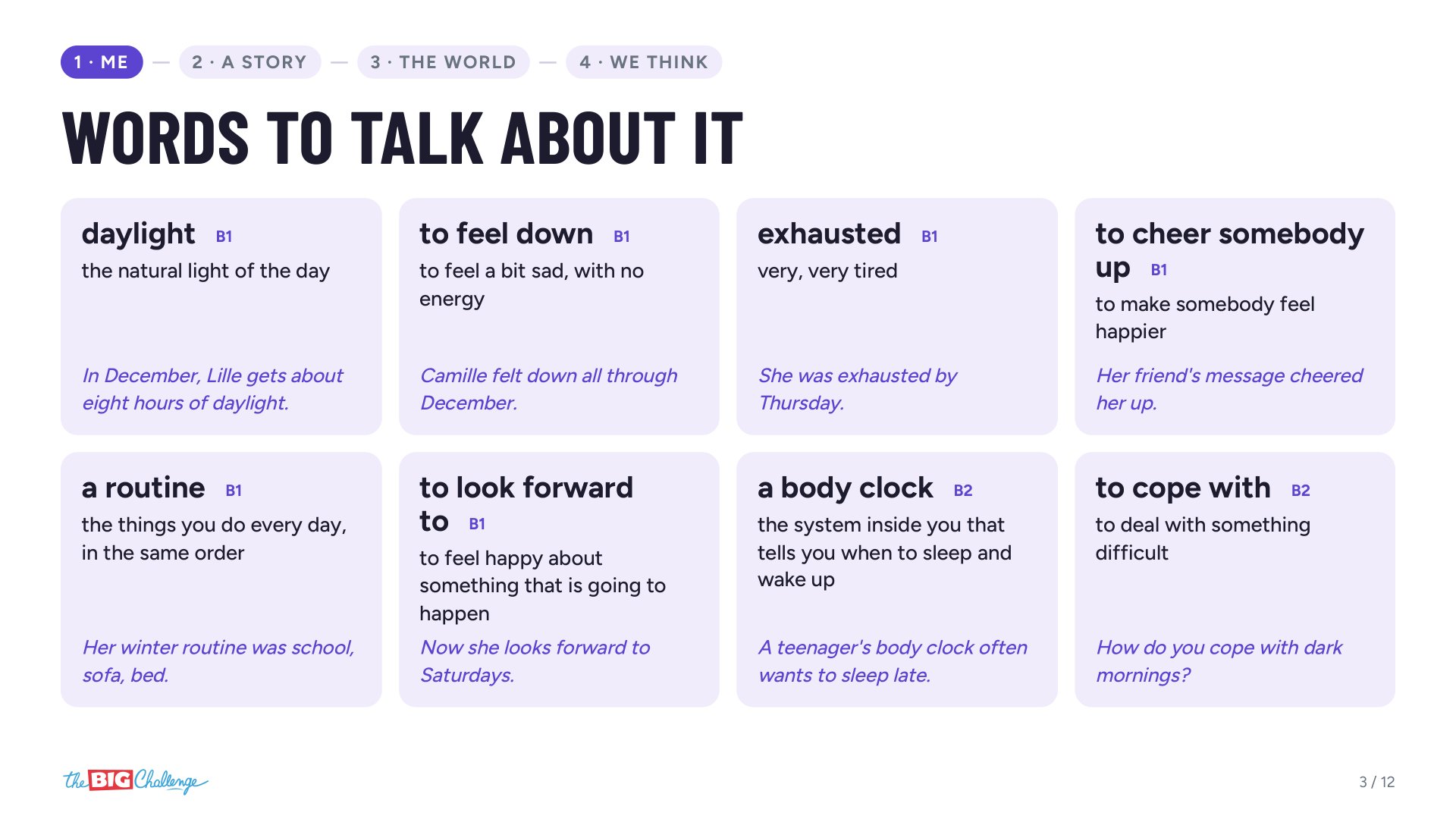
Every slide asks the class to do something: say what they love and hate about winter, learn eight words (daylight, to feel down, exhausted, to cheer somebody up, a routine, to look forward to, and for stronger pupils a body clock and to cope with), choose three feeling words for Camille in December and after climbing, read four facts, say which of four invented voices they agree with, choose three things that help people feel better in winter, fill in three boxes (sleep, school, life after school), stand on a line from 1 to 5 and write a reply to Camille. The words come before the talking, and each question has a B1 version for everyone and a B2 one for stronger pupils. The pupil sheet follows the slides, so every pupil leaves with something written. The language in use is the past simple and "used to" for the story, the present perfect with "since" (Since November, she has stayed ...), the second conditional for imagined choices (If we started at 9:00, I'd ...), "should" for advice, and words for giving reasons (because, so, but, although). The facts come from timeanddate.com, the UK Parliament petitions site, the German Federal Agency for Civic Education (bpb.de) and a study in the journal Sleep (2019), with the sources on the slide. The four voices are invented opinions and are labelled as such. Mood and sleep are personal: the tasks ask about winter and about Camille, never how a pupil feels or sleeps, and the lesson gives no medical advice.
Suggested procedure45 min
- 2 min
Show the cover and read the big question: "Should school start later in winter?" No answers yet.
- 8 min
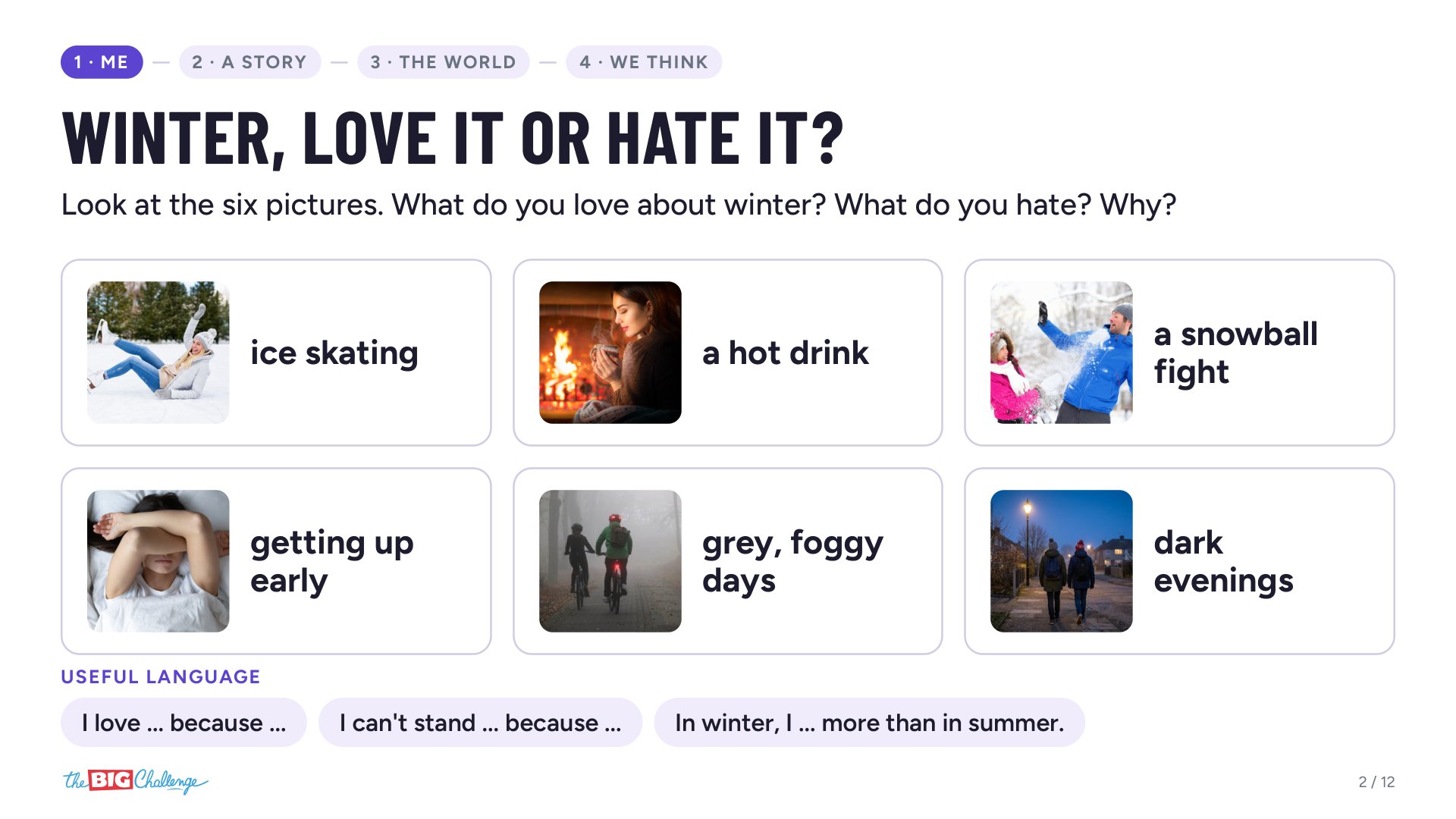
Winter, love it or hate it? Pairs choose one thing they love and one they can't stand, and say why. Then read the eight words and their examples together.
- 8 min
Camille's dark mornings: read the story together and check the four facts (why did Saturday change her mood?), then each pupil chooses three feeling words for December and for Saturday.
- 10 min
Winter mornings in three countries and Four opinions: read the four facts (which one surprises you most? When does your school start?), then the bubbles aloud; pairs choose the voice they agree with most.
- 11 min
What helps in winter?, Sleep, school, life and Where do you stand?: pupils choose three ideas, fill in the three boxes with a partner, then stand on the line from 1 to 5. Come back to the big question.
- 6 min
Dear Camille: pupils write a short reply with one good thing about a later start, one problem and their vote ("If I were you, I'd vote ... because ..."). Two or three read theirs aloud.
Adaptations
- SupportKeep the word slide on screen during the story and the voices, and accept one-sentence answers built on the useful language. Pupils can draw their three things on the sheet instead of writing them.
- ExtensionAsk stronger pairs the B2 question on the voices slide ("What should Camille vote? What would you advise her?"), and have them argue for a place on the line from 1 to 5 that is not their own.