Is it worth it?
- A comparison

 Preview · 3 of 11
Objective & content
Big money, big risk, big effort: when is it worth it? This 45-minute discussion lesson follows one path: the pupils first, then two true stories, then what the class thinks. The first story is Artemis II, when four astronauts flew around the Moon in April 2026. The second is the kākāpō, a flightless New Zealand parrot that fell to 51 birds in 1995 and is now coming back. By the end, pupils can talk about cost, risk and effort, compare the two stories, defend an opinion and pitch a project in 30 seconds.
Documents to download (2)
- Pupil sheet In your teacher account
- Colour version In your teacher account
Pedagogical guide
Every slide asks the class to do something: choose two picture cards, pick three feeling words, compare the Moon and the kākāpō in three boxes, say which of four opinions they agree with, choose three projects for 100 million euros, stand on a line from 1 to 5, pitch a project and vote. The words come before the talking, and each question has an A2 version for everyone and a B1 one for stronger pupils. The four opinions on the voices slide (an engineer, a nurse, a ranger, a pupil) are invented voices, not real people's words. The pupil sheet follows the slides, so every pupil leaves with something written. Money is discussed as a class or a town budget: no question asks what a pupil's family can pay for. The kākāpō is a taonga (a treasure) for Ngāi Tahu, a Māori people who help run the rescue: say it with respect.
Suggested procedure45 min
- 2 min
Show the cover and read the big question: "Big money, big risk, big effort: when is it worth it?" No answers yet: you come back to it at the end.
- 6 min
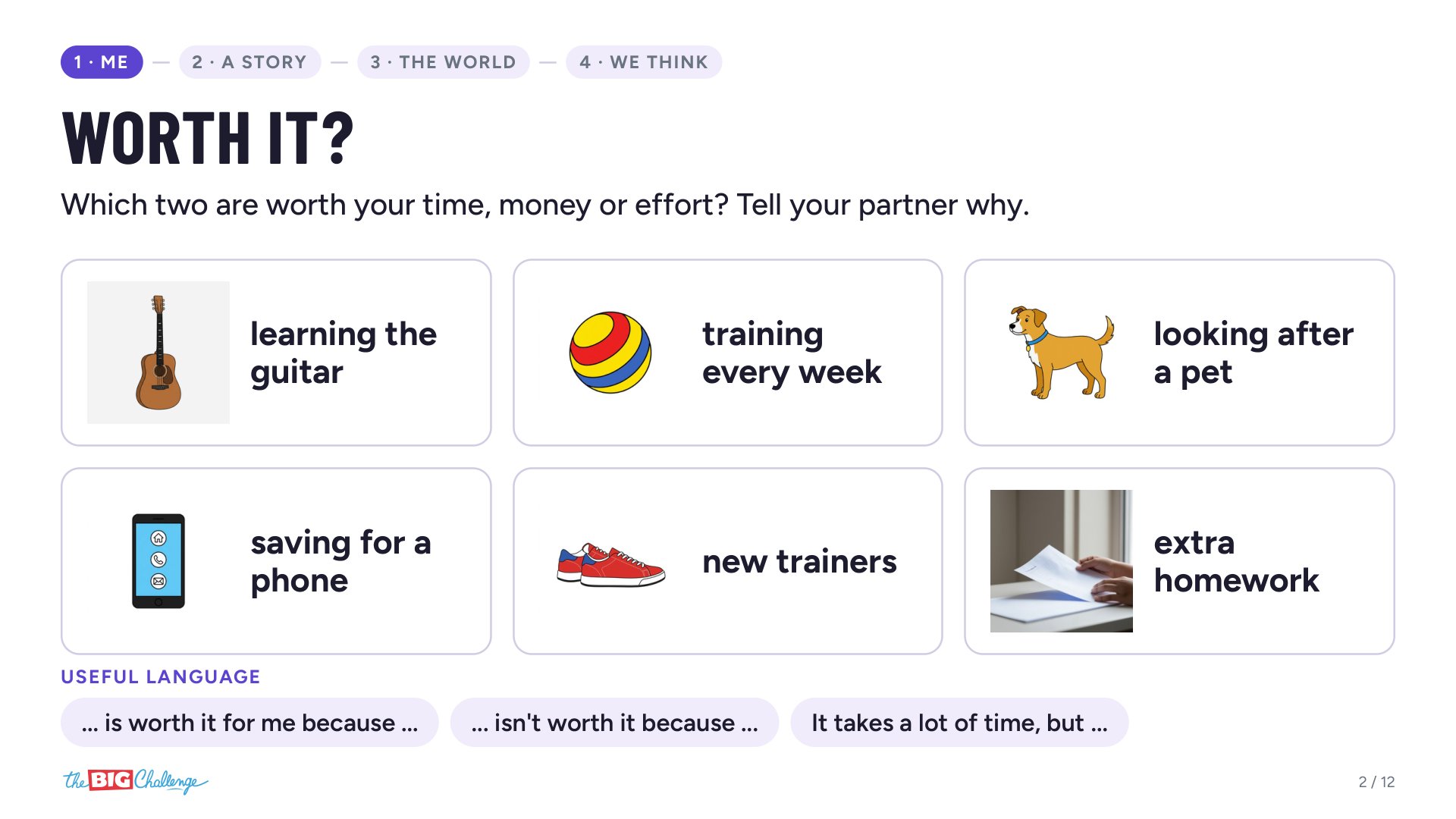
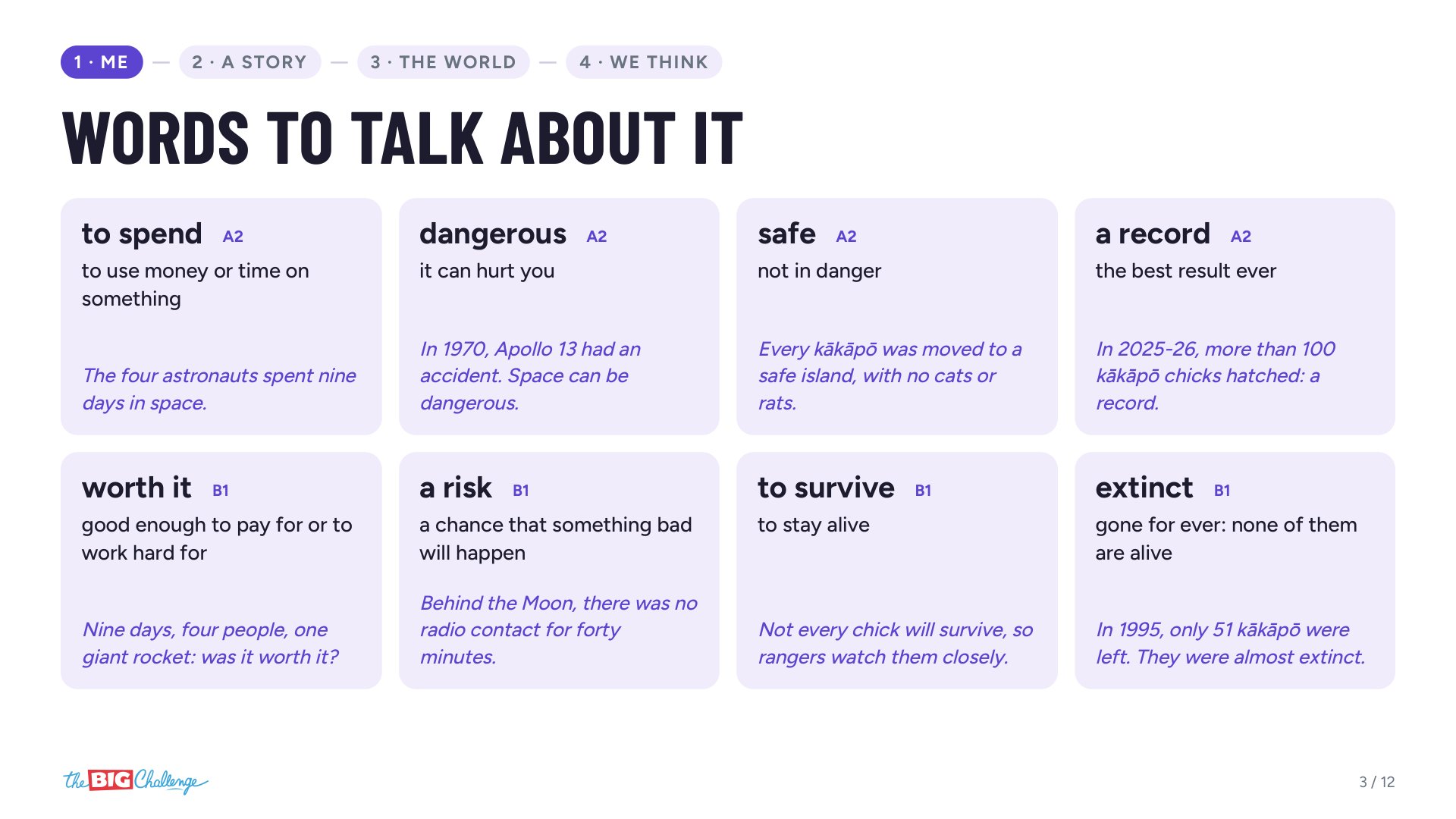
Worth it?: pairs choose two cards each and say why. Then read the eight words and their examples together.
- 8 min
Artemis II and Forty minutes alone: read the three lines and the quote together, then pupils choose three feeling words and compare with a partner.
- 5 min
The kākāpō comeback: read the text and check the four facts.
- 4 min
The Moon and the kākāpō: pairs fill the three boxes on the pupil sheet; collect a few answers for the middle box.
- 5 min
Four opinions: read the bubbles aloud and say clearly that the voices are invented; pairs pick the voice they agree with most.
- 5 min
100 million euros: pupils choose alone, then agree on three projects with a partner.
- 4 min
Where do you stand?: pupils stand on a line from 1 to 5 and explain their place. Return to the big question.
- 6 min
Make your pitch!: groups prepare on the sheet, pitch in 30 seconds, then the class votes (never for its own project).
Adaptations
- SupportKeep the word slide on screen during the voices and the project choice, and accept one-sentence answers built on the useful language. Pupils can point to the picture cards instead of writing.
- ExtensionAsk stronger pupils the B1 question on the voices slide ("Could one of these voices change your mind?"), and have them argue the side they do not hold on the line from 1 to 5.
🔒 Restricted content
This resource requires a subscription to be viewed.
Unlock the resourceIncluded in the subscription