Beauty contests: time to stop?
- A comparison
- A debate
 Preview · 3 of 11
Objective & content
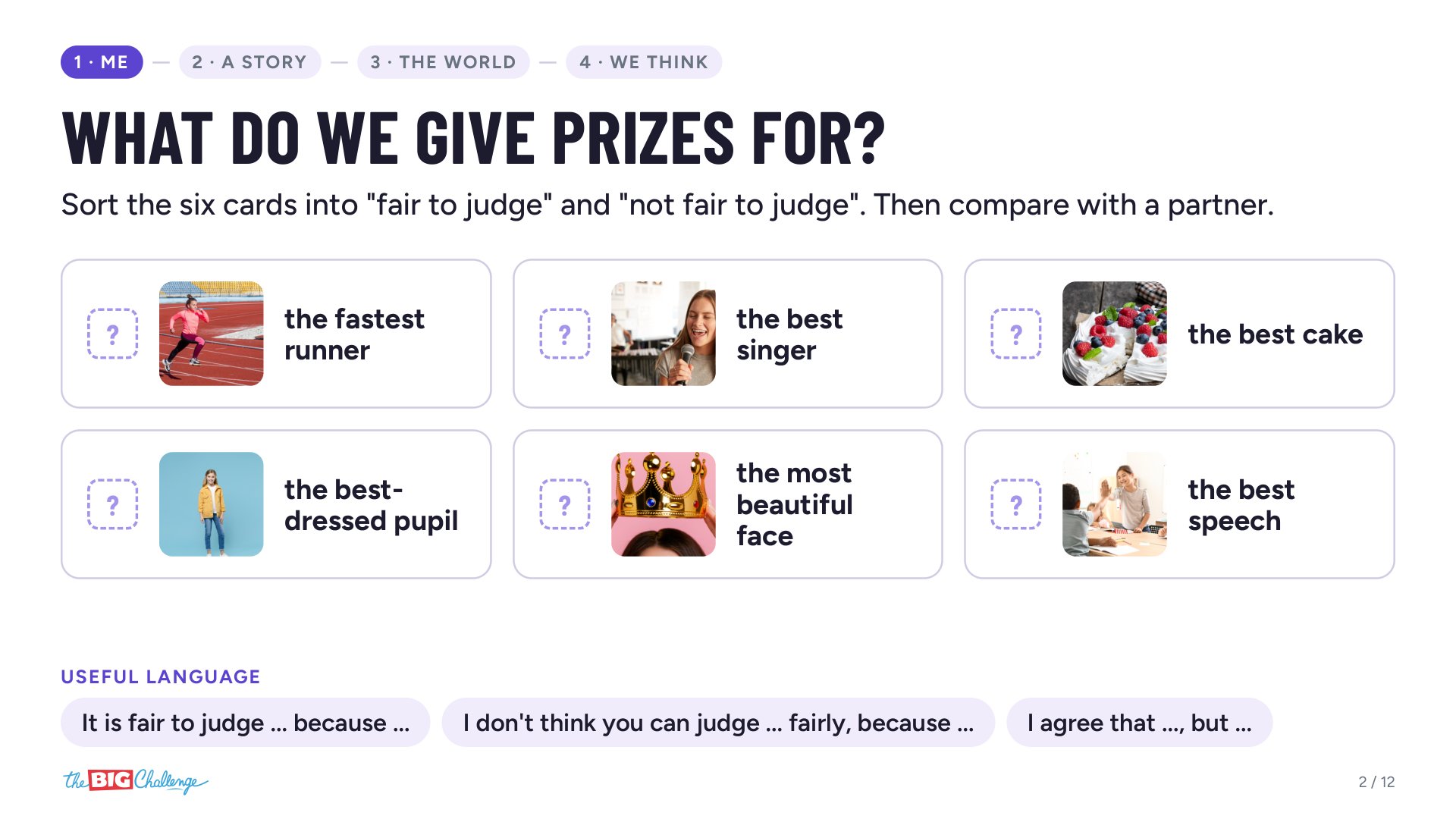
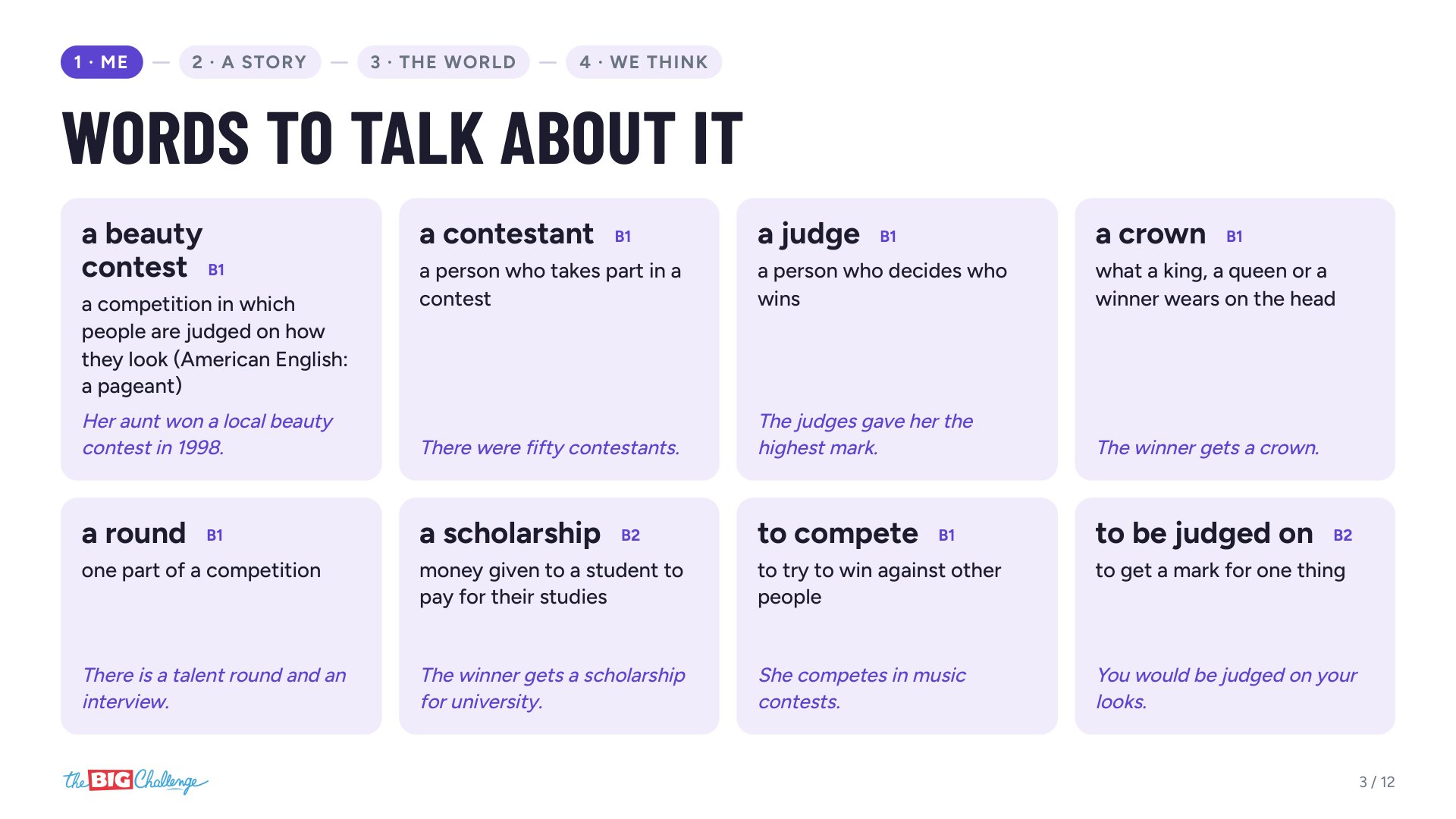
Beauty contests: time to stop? This 55-minute B1+ discussion lesson follows one path: the pupils first, then a story, then the world, then what the class thinks. It starts with what we give prizes for: the fastest runner, the best singer, the best cake, the best-dressed pupil, the most beautiful face, the best speech. The story, written for this lesson, is Leila, 17, from New Jersey, who wants to study medicine, and university is expensive. Her aunt, who won a local contest in 1998, gives her an entry form: the winner gets a scholarship. There is a talent round, an interview and an evening dress round. Her best friend, Sam, says: "You'd be judged on your looks. Don't do it." Then the real facts: Miss America begins in 1921 in Atlantic City to keep tourists in town; in 1968 women protest outside it and the first Miss Black America contest is held the same day; in 1970 protesters interrupt Miss World in London, and Jennifer Hosten of Grenada becomes the first Black Miss World; in 1983 Vanessa Williams becomes the first Black Miss America; in 2018 Miss America drops its swimsuit round. By the end, pupils can agree and disagree, imagine a choice with the second conditional, and defend a side in a debate.
Documents to download (2)
- Pupil sheet In your teacher account
- Discussion lesson (slides) In your teacher account
Pedagogical guide
Every slide asks the class to do something: sort six picture cards into "fair to judge" and "not fair to judge", learn eight words, answer questions on Leila's story, choose a feeling word for Leila, her aunt and Sam, fill in the dates on the sheet, say who they agree with among four invented voices (Leila's aunt, 46; Sam, 17; Grace, 19, a contestant from Texas; Mr Okafor, 52, a teacher), choose three rounds for a contest of their own and explain one with "If we kept ..., people would ...", weigh fairness, freedom and change, stand on a line from 1 to 5 and, last, debate a motion before a class vote: "Beauty contests should stop." The language help gives agreeing and disagreeing, the second conditional, "although" and "whereas". The lesson takes no side: it gives both sides and no verdict, and Leila's choice stays open. It judges the contests, never people: no pupil is ever asked to judge a face or to talk about their own looks, and the card "the most beautiful face" shows a crown, not a person. Leila, her aunt, Sam, Grace and Mr Okafor are invented and labelled as such; the facts are real and sourced on the teacher slide.
Suggested procedure55 min
- 12 min
Cover, "What do we give prizes for?" and the words.
- 10 min
"Leila's form" and "How does everyone feel?".
- 11 min
"A hundred years of Miss America" (pupils fill in the dates) and the four voices.
- 13 min
"Your rules", the three questions to weigh and "Where do you stand?".
- 9 min
The debate, then the vote. Back to the big question.
Adaptations
- SupportKeep the word slide and the help phrases on screen during the debate, and let each side read its arguments from the sheet.
- ExtensionPupils write Leila's message to her aunt, with her decision and one reason, in six to eight sentences.
🔒 Restricted content
This resource requires a subscription to be viewed.
Unlock the resourceIncluded in the subscription