Pitch it!
A teaching resource designed to energise your English lessons.
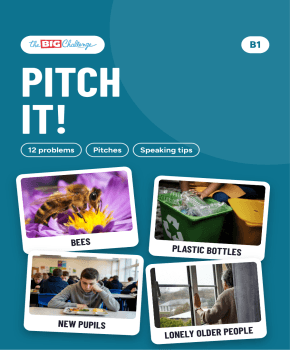
A pitch pack of 12 real problems from school and town life: plastic bottles, food waste in the canteen, lonely older people, not enough exercise, traffic outside school, disappearing bees, clothes in the bin, energy wasted at school, nowhere for teenagers to go, old phones and laptops, teenagers who don't read for fun, and new pupils on their own. Each card is a half page with a photo, the problem, two facts with their source, three idea starters, two questions to think about and three useful words, two cards to a page to cut in half. Each pair invents a solution and pitches it in two minutes, like on a TV show for inventors. A speaking tips page gives a four-part pitch and phrases to persuade, and a class grid lets everyone score the ideas and vote. 9 pages with a teacher page.
Documents to download (1)
- Fact files, speaking tips, listening grid In your teacher account
Teaching guide
Objective & content
A pitch pack for B1 classes: twelve real problems from school and town life (plastic bottles, food waste in the canteen, lonely older people, not enough exercise, traffic outside school, disappearing bees, clothes in the bin, energy wasted at school, nowhere for teenagers to go, old phones and laptops, teenagers who don't read for fun, new pupils on their own). Every card has the same parts: the problem, two facts with their source, three idea starters to pick, mix or replace with their own, two questions to think about and three useful words, with a photo. Two cards share a page: print 6 pages and cut them in half. Each pair invents a solution and pitches it to the class. By the end, pupils can present an idea persuasively, explain how it works, support it with a fact and answer a question they did not expect.
Pedagogical guide
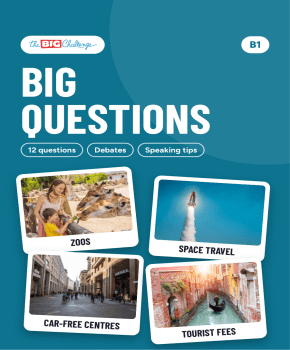
Pupils persuade rather than take a side, so this pack works well after Big questions. Each card gives a real problem with real, sourced facts (UN agencies, charities, official surveys), and every pitch must start from one of them. Three short idea starters on each card help pupils who don't know where to begin; stronger pupils mix them or invent their own. The language is the first conditional (If we do this, fewer pupils will ...), should, could and would (It would help ...), purpose (so that, to + verb), the passive in the facts (are thrown away, was recycled), sequencing (first, then) and persuading (Imagine a school where ..., So please vote for us!). The speaking tips page gives a four-part pitch (the problem / your idea / how it works / why it will work), useful phrases, three ways to answer a question you didn't expect and four tips. The class grid asks for each idea, whether it will work and a score out of 5.
Suggested procedure
One or two lessons of about 50 minutes.
- (5 min) Read one problem to the class and ask for quick ideas. Cut the card pages in half and give each pair one problem.
- (15 min) Pairs invent a solution, give it a name and prepare a two-minute pitch with the speaking tips page.
- (25 min) Pairs pitch their ideas. After each pitch, the class asks one question. The class fills the grid with the idea, whether it will work and a score.
- (5 min) Pupils answer "Which idea would you choose for your school or town? Why?" with "I'd choose ... because ..." and the class votes.
Adaptations
[S] Pairs use the useful words and the four-part frame from the tips page, and pitch for one minute.
[A] Pairs add a cost and a plan for the first month, or the winning idea becomes a real class project with a letter to the head teacher.
Materials & prerequisites
Print factfiles.pdf: the 6 card pages (pages 1 to 6, two cards a page, cut in half along the dashed line) so each pair has one problem, the speaking tips page (page 7) and the class grid (page 8) for everyone; page 9 is the teacher page. Pupils should know the first conditional and should / could / would. It goes well with work on the environment, the local community or school life, and with the B1 Big questions.
Possible adaptations
- Lower levels: Offer segmented listening and additional visual aids.
- Advanced levels: Encourage an oral summary and a debate in English on the theme.
- Large groups: Organise group work with differentiated roles.
🔒 Restricted content
This resource requires a subscription to be viewed.
Unlock the resourceIncluded in the subscription