April Fool's Day
Interactive exercises to consolidate your students’ learning.
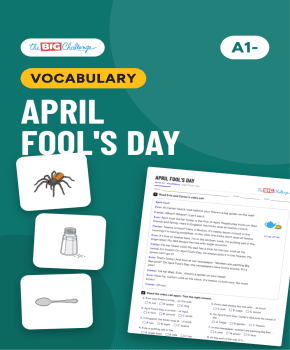
April Fool's Day, the first of April, through a video call between two friends: Evie in England, where tricks stop at midday, tells Carter in Boston, USA, where they go on all day, about the salt she put in the sugar bowl for her dad's tea, the clocks her brother changed so that Mum got up an hour early and a funny untrue story in the newspaper about workers who painted Big Ben pink, while Carter shows her the cereal his dad put in the freezer last night. Pupils answer eight questions, name six pictures, match ten words with their meanings, complete seven sentences and unscramble five April Fool's words, then circle the right word in each of the ten brackets of Evie's message; answer key included.
Documents to download (2)
- Colour version In your teacher account
- Black and white version In your teacher account
Teaching guide
Objective & content
On April Fool's Day, Evie in England and Carter in Boston, in the USA, talk on a video call. Evie starts with a trick: "Quick, look behind you! There's a huge spider on the wall!", then "April fool!". It is the first of April: in England, people play tricks on their friends and family only in the morning, and after midday you can't play tricks any more; in the USA, people play tricks all day. It is half past twelve in England and only half past seven in the morning in Boston, and Carter's dad already played a trick on him: he put Carter's bowl of cereal in the freezer last night, so now the cereal is frozen and the spoon can't go in. Evie played her tricks at breakfast: she put salt in the sugar bowl, and Dad put two spoons of it in his tea; her brother changed all the clocks, so Mum got up an hour early. On April Fool's Day, the newspapers and the TV news often have a funny story that isn't true: today, a newspaper says that last night, workers painted Big Ben pink. At the end, Carter says there's a spider on Evie's head, but it is after twelve o'clock, and after midday the person who plays a trick is the fool: Carter is the April fool. A picture of a cup of tea sits beside the dialogue. Pupils answer eight multiple-choice questions, name six pictures from a box of eight words, match ten words with their meanings, complete seven sentences from a box of nine words and unscramble five April Fool's words. The sheet ends on Evie's message to Carter after the call, where pupils circle the right word in each of ten brackets.
Pedagogical guide
The two friends compare one day in two countries: tricks only in the morning in England, tricks all day in the USA, and a time difference that puts Evie at lunchtime and Carter at breakfast. The words of the sheet (trick, fool, midday, huge, get up, early, frozen, true) come from that comparison, and the call moves between what happened this morning and last night and what is happening now, so pupils read for facts and for words. The vocabulary comes out of the call, never from a list: pupils then name it, match it with meanings and use it in new sentences that are not about April Fool's Day (a frozen lake in winter, the news on TV every evening). The last task puts the words in a different text, Evie's message after the call, where Mum's own trick comes too late: each bracket offers three words, and only one fits the meaning of the sentence. Every task tests words, never grammar. The day is told the way most people live it: small, kind tricks in the family, "April fool!" and a funny story in the newspaper that isn't true.
Suggested procedure
- (5 min) Ask pupils what people do on 1 April in their country; write the words on the board.
- (10 min) Two pupils read the video call aloud; the class answers the eight questions.
- (10 min) Pupils name the six pictures and match the ten words with their meanings.
- (10 min) Pupils complete the seven sentences and unscramble the five April Fool's words.
- (10 min) Pupils read Evie's message and circle the right word in each bracket.
- (5 min) Check with the answer key on page 4.
Adaptations
[S] Ask pupils what people do on 1 April in their country.
[A] Pupils act out the video call in pairs. To take it further, pupils tell the class about a funny trick, a real one or an invented one; it must be funny for everybody.
Materials & prerequisites
One copy of the three pupil pages per pupil, in colour or in black and white. Page 4 is the answer key with teacher notes: keep it. Pupils should be able to read short sentences in the past and with going to (my brother changed all the clocks, I'm going to swim), and tell the time (half past seven).
Possible adaptations
- Lower levels: Offer segmented listening and additional visual aids.
- Advanced levels: Encourage an oral summary and a debate in English on the theme.
- Large groups: Organise group work with differentiated roles.
🔒 Restricted content
This resource requires a subscription to be viewed.
Unlock the resourceIncluded in the subscription