St Patrick's Day
Interactive exercises to consolidate your students’ learning.
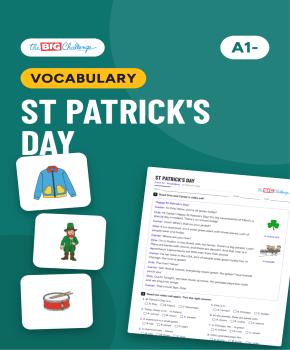
St Patrick's Day, Ireland's national day on the seventeenth of March, through a video call between two friends: Orla in Dublin is going to the big parade with its bands, Irish dancers and people dressed as leprechauns, while Carter tells her that millions of Americans have Irish families, that Chicago makes its river green every year and that at his school children who forget to wear green get a little pinch. Pupils answer eight questions, name six pictures, match ten words with their meanings, complete seven sentences and unscramble five St Patrick's words, then circle the right word in each bracket of Orla's message; answer key included.
Documents to download (2)
- Colour version In your teacher account
- Black and white version In your teacher account
Teaching guide
Objective & content
On St Patrick's Day, Orla in Dublin tells Carter in the USA about the seventeenth of March, Ireland's national day: St Patrick lived in Ireland a long time ago, there is no school, and Orla is going to the big parade with her family. On her jacket she has a shamrock, a small green plant with three leaves and a symbol of Ireland. At the parade there are bands with drums, Irish dancers and people in big costumes, some dressed as leprechauns, the little men from old Irish stories; last year, Orla danced in the parade with her dance class. Carter says that millions of Americans have Irish families: in Chicago, they make the river green every year, and at his school, children who forget to wear green get a little pinch from their friends. Tonight, Orla's grandad is going to play the violin at home. Two pictures sit beside the dialogue, a shamrock and a parade. Pupils answer eight multiple-choice questions, name six pictures from a box of eight words, match ten words with their meanings, complete seven sentences from a box of nine words and unscramble five St Patrick's words. The sheet ends on Orla's message to Carter after the parade, where pupils circle the right word in each of ten brackets.
Pedagogical guide
The two friends compare one day in two countries: a national day with a parade in Dublin, a green river and green clothes at school in the USA. The words of the sheet (national day, symbol, costume, celebrate, practise, forget) come from that comparison, and the call moves between what happened last year, what is happening today and what is going to happen tonight, so pupils read for facts and for words. The vocabulary comes out of the call, never from a list: pupils then name it, match it with meanings and use it in new sentences that are not about St Patrick's Day (a sports bag to remember, a witch costume for Halloween). The last task puts the words in a different text, Orla's message after the parade: each bracket offers three words, and only one fits the meaning of the sentence. Every task tests words, never grammar. The day is told the way most people live it: green clothes, a shamrock, the parade and music at home.
Suggested procedure
- (5 min) Ask what pupils know about Ireland and what colour they think of; write the words on the board.
- (10 min) Two pupils read the video call aloud; the class answers the eight questions.
- (10 min) Pupils name the six pictures and match the ten words with their meanings.
- (10 min) Pupils complete the seven sentences and unscramble the five St Patrick's words.
- (10 min) Pupils read Orla's message and circle the right word in each bracket.
- (5 min) Check with the answer key on page 4.
Adaptations
[S] Ask what pupils know about Ireland and what colour they think of.
[A] Pupils act out the video call in pairs. To take it further, pupils say in five sentences what people do on the national day of their own country.
Materials & prerequisites
One copy of the three pupil pages per pupil, in colour or in black and white. Page 4 is the answer key with teacher notes: keep it. Pupils should be able to read short sentences in the past and with going to (I danced in the parade, my grandad is going to play the violin).
Possible adaptations
- Lower levels: Offer segmented listening and additional visual aids.
- Advanced levels: Encourage an oral summary and a debate in English on the theme.
- Large groups: Organise group work with differentiated roles.
🔒 Restricted content
This resource requires a subscription to be viewed.
Unlock the resourceIncluded in the subscription