The possessive 's: whose is it?
Interactive exercises to consolidate your students’ learning.
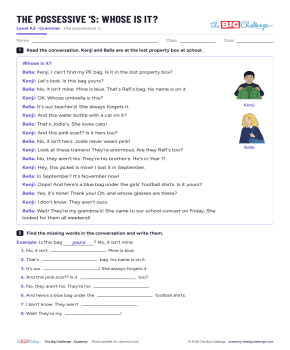
The possessive 's (Rafi's bag, the girls' shirts), Whose...? and mine, yours, his, hers, ours and theirs, seen through a conversation between Kenji and Bella at the lost property box at school. Pupils find the missing words, read the rule, choose the right word, write the owner with 's or an apostrophe, change my book into mine and solve a lost property puzzle; answer key included.
Documents to download (2)
- Colour version In your teacher account
- Black and white version In your teacher account
Teaching guide
Objective & content
This grammar sheet teaches how to say who things belong to: 's for one person (Rafi's bag), an apostrophe after a plural in -s (the girls' football shirts), the question Whose... ? and the possessive pronouns mine, yours, his, hers, ours and theirs. Pupils read a conversation between Kenji and Bella at the lost property box at school, find the missing words and read the rule, given in a box. By the end, they can ask and say whose things are.
Pedagogical guide
Page 1 is the conversation, with a picture of Kenji and of Bella: the umbrella is their teacher's, the enormous trainers are Rafi's brother's, Kenji finds the jacket he lost in September, and the glasses are Bella's grandma's. Pupils find eight missing words in sentences from the conversation. Page 2 has the rule, given in a box in short lines ('s for one person, an apostrophe after a plural in -s, Whose... ?, my and mine, no noun after mine, and no apostrophe in yours or hers), six sentences where pupils tick the right word, six sentences where they write the owner with 's or an apostrophe, and eight sentences to change, such as It's my book into It's mine. Page 3 is a lost property puzzle: four friends lost four things (an umbrella, a cap, a scarf, headphones, shown in pictures). Pupils use three clues to fill a grid, write whose each thing is with 's, then tick the word each speaker uses (mine, yours, his, hers, ours). Every exercise opens with a worked example.
Suggested procedure
- (5 min) Pick up a few things in the classroom and ask "Whose pen is this? Is it yours?"
- (10 min) Read the conversation aloud; pupils find the missing words.
- (5 min) Read the rule in the box with the class; pupils find examples of it in the text.
- (10 min) Page 2: tick the right word, write the owner, then change the sentences.
- (10 min) The lost property puzzle: pupils fill the grid in pairs, then write and tick the answers.
- (5 min) Check with the answer key on page 4.
Adaptations
[S] Pupils read the conversation aloud in pairs, one as Kenji and one as Bella, before the tasks.
[A] Pupils write four sentences about things that belong to people in their family, with 's and mine, his or hers.
Materials & prerequisites
One copy of pages 1 to 3 per pupil. Page 4 is the answer key and teacher notes: keep it. Pupils need the possessive adjectives (my, your, his, her, our, their), regular plurals and the words for clothes and school things. To take it further, pupils write a lost property puzzle with four classmates.
Possible adaptations
- Lower levels: Offer segmented listening and additional visual aids.
- Advanced levels: Encourage an oral summary and a debate in English on the theme.
- Large groups: Organise group work with differentiated roles.
🔒 Restricted content
This resource requires a subscription to be viewed.
Unlock the resourceIncluded in the subscription