The body and health
Interactive exercises to consolidate your students’ learning.
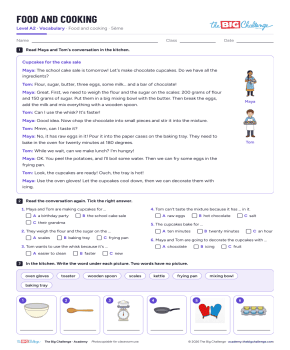
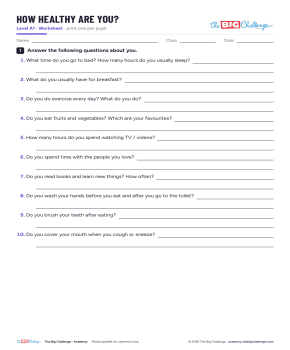
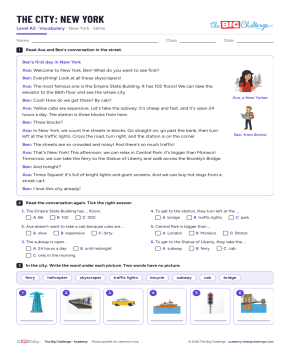
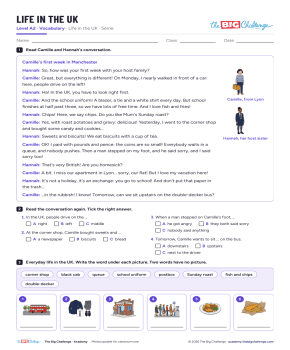
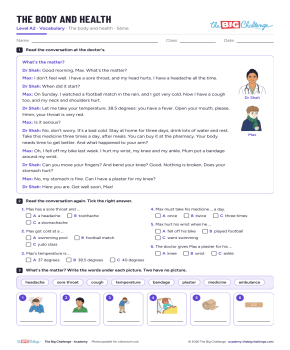
Max visits Dr Shah with a bad cold and a sore wrist from a bike fall: the conversation carries the words of the body, being ill and getting better. Pupils answer questions, name problems from pictures, label a body, match meanings, complete sentences, make words with -ache and finish a parent's email to the teacher; answer key included.
Documents to download (2)
- Colour version In your teacher account
- Black and white version In your teacher account
Teaching guide
Objective & content
This sheet on the body and health starts from a visit to the doctor's: Max has a bad cold after a football match in the rain, and a sore wrist, knee and ankle after a fall off his bike. Dr Shah examines him and tells him how to get better. The conversation carries the target words, from sore throat, cough and fever to medicine, bandage and plaster. Pupils learn to say what is wrong ("I have a sore throat", "My knee hurts") and to understand simple advice. They answer six multiple-choice questions, name six health problems and treatments from a box of eight words, label eight parts of the body on a picture, match eight words with their meanings, complete seven sentences and make four words with -ache. The sheet ends on an email from Max's mum to his teacher, with nine words to choose.
Pedagogical guide
Pupils meet every word in the conversation before they practise it, then move from recognising the words to using them. Nothing is frightening: a bad cold and a sprained wrist, and nothing is broken. Every task tests words only: no answer depends on a tense. In the picture task, the body picture and the gap-fill, two words in each box are extra, so pupils cannot finish by elimination. The word-form task asks for one kind of word, nouns with -ache, and opens with a worked example (headache). The email is the hardest task: in each bracket, pupils choose one word out of three, and only one fits the meaning of the sentence.
Suggested procedure
- (5 min) Mime a problem (a headache, a cough); the class says what's the matter. Write the words on the board.
- (10 min) Two pupils read the conversation aloud; the class answers the six questions and names the six pictures.
- (10 min) Pupils label the body picture, then match the eight words with their meanings.
- (10 min) Pupils complete the sentences, then read the worked example together and make the words with -ache.
- (10 min) Pupils read the email from Max's mum and circle the right word in each bracket.
- (5 min) Check with the answer key on page 4.
Adaptations
[S] A pupil mimes a problem; the class says what's the matter.
[A] In pairs, pupils act out a visit to the doctor's, one patient and one doctor. To take it further, they write a note to explain why they missed a PE lesson.
Materials & prerequisites
One copy of the three pupil pages per pupil, in colour or in black and white. Page 4 is the answer key: keep it. Pupils should know the present simple, the past simple of common verbs, the imperative and can.
Possible adaptations
- Lower levels: Offer segmented listening and additional visual aids.
- Advanced levels: Encourage an oral summary and a debate in English on the theme.
- Large groups: Organise group work with differentiated roles.
🔒 Restricted content
This resource requires a subscription to be viewed.
Unlock the resourceIncluded in the subscription