What's the matter?
Interactive exercises to consolidate your students’ learning.
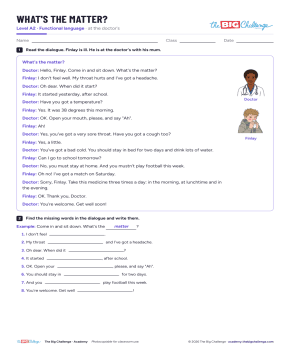
Saying what is wrong at the doctor's, saying when it started and understanding the doctor's advice, seen through Finlay's visit with a bad cold. Pupils find the missing words in the dialogue, read the useful phrases, match situations to phrases, choose the best reply, put a dialogue in order, complete another one and act out a role-play in pairs, a patient with symptom cards and a doctor with an advice table; answer key included.
Documents to download (2)
- Colour version In your teacher account
- Black and white version In your teacher account
Teaching guide
Objective & content
This functional language sheet teaches pupils to say what is wrong at the doctor's (I don't feel well. I've got a headache / a sore throat / a cough. I've got earache. My leg hurts.), say when it started (It started yesterday.), understand the doctor's advice (You should stay in bed. Take this medicine three times a day. You mustn't go swimming.) and say Get well soon! Pupils read a dialogue in which Finlay sees the doctor, find the missing words and read the useful phrases, given in a box. By the end, they can explain a health problem, answer the doctor's questions and understand simple advice.
Pedagogical guide
Page 1 is the dialogue, with a picture of the doctor and of Finlay, who is at the doctor's with his mum: his throat hurts, he has got a headache, a cough and a temperature (38 degrees this morning), and it started yesterday after school. The doctor says he has a bad cold: two days in bed, lots of water, the medicine three times a day, no school tomorrow and no football this week, so no match on Saturday. Pupils find eight missing words in lines from the dialogue. Page 2 has the useful phrases in a box, with the key words in bold, five situations to match to a phrase (a temperature, a cough, a bad leg after a bike fall, the doctor's question, a card for an ill friend) and six lines with three replies each, where pupils tick the best one. Page 3 has a dialogue in which Dara has stomach ache after too much ice cream, to number from 1 to 8, and a dialogue about earache to complete with six words in a box. The last task is a role-play: pupils cut out cards A and B. A is the patient, with three symptom cards (a headache, a cough, earache, and when each one started); B is the doctor, who asks questions and gives the advice in the table on card B (You should ... / You mustn't ... for five problems). Then they swap the cards. Every exercise opens with a worked example.
Suggested procedure
- (5 min) Mime a headache and say "I don't feel well. I've got a headache."; pupils mime another problem and say "I've got ..."
- (10 min) Read the dialogue aloud; pupils find the missing words.
- (5 min) Read the useful phrases in the box with the class; pupils find them in the dialogue.
- (10 min) Page 2: pupils match the situations to the phrases, then tick the best replies.
- (10 min) Page 3: pupils number the lines of Dara's dialogue, then complete the second dialogue.
- (10 min) Role-play: the patient uses one symptom card for each visit, the doctor asks and gives advice from the table, then they swap.
- (5 min) Check with the answer key on page 4.
Adaptations
[S] Pupils read the dialogue aloud in pairs, one as the doctor and one as Finlay, before the tasks.
[A] Pupils write a "Get well soon!" card for a friend with two pieces of advice.
Materials & prerequisites
One copy of pages 1 to 3 per pupil, and scissors for the role-play cards. Page 4 is the answer key and teacher notes: keep it. The role-play is free speaking: the doctor's advice is on card B. Pupils need the parts of the body, have got, and the past simple of a few verbs (it started, it was). To take it further, pupils draw a person and label what hurts, and the class guesses the problem.
Possible adaptations
- Lower levels: Offer segmented listening and additional visual aids.
- Advanced levels: Encourage an oral summary and a debate in English on the theme.
- Large groups: Organise group work with differentiated roles.
🔒 Restricted content
This resource requires a subscription to be viewed.
Unlock the resourceIncluded in the subscription