Chain reaction
A teaching resource designed to energise your English lessons.
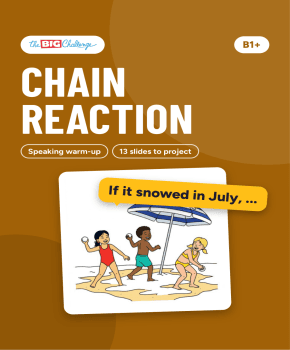
A projectable B1+ speaking warm-up: 12 imaginary situations, such as If dogs could talk ... or If I woke up invisible ..., each with a picture. Each pupil turns the last ending into a new if sentence, and the chain goes round the class.
Documents to download (1)
- Slide bank In your teacher account
Teaching guide
Objective & content
By the end, B1+ pupils can build and link imaginary situations with if + past simple and would: If there were no school tomorrow, I'd stay in bed. If I stayed in bed, I'd miss breakfast. The bank is 13 projectable slides: a how-to slide, then 12 starting lines (If dogs could talk..., If I could fly..., If it snowed in July..., If I woke up invisible...), each with a picture and the phrases to keep the chain going.
Pedagogical guide
Use it as a five-minute warm-up that drills the structure without feeling like a drill. Each pupil must turn the last ending into a new if sentence (I'd stay in bed becomes If I stayed in bed, ...), so everyone uses both halves of the structure and has to listen to the person before them. The starting lines are imaginary and a little silly, so chains quickly become funny, which keeps the class listening. The slides are interchangeable: one chain per lesson.
Suggested procedure
- (1 min) Show the how-to slide and read the example together.
- (3 min) Show one starting line. The first pupil finishes it, the next pupil starts with that ending, and the chain goes round the class.
- (1 min) Stop when the chain breaks or comes back to the start. Which link was the funniest?
Adaptations
- [S] Pupils work in pairs and take turns, with the starters as help, and count how many links they make in two minutes.
- [A] Each new link must be the opposite of the last one (a good thing, then a bad thing), or pupils write their own chain of five sentences.
Materials & prerequisites
A projector or screen; the bank is a 16:9 PDF, one slide per page, with no printing needed. Assumes the past simple of common verbs and would.
Possible adaptations
- Lower levels: Offer segmented listening and additional visual aids.
- Advanced levels: Encourage an oral summary and a debate in English on the theme.
- Large groups: Organise group work with differentiated roles.
🔒 Restricted content
This resource requires a subscription to be viewed.
Unlock the resourceIncluded in the subscription