What would you do if...?
A teaching resource designed to energise your English lessons.
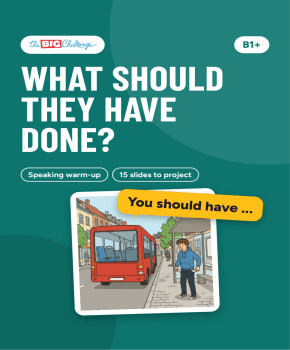
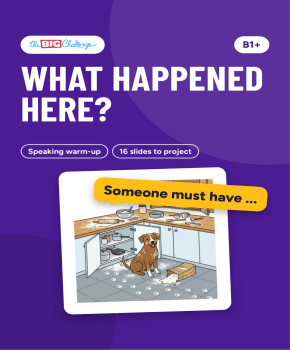
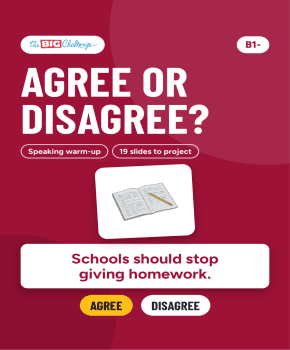
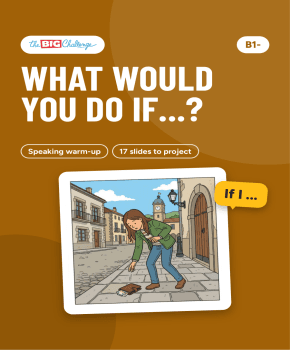
A projectable B1- speaking warm-up: 16 everyday dilemmas for teenagers, such as finding a wallet in the street or a friend who wants to copy your homework. Pupils say what they would do and why, with the second conditional.
Documents to download (1)
- Slide bank In your teacher account
Teaching guide
Objective & content
By the end, B1- pupils can say what they would do in a tricky situation and give a reason, with the second conditional: If I found a wallet, I would take it to the police. The bank is 17 projectable slides: a how-to slide, then 16 everyday dilemmas for teenagers (a wallet in the street, too much change in a shop, a friend who wants to copy your homework), each with a picture and five sentence starters.
Pedagogical guide
Use it as a five-minute warm-up that gets the whole class talking. Every dilemma has more than one honest answer, so pupils disagree, and disagreeing is what makes them explain: I wouldn't, because .... The starters on every slide keep the grammar in front of them, so the effort goes into the reason, not the verb form. The slides are interchangeable: show one or two per lesson.
Suggested procedure
- (1 min) Show the how-to slide and read the example together.
- (2 min) Show one dilemma and read it together. Pupils think alone, then talk in pairs.
- (2 min) Some pairs tell the class. Who would do the same? Hands up.
Adaptations
- [S] Give two choices (keep it or give it back) and pupils choose one and say why.
- [A] Change the situation (What would you do if it was your best friend?) or pupils invent a new dilemma for the class.
Materials & prerequisites
A projector or screen; the bank is a 16:9 PDF, one slide per page, with no printing needed. Assumes the past simple and would + verb.
Possible adaptations
- Lower levels: Offer segmented listening and additional visual aids.
- Advanced levels: Encourage an oral summary and a debate in English on the theme.
- Large groups: Organise group work with differentiated roles.
🔒 Restricted content
This resource requires a subscription to be viewed.
Unlock the resourceIncluded in the subscription