Can you repeat that, please?
Interactive exercises to consolidate your students’ learning.
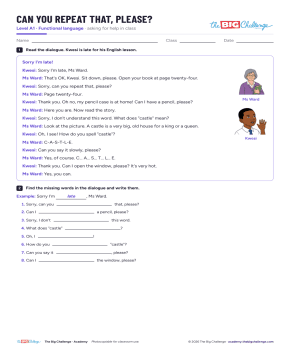
Asking for help in English in class, through a dialogue in which Kwesi, late for his English lesson, asks his teacher to repeat, to explain a word and to spell it. Pupils find the missing words, read the useful phrases, match situations to phrases, tick the best replies, put a dialogue in order, complete sentences and act out a role-play in pairs; answer key included.
Documents to download (2)
- Colour version In your teacher account
- Black and white version In your teacher account
Teaching guide
Objective & content
This functional language sheet teaches pupils to ask for help in English in class: to ask the teacher to repeat or to speak slowly (Can you repeat that, please? Can you say it slowly, please?), to ask what a word means and how to spell it (What does "castle" mean? How do you spell "castle"?), to say they don't understand, to ask for things and ask permission (Can I have a pencil, please? Can I open the window, please?) and to say sorry when they are late. Pupils read a dialogue in which Kwesi is late for his English lesson and asks his teacher, Ms Ward, for help, then find the missing words. By the end, they can use these phrases in their own English lessons.
Pedagogical guide
Page 1 is the dialogue, with a picture of Ms Ward and of Kwesi: his pencil case is at home, he doesn't know the word castle, and Ms Ward explains it and spells it for him, slowly. Pupils find eight missing words in lines from the dialogue. Page 2 has the useful phrases, given in a box (with the answers Yes, you can., Yes, of course. and Sorry, you can't.), five situations to match to a phrase and six lines to answer by ticking the best reply out of three. Page 3 has a second dialogue, between Sana and her teacher, with eight lines to number in order, and six things a pupil says to complete with the words in the box. The last task is a role-play: pupils cut out the cards and act out a role-play in pairs, A as a pupil who is late and B as the teacher, then they swap. Every exercise opens with a worked example. The answer key is included; the role-play is free speaking, so any answer that uses the phrases and fits the card is right. The sheet uses can, the imperative and the present simple (What does ... mean?, I don't understand).
Suggested procedure
- (5 min) Say a sentence very fast, then ask the class what they can say. Write Can you repeat that, please? and Can you say it slowly, please? on the board.
- (10 min) Read the dialogue aloud; pupils find the missing words.
- (5 min) Page 2: read the useful phrases in the box with the class; pupils find them in the dialogue.
- (10 min) Pupils match the situations to the phrases, then tick the best replies.
- (10 min) Page 3: pupils number the lines of Sana's dialogue, then complete the sentences with the words in the box.
- (10 min) Role-play in pairs: A is the pupil, B is the teacher, then they swap.
- (5 min) Check with the answer key on page 4.
Adaptations
[S] Pupils read the dialogue aloud in pairs, one as Kwesi and one as Ms Ward, before the tasks.
[A] Pupils make a poster of five classroom phrases for the wall.
Materials & prerequisites
One copy of pages 1 to 3 per pupil, and scissors for the role-play cards. Page 4 is the answer key and teacher notes: keep it. Pupils need can, the alphabet (to spell words) and the words for the classroom and school things (pencil, ruler, book, page, window). To take it further, for a week pupils use only English to ask for help in class, and the class counts the phrases.
Possible adaptations
- Lower levels: Offer segmented listening and additional visual aids.
- Advanced levels: Encourage an oral summary and a debate in English on the theme.
- Large groups: Organise group work with differentiated roles.
🔒 Restricted content
This resource requires a subscription to be viewed.
Unlock the resourceIncluded in the subscription