Comparatives and superlatives
Interactive exercises to consolidate your students’ learning.
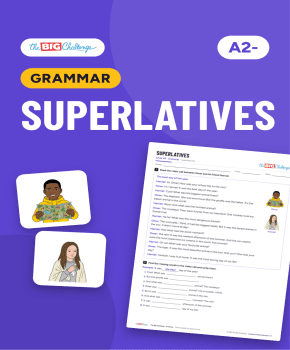
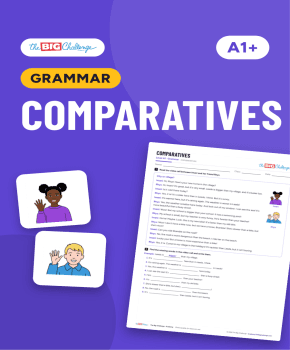
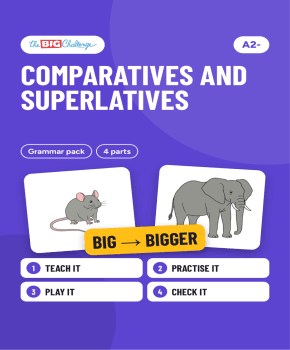
Everything to teach comparatives and superlatives: slides to project, a three-level practice sheet, a team game and a 10-minute quiz with answers. Ruby's trip to the pet shop starts the lesson; pupils then learn -er and more with than, the -est and the most, spelling, good, bad and far, and as ... as. For A1+ to A2+, two lessons of about 45 minutes.
Documents to download (4)
- Teach it: lesson slides In your teacher account
- Play it: team game In your teacher account
- Check it: quiz and key In your teacher account
- Colour version In your teacher account
Teaching guide
Objective & content
Everything to teach comparatives and superlatives in one pack of four parts: slides to project, a three-level practice sheet, a team game and a 10-minute quiz with answers. The pack starts from a short story, Ruby's trip to the pet shop ("Which pet is the best?"), in which pupils notice the forms before they meet the rule. It then covers short adjectives with -er and than, long adjectives with more, the spelling of nicer, easier and bigger, superlatives with the -est and the most, and the irregular good, bad and far. As ... as is a short extension on the last practice page. By the end, pupils can compare two things, name the top of a group and spell the forms correctly.
Pedagogical guide
The rule is given in Remember! boxes, not left to be deduced; the story and a picture ladder (small, bigger, the biggest) make the forms easy to notice first. The practice sheet is one A4 sheet at three levels: every page has a Bronze, a Silver and a Gold task, so the whole class works on the same page and each pupil moves up when they finish. The game puts the same language under time pressure, in four rounds, and the quiz gives a mark out of 20. The pack stays at A2- level: the sentences are in the present simple, and no present perfect, could or should, or longer linking words appear. As ... as is for Gold pupils only and has its own Remember! line. The key page of the practice sheet holds the answers, teacher notes, five common mistakes (for example "A dog is more big than a cat") and a note that further and farther are both right. Spelling is British English.
Suggested procedure
The pack fits two lessons of about 45 minutes. Lesson 1 is Teach it and Practise it; lesson 2 is Play it and Check it. The four parts can also be used alone.
- (25 min) Teach it (lesson.pdf, lesson 1): show the story and ask "Which pet is the best?", read the Remember! boxes, the spelling cards and the picture ladder aloud, say good, better, the best together three times, then do the six-question quick check with the class. The last slide is for the teacher and is not projected.
- (20 min) Practise it (practice.pdf, lesson 1): give each pupil the three pages and a start (Bronze, Silver or Gold); correct page by page, with one pupil from each medal reading an answer.
- (20 min) Play it (game.pdf, lesson 2): make teams, show each question, give 20 seconds to write the answer, then show the answer slide and keep the score. Round 4 is worth double points.
- (10 min) Check it (quiz.pdf, lesson 2): pupils work alone on page 1; mark out of 20 with page 2.
Adaptations
[S] Start every pupil at Bronze and keep the Remember! slides on screen during the practice and the game. Accept a short answer in the game and do the quiz in two halves.
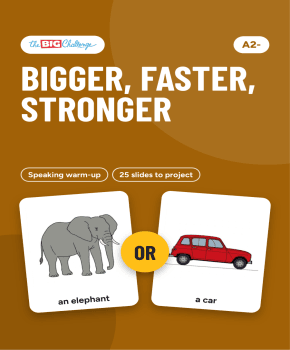
[A] Send fast pupils straight to Gold and then to the as ... as task on page 3, where they compare facts. In the game, ask them to say each answer aloud in a full sentence. As an extra, pairs compare two things on their desks, then find the biggest or the oldest thing in the room.
Materials & prerequisites
A projector or screen for lesson.pdf and game.pdf (one PDF page per slide, turned with the arrow keys), and paper for the teams' answers. Print practice.pdf (3 pages for pupils; the key page is for the teacher) and quiz.pdf (page 1 for pupils, page 2 is the key), one copy per pupil. Pupils should already know the present simple, be and common adjectives such as big, small, old and cheap. It goes well after a unit on describing people, animals and things.
Possible adaptations
- Lower levels: Offer segmented listening and additional visual aids.
- Advanced levels: Encourage an oral summary and a debate in English on the theme.
- Large groups: Organise group work with differentiated roles.
🔒 Restricted content
This resource requires a subscription to be viewed.
Unlock the resourceIncluded in the subscription