What do you think?
Interactive exercises to consolidate your students’ learning.
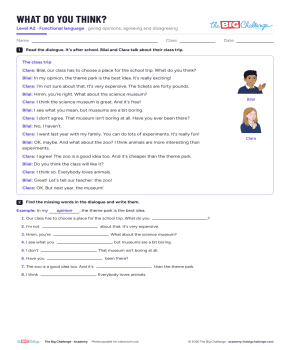
Giving an opinion, asking for one, agreeing, disagreeing politely and half agreeing, seen through Bilal and Clara choosing a place for their class trip. Pupils find the missing words in the dialogue, read the useful phrases, match situations to phrases, choose the best reply, put a dialogue in order, complete another one and act out a role-play in pairs with topic cards; answer key included.
Documents to download (2)
- Colour version In your teacher account
- Black and white version In your teacher account
Teaching guide
Objective & content
This functional language sheet teaches pupils to give an opinion (In my opinion, the theme park is the best idea. I think the science museum is great.), ask for one (What do you think?), agree (I agree. You're right. I think so.), disagree politely (I don't agree. I'm not sure about that. I don't think so.) and half agree (I see what you mean, but...). Pupils read a dialogue in which Bilal and Clara choose a place for their class trip, find the missing words and read the useful phrases, given in a box. By the end, they can give an opinion, say why with because, and agree or disagree politely.
Pedagogical guide
Page 1 is the dialogue, with a picture of Bilal and of Clara: it's after school, and their class has to choose a place for the school trip. Bilal wants the theme park, but Clara says it's very expensive (the tickets are forty pounds). Clara likes the science museum, which is free; Bilal thinks museums are a bit boring, and Clara, who went last year with her family, doesn't agree. Then Bilal suggests the zoo, Clara agrees because it's cheaper than the theme park, and they choose the zoo, with the museum for next year. Pupils find eight missing words in lines from the dialogue. Page 2 has the useful phrases in a box, with the key words in bold, five situations to match to a phrase (pizza, football, a film, a phone that costs a lot, a beach that is far) and six lines with three replies each, where pupils tick the best one. Page 3 has a dialogue in which Jonas and Iman talk about a superhero film, to number from 1 to 8, and a dialogue about school uniform to complete with six words in a box. The last task is a role-play: pupils cut out cards A and B, each with three topics (the best sport, homework at the weekend, phones at school; the best film or series, school uniform, a holiday at the beach or in the mountains). They take turns: one gives an opinion, says why and asks What do you think?, the other agrees, disagrees or half agrees and says why. Every exercise opens with a worked example.
Suggested procedure
- (5 min) Say "In my opinion, pizza is the best food. What do you think?"; pupils answer "I agree." or "I don't agree."
- (10 min) Read the dialogue aloud; pupils find the missing words.
- (5 min) Read the useful phrases in the box with the class; pupils find them in the dialogue.
- (10 min) Page 2: pupils match the situations to the phrases, then tick the best replies.
- (10 min) Page 3: pupils number the lines of Jonas and Iman's dialogue, then complete the dialogue about school uniform.
- (10 min) Role-play: pupils take turns to give an opinion on a topic from their card and say why, then agree or disagree with their partner.
- (5 min) Check with the answer key on page 4.
Adaptations
[S] Pupils read the dialogue aloud in pairs, one as Bilal and one as Clara, before the tasks.
[A] Pupils write their opinion on one topic in three sentences, with because.
Materials & prerequisites
One copy of pages 1 to 3 per pupil, and scissors for the role-play cards. Page 4 is the answer key and teacher notes: keep it. The role-play is free speaking, so any answer that uses the phrases and says why is right. Pupils need the past simple (I went, did you watch), comparatives (cheaper, more interesting), Have you ever...? and because. To take it further, hold a class vote on a real class trip, where each pupil gives an opinion before the vote.
Possible adaptations
- Lower levels: Offer segmented listening and additional visual aids.
- Advanced levels: Encourage an oral summary and a debate in English on the theme.
- Large groups: Organise group work with differentiated roles.
🔒 Restricted content
This resource requires a subscription to be viewed.
Unlock the resourceIncluded in the subscription