Short story: The Canterville Ghost
Interactive exercises to consolidate your students’ learning.
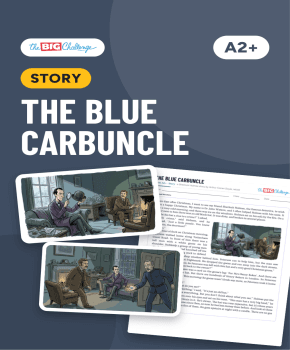
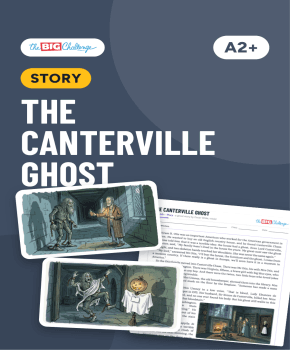
The funny ghost story by Oscar Wilde (1887), retold at A2+ with the story untouched: an American family buys an old English house with a ghost, and nobody is afraid of him. Washington cleans the bloodstain, Mr Otis offers oil for the chains and the twins play tricks on the ghost, until Virginia feels sorry for him and helps him find peace. Four pages of story with pictures, then six choice questions, "Find the clues" questions, a box and gap fill on three verb forms from the story, and a pair writing task; answer key and teacher notes included, in colour and in black and white. One long lesson or two short ones.
Documents to download (2)
- Worksheet In your teacher account
- Worksheet (black and white) In your teacher account
Teaching guide
Objective & content
The funny ghost story by Oscar Wilde (1887), retold at A2+. The language is simplified, the story is not: every trick and the ending are Wilde's. An American family buys Canterville Chase, an old English house with a ghost, and nobody is afraid of him. Washington cleans the bloodstain with his stain remover, Mr Otis politely offers oil for the noisy chains, and the twins play trick after trick on the poor ghost. Only Virginia, fifteen, feels sorry for him, and she helps him find peace at last. By the end, pupils can follow a story of about 1,600 words, explain why things happened in it, and use three verb forms from the story.
Pedagogical guide
The story runs over four pages, set like a novel, with one drawing on each page. Page 5 holds the tasks. Six choice and true or false questions check the story. "Find the clues" sends pupils back into the text: why the bloodstain came back every morning (and once in green), why the ghost screamed at the Otis Ghost, why Virginia went into the Tapestry Room, and how the family knew that the ghost was forgiven. A box gives three verb forms from the story (the past simple, will for an offer or a promise, have + past participle), then pupils complete four sentences from the story with them. In the last task, pupils work in pairs: they are Washington, and they write a short letter to a friend in America about the house and its ghost. Page 6 is the answer key with the teacher notes.
Suggested procedure
- (5 min) Ask "Are you afraid of ghosts? What do ghosts do in stories?"
- (20 min) Read the story aloud, or pupils read in pairs. Stop after "I'm going to teach them a lesson," and ask "What do you think he is going to do?" Stop again after "the Tapestry Room was empty." and ask "Where did Virginia go?"
- (10 min) Pupils answer the choice questions, then the "Find the clues" questions; check together.
- (10 min) Pupils read the box and complete the four sentences.
- (10 min) In pairs, pupils write Washington's letter home, then read some aloud.
Adaptations
[S] Read the story over two lessons, two pages at a time, and go through the words they may need first (ghost, bloodstain, chains, corridor, sheet, tapestry). Pupils can answer the choice questions and two of the clues only.
[A] Pupils retell one night of the story from the ghost's point of view: the oil, the pillow or the Otis Ghost.
Materials & prerequisites
One copy per pupil, in colour or black and white: pages 1 to 5 are for pupils, page 6 is the answer key. Pupils should know the past simple of common irregular verbs.
Possible adaptations
- Lower levels: Offer segmented listening and additional visual aids.
- Advanced levels: Encourage an oral summary and a debate in English on the theme.
- Large groups: Organise group work with differentiated roles.
🔒 Restricted content
This resource requires a subscription to be viewed.
Unlock the resourceIncluded in the subscription