Daily routine
Interactive exercises to consolidate your students’ learning.
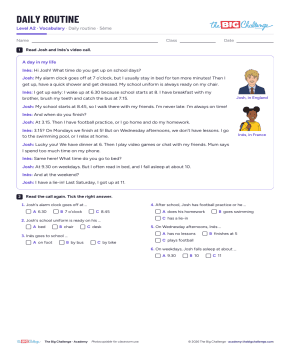
Josh in England and Inès in France compare their school days on a video call, from the alarm clock to bedtime and the weekend lie-in. Pupils answer questions, name pictures, match meanings, complete sentences, practise collocations with have, get, go and do, then solve a mystery word; answer key included.
Documents to download (2)
- Colour version In your teacher account
- Black and white version In your teacher account
Teaching guide
Objective & content
This sheet on daily routine starts from a video call between Josh, in England, and Inès, in France, who compare their school days: getting up, getting ready, school times, after school, the evening and the weekend. The call carries the target words, from alarm clock, get dressed and catch the bus to on time, fall asleep and lie-in. Pupils answer six multiple-choice questions on it, name six pictures from a box of eight words, match eight words with their meanings, complete seven sentences from a box of nine words and write have, get, go or do in six collocations. The sheet ends on a mystery word: seven clues about the call give the hidden word BEDTIME.
Pedagogical guide
Pupils meet every word in the call before they practise it, then move from recognising the words to using them. Every task tests words only: no answer depends on a tense. The collocations task asks for one choice only (have, get, go or do) and opens with a worked example (have breakfast). The mystery word is the hardest task: most clues send pupils back to the call (who has breakfast with her brother, what is ready on Josh's chair). The call also compares two school systems: English pupils wear a uniform and finish at about 3.15, while many French collèges start at 8 and have no lessons on Wednesday afternoons.
Suggested procedure
- (5 min) Ask "What time do you get up?" and write the times and the morning actions on the board.
- (10 min) Two pupils read the call aloud; the class answers the six questions.
- (10 min) Pupils name the six pictures and match the eight words with their meanings.
- (12 min) Pupils complete the sentences, then read the worked example together and write have, get, go or do.
- (8 min) Pupils read the seven clues and find the mystery word.
- (5 min) Check with the answer key on page 4.
Adaptations
[S] A pupil mimes a morning action and the class says it.
[A] Pupils compare their school day with Josh's or Inès's in four sentences. To take it further, they interview a family member about their routine and report back.
Materials & prerequisites
One copy of the three pupil pages per pupil, in colour or in black and white. Page 4 is the answer key: keep it. Pupils should know the present simple, adverbs of frequency such as always, usually and never, and how to tell the time.
Possible adaptations
- Lower levels: Offer segmented listening and additional visual aids.
- Advanced levels: Encourage an oral summary and a debate in English on the theme.
- Large groups: Organise group work with differentiated roles.
🔒 Restricted content
This resource requires a subscription to be viewed.
Unlock the resourceIncluded in the subscription