What Time Is It?
Interactive exercises to consolidate your students’ learning.
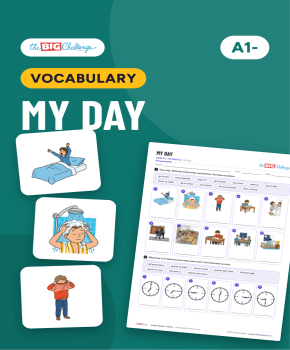
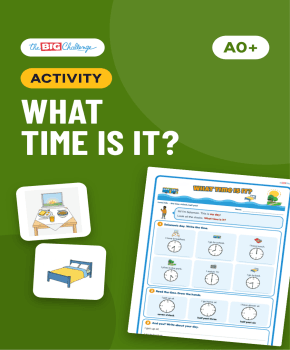
Pupils follow Solomon through his day, from breakfast to bed, and write the time on six clocks with "o'clock" and "half past". Then they read three times and draw the hands on empty clocks, and write when they get up and go to bed. Answer key included.
Documents to download (2)
- Colour version In your teacher account
- Black and white version In your teacher account
Teaching guide
Objective & content
This activity sheet is about telling the time. Solomon shows his day: six pictures, each with a short sentence ("I have breakfast.", "I go to school.") and a clock. Pupils read the clocks and write the times, read times and draw the hands on empty clocks, then write about their own day. The sheet uses only o'clock and half past. By the end, pupils ask and answer What time is it? It's half past seven. and say when they do things ("I get up at seven o'clock.").
Pedagogical guide
Task 1 follows Solomon through his day, in order: breakfast at half past seven, school at eight o'clock, lunch at twelve o'clock, the park at half past four, TV at six o'clock and bed at half past eight. Pupils read each clock and write the time in words on the line. The clocks are drawn exactly, so at half past the short hand sits between two numbers: show this on the board before pupils start. Task 2 turns it round: three times are written under empty clocks (seven o'clock, half past three, half past six, for getting up, going home and having dinner) and pupils draw the two hands, the short hand for the hour and the long hand for the minutes. These three times fit into Solomon's day. Task 3 asks pupils to complete two sentences about their own day: "I get up at ..." and "I go to bed at ...". Page 2 gives the answer key, with the three clocks of Task 2 drawn, and the teacher notes.
Suggested procedure
- (5 min) Draw a clock on the board and move the hands: "What time is it?"
- (10 min) Task 1: pupils read each clock in Solomon's day and write the time; check together.
- (10 min) Task 2: pupils read the three times and draw the hands; check with the clocks on page 2.
- (5 min) Task 3: pupils write when they get up and go to bed.
- (5 min) In pairs, pupils read their two sentences to a partner.
Adaptations
[S] Read the first two clocks of Task 1 together before pupils go on alone.
[A] Pupils ask a partner: "What time do you go to bed?"
Materials & prerequisites
One copy per pupil of page 1, in colour or black and white. Pupils need only a pencil. Page 2 is the answer key with teacher notes: keep it. Pupils should know the numbers one to twelve; the routine sentences are written under each picture.
Possible adaptations
- Lower levels: Offer segmented listening and additional visual aids.
- Advanced levels: Encourage an oral summary and a debate in English on the theme.
- Large groups: Organise group work with differentiated roles.
🔒 Restricted content
This resource requires a subscription to be viewed.
Unlock the resourceIncluded in the subscription