My day
Interactive exercises to consolidate your students’ learning.
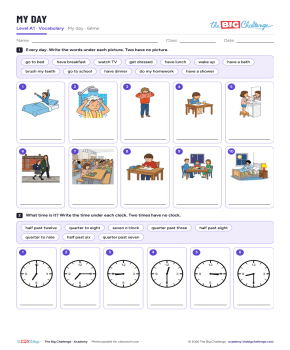
Waking up, school, homework and bed, seen through Megan's school day in York. Pupils name everyday actions, read the time on clocks, answer questions on the text, unscramble the days of the week, complete sentences and solve a crossword; answer key included.
Documents to download (2)
- Colour version In your teacher account
- Black and white version In your teacher account
Teaching guide
Objective & content
This sheet on the school day teaches everyday actions, such as wake up, get dressed, have breakfast, brush my teeth, do my homework and go to bed, with the days of the week, morning, afternoon and evening, and the time with o'clock, half past, quarter past and quarter to. Pupils name pictures and read clocks, read Megan's text about her day in York, then use the words. By the end, they can say what they do every day and at what time.
Pedagogical guide
Page 1 names ten everyday actions from pictures, then six times from clocks; each word box holds two extra words, so pupils must choose. Page 2 is Megan's text: an eleven-year-old in York, in the north of England, tells her school day from seven o'clock to bed at half past eight, then her weekend. Eight multiple-choice questions follow, then eight sentences where pupils unscramble a day of the week (DOMYAN, DAYSDEWNE) or weekend; the words around each gap (the day after Monday) give the answer. Page 3 has eleven sentences to complete from a word box of actions and parts of the day, then a crossword of ten words with clues and no word list: pupils recall and spell the words, so it is the hardest task. Every task tests words only. The grammar stays on the present simple: there is no past tense on the sheet.
Suggested procedure
- (5 min) Mime a few morning actions; the class guesses, and you write the English on the board.
- (8 min) Page 1: pupils write the actions under the pictures alone, then compare in pairs.
- (5 min) Pupils write the times under the clocks.
- (10 min) Read Megan's text aloud; pupils answer the questions.
- (5 min) Pupils unscramble the days of the week.
- (10 min) Page 3: pupils complete the sentences, then do the crossword.
- (5 min) Check with the answer key on pages 4 and 5.
Adaptations
[S] Mime an action for the class to say it; draw a big clock on the board and move the hands.
[A] Pupils write five sentences about their own day with a time in each ("I get up at seven o'clock").
Materials & prerequisites
One copy of pages 1 to 3 per pupil; a clock with hands, or one drawn on the board, helps. Pages 4 and 5 are the answer key and teacher notes: keep them. Pupils need the present simple of be and have and the numbers to twelve. To take it further, pupils draw their own day as a comic strip of six pictures with a time under each, then present it to a partner.
Possible adaptations
- Lower levels: Offer segmented listening and additional visual aids.
- Advanced levels: Encourage an oral summary and a debate in English on the theme.
- Large groups: Organise group work with differentiated roles.
🔒 Restricted content
This resource requires a subscription to be viewed.
Unlock the resourceIncluded in the subscription