Animals & Pets: Let's Chat
A teaching resource designed to energise your English lessons.
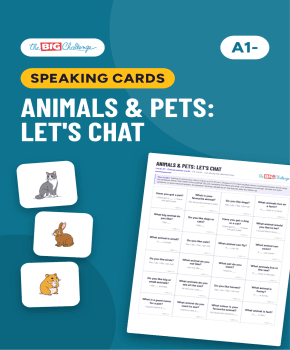
A1 speaking deck: 24 'Animals & pets' chat prompts (have got, can, favourite animals), playable on screen or as cut-out cards.
Teaching guide
Objective & content
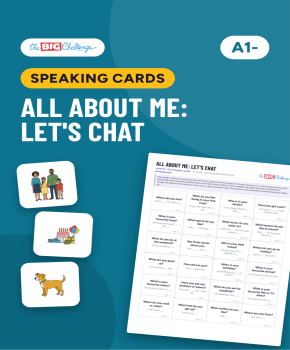
By the end, A1 students can talk aloud about pets and animals using have got, can and simple preferences. This speaking deck gives 24 "Animals & pets" chat prompts, each with a sentence-frame scaffold. It plays on screen (draw and shuffle) or prints as a single A4 sheet of cut-out cards.
Pedagogical guide
Use this deck as a warm-up once have got and can are introduced — animals are a natural, high-interest topic for practising both structures. Each card's frame does the heavy lifting ("I have got a ___. / I have not got a pet."), so students focus on vocabulary retrieval and pronunciation rather than sentence construction. No question-forming is expected at A1.
Suggested procedure
- (2 min) Form groups of 3–4 and shuffle or display the deck.
- (1 min) Model one card: read the question, complete the frame aloud.
- (8–10 min) Students take turns drawing a card and answering aloud using the frame; the teacher circulates and prompts extra detail where possible.
- (2 min) Whole-class share-out: ask 2–3 students what pet or animal they talked about.
Adaptations
- [S] Accept one completed sentence per card; pre-teach 5–6 animal words before starting.
- [A] Add one more sentence beyond the frame (a description or a reason).
Materials & prerequisites
Plays on screen (draw/shuffle) or prints as a single A4 sheet of cut-out cards. Assumes have got, can, and basic animal/pet vocabulary.
Curriculum alignment
Maps to Cycle 3 "child and close environment" (FR 6e) — pets and animals in the child's everyday world.
Assessment & extensions
Listen for correct have got / can forms as an informal speaking check. Extend with an "animal I would like to have" drawing-and-caption task, or move to the A2 Animals & Pets deck once comparatives are secure.
Possible adaptations
- Lower levels: Offer segmented listening and additional visual aids.
- Advanced levels: Encourage an oral summary and a debate in English on the theme.
- Large groups: Organise group work with differentiated roles.