The day before the final
Interactive exercises to consolidate your students’ learning.
Each other and one another beside the -self words: each other's + noun (We know each other's moves), they blame themselves against they blame each other, a -self word for emphasis (The coach herself says ...), by ourselves for alone, the verbs that take no -self word in English (feel, relax, concentrate, meet) and a -self word inside a phrasal verb (pick yourself up, push yourself on, let yourself down). Pupils read an interview with the captain of a school basketball team the day before the final, find the missing words, read the rule, tick the sentence that means the same, tick the right word, write a -self word, each other or nothing, circle the right words in a text for the school magazine and write four sentences of their own; answer key included.
Documents to download (2)
- Colour version In your teacher account
- Black and white version In your teacher account
Teaching guide
Objective & content
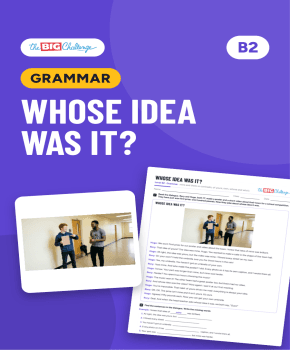
This grammar sheet teaches each other and one another beside the -self words (myself ... themselves). Pupils meet each other's + noun (We know each other's moves.), the difference between they blame themselves and they blame each other, a -self word for emphasis (The coach herself says ...), by ourselves for alone, the verbs that take no -self word in English (feel, relax, concentrate, meet), and a -self word inside a phrasal verb (pick yourself up, push yourself on, let yourself down). Pupils read an interview: Conrad, who writes for the school magazine, talks to Dalia, the captain of the school girls' basketball team, the day before the final. They find the missing words and read the rule, set out in a chart. By the end, they ask who does it and who gets it, choose between each other and a -self word, and leave the -self word out after feel, relax, concentrate and meet.
Pedagogical guide
The sheet works on two questions: who does it, and who gets it? Page 1 is the dialogue, with a picture of the scene and six sentences to complete. Page 2 opens with the rule chart (six rows: each other and one another, each other's + noun, the -self words, a -self word for emphasis and by + a -self word, the four verbs with no -self word, the three phrasal verbs), then works on meaning (exercise 4: five sentences, tick the sentence that means the same) and on choosing the right word (exercise 5: six items, three words to choose from each time). Page 3 opens with the chart of four usual mistakes (I feel myself good, We know us, We know each others moves, She picked her up). Pupils then write a -self word, each other, each other's, or X when the sentence needs nothing (exercise 7: six sentences), circle the right words in the text Conrad writes for the magazine (exercise 8: eleven choices, the first one done as an example) and write four sentences about a team or a group of friends they know (exercise 9). Exercises 2, 4, 5 and 7 open with a worked example.
Suggested procedure
- (5 min) Write We trust each other. and We blamed ourselves. on the board. For each sentence, ask who does it and who gets it; keep the two sentences for step 3.
- (10 min) Read the dialogue aloud, or let two pupils read Conrad and Dalia; pupils complete the six sentences (exercise 2).
- (5 min) Read the rule chart with the class. Come back to the two sentences on the board and find the row of the chart for each one. In pairs, pupils say one sentence about their class with each other and one with ourselves.
- (15 min) Page 2: exercises 4 and 5.
- (15 min) Page 3: the chart of mistakes, then exercises 7 and 8.
- (5 min) Check exercises 2, 4, 5, 7 and 8 with the answer key on page 4. Pupils can do exercise 9 at home.
Adaptations
[S] Pupils read the dialogue aloud in pairs, then swap the roles of the interviewer and the captain, before they look for the missing words.
[A] In pairs, pupils interview each other about a team or a club they know and report three things with each other, each other's and by + a -self word.
Materials & prerequisites
One copy of pages 1 to 3 per pupil, in colour or in black and white. Page 4 is the answer key and teacher notes: keep it. Pupils need the present simple, the past simple and the present perfect, the -self words in their basic use (myself, yourself, themselves), and a few words for a team sport (coach, captain, training, defeat).
Curriculum alignment
French lycée programme (2025), grammar list at B2: "reciprocal pronouns (each other, one another)". The same programme already lists "reflexive pronouns with phrasal verbs" at B1+ and "reflexive and reciprocal verbs" at A2+, which the sheet takes further.
Possible adaptations
- Lower levels: Offer segmented listening and additional visual aids.
- Advanced levels: Encourage an oral summary and a debate in English on the theme.
- Large groups: Organise group work with differentiated roles.
🔒 Restricted content
This resource requires a subscription to be viewed.
Unlock the resourceIncluded in the subscription