Can you tell me more?
Interactive exercises to consolidate your students’ learning.
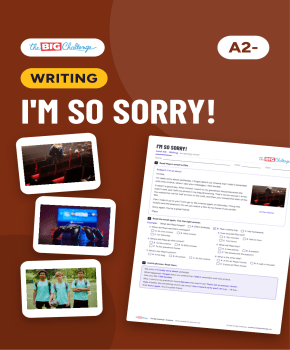
Writing an email asking for information, seen through Tom's email to a summer climbing club: who he is, why he is writing and his questions about age, days, times, price and equipment. Pupils answer questions on the email, read the useful phrases, complete four questions with words from a box, then write to a drama club, a sailing course, a coding camp or an art workshop from a card or a real club and tick a checklist; model email and answer key included.
Documents to download (2)
- Worksheet In your teacher account
- Worksheet (black and white) In your teacher account
Teaching guide
Objective & content
This writing sheet teaches pupils to write an email asking for information (Dear Sir or Madam, My name is..., I saw your poster about..., I'd like some more information, please, How old do you need to be?, What days does... meet?, How much does it cost?, Do I need...?, Can we...?, I hope to hear from you soon, Best wishes). Pupils read Tom's email to a climbing club, take its phrases and write their own. By the end, they can write an email of 80 to 100 words with clear questions and a polite ending.
Pedagogical guide
Page 1 has Tom's email, with a photo of a climbing wall. Tom, thirteen, saw a poster at school about a summer climbing club. He climbed at a sports centre last year but is not very good yet, so he asks whether that is OK; he also asks about the age, the days and times, the price and whether he needs his own shoes and helmet, and whether his friend Ali can join too. Pupils answer six questions with three options each, then read the useful phrases, set out in the order of the email (start, who you are, why you're writing, questions, about you, end). Page 2 starts with four questions to complete with How much, does, Do and When. Then pupils write to a club or course from a card (a drama club, a sailing course, a coding camp, an art workshop, each with three facts that leave questions open) or to a real club, and tick the checklist. The answer key gives a model email to the drama club.
Suggested procedure
- (5 min) Ask "Which club would you like to join? What do you need to know first?"
- (10 min) Read Tom's email aloud; pupils answer the questions.
- (5 min) Read the useful phrases with the class; pupils count Tom's questions.
- (5 min) Page 2: pupils complete the questions.
- (20 min) Pupils choose a club, write their email and tick the checklist.
- (5 min) In pairs, one pupil reads the email and the other answers the questions as the club.
Adaptations
[S] Pupils copy Tom's email and change the club and the questions.
[A] Pupils write the club's answer.
Materials & prerequisites
One copy of pages 1 and 2 per pupil. Page 3 is the answer key, the model email and the teacher notes: keep it. Pupils need questions with do and does, question words and the past simple. To take it further, pupils find a real club or course in their town and write the questions they would ask.
Possible adaptations
- Lower levels: Offer segmented listening and additional visual aids.
- Advanced levels: Encourage an oral summary and a debate in English on the theme.
- Large groups: Organise group work with differentiated roles.
🔒 Restricted content
This resource requires a subscription to be viewed.
Unlock the resourceIncluded in the subscription