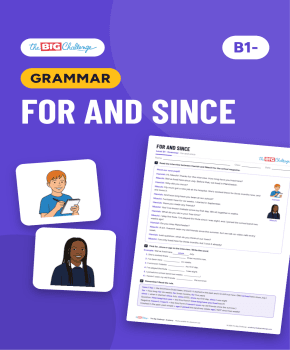
I did feed him!
Interactive exercises to consolidate your students’ learning.
Emphatic do: do, does or did before the base verb in a positive sentence, to insist that something is true when somebody doubts it (I did feed him!), set against the normal form pupils know (I went on a normal day, I DID go when somebody says I didn't). Pupils read a dialogue between a sister and a brother who both fed the dog, find the missing words, read the rule, tick, answer back and finish sentences with but, circle the right words in a message, then write a short dialogue; answer key included.
Documents to download (2)
- Colour version In your teacher account
- Black and white version In your teacher account
Teaching guide
Objective & content
This grammar sheet teaches emphatic do: do, does or did before the base verb in a positive sentence, to insist that something is true when somebody doubts it (I did feed him!). It sets the form against the normal positive sentence pupils already know, which takes no do: on a normal day they say I went, and I DID go only when somebody says they didn't. Pupils read a dialogue between Darcy and her brother Kian, who both say they fed the dog, find the missing words and read the rule, given in a box. By the end, they can answer back with the right helper for the subject and the time, and they stop writing I did fed him.
Pedagogical guide
Pupils have learnt that do, does and did belong in questions and negatives, and that a positive sentence has none. Say it plainly: that rule still stands, and emphatic do is the one exception, used only to insist or to set a positive against a negative (I didn't walk him, but I did feed him). In speech, do, does or did is stressed. Page 1 is the dialogue, with three small pictures, six missing words to find and the rule box. On page 2, pupils tick the right word of three (the first speaker's doubt gives the subject and the time), read a warning box on the verb after the helper (no -s, no past form), tick the right sentence of two, then answer back with the verb given. On page 3, pupils finish five sentences with but and a helper, circle the right words in Darcy's message to her gran, then write a six-line dialogue of their own. Exercises 2, 4, 6, 7, 8 and 9 open with a worked example, and the writing task with a starter. The sheet uses the present simple, the past simple, the present continuous, will (one line) and have got, with no present perfect, no passive and no conditional. It leaves out the imperative (Do sit down), inversion and cleft sentences.
Suggested procedure
- (5 min) Say to a pupil: You didn't do your homework! Let them answer, then model I DID do it! with a loud did. Write I did it and I DID do it on the board and ask what changes.
- (10 min) Read the dialogue aloud, in pairs or with two pupils; pupils find the six missing words (exercise 2).
- (5 min) Read the rule box with the class: the normal form first, then the form with emphasis, then who takes do, does or did.
- (15 min) Page 2: exercise 4, the warning box, then exercises 6 and 7.
- (10 min) Page 3: exercises 8 and 9.
- (5 min) Check with the answer key on page 4. Pupils can write exercise 10 at home and read it aloud in pairs next lesson, loud on the helper.
Adaptations
[S] Pupils read the dialogue aloud in pairs and make the stressed word loud before they look for the missing words.
[A] In pairs, pupils play "No, you didn't!": one says something about the other (You didn't do your homework), the other answers back with do, does or did.
Materials & prerequisites
One copy of pages 1 to 3 per pupil, in colour or in black and white. Page 4 is the answer key and teacher notes: keep it. Pupils need questions and negatives with do, does and did, the past simple of common verbs, regular and irregular, and a few words for home and pets (bowl, feed, walk the dog). Gran is a British word for grandmother.
Curriculum alignment
French collège programme (2025), 3e (p. 36, Grammaire, La phrase et son organisation): "l'emphase avec des auxiliaires (I do like / I did visit)". This line applies to 3e from 2028-29. The same point comes back in the lycée programme in 1re (B1).
Possible adaptations
- Lower levels: Offer segmented listening and additional visual aids.
- Advanced levels: Encourage an oral summary and a debate in English on the theme.
- Large groups: Organise group work with differentiated roles.
🔒 Restricted content
This resource requires a subscription to be viewed.
Unlock the resourceIncluded in the subscription