For and since
Interactive exercises to consolidate your students’ learning.
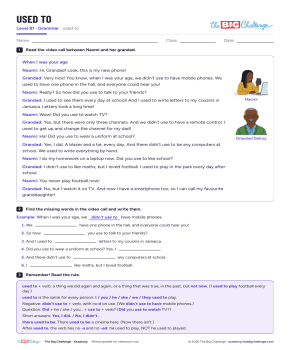
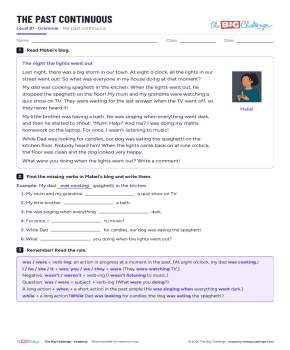
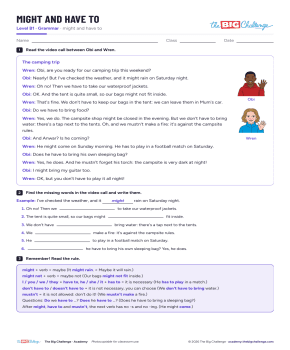
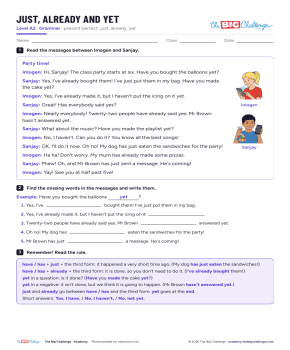
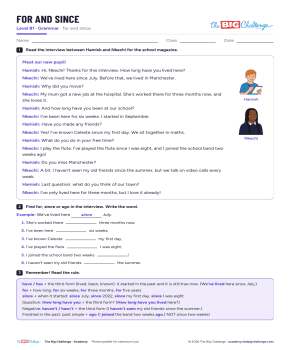
The present perfect with for and since for something that started in the past and is still true now, with How long questions, negatives and the past simple with ago, seen through a school magazine interview with Nkechi, a new pupil who plays the flute. Pupils find for, since and ago in the text, read the rule, choose the right word, write verbs, negatives and questions, then use Danyal's timeline to write sentences with for and since; answer key included.
Documents to download (2)
- Colour version In your teacher account
- Black and white version In your teacher account
Teaching guide
Objective & content
This grammar sheet teaches the present perfect with for and since for something that started in the past and is still true now (We've lived here since July. She's worked there for three months.), questions with How long have you...?, the negative (I haven't seen my old friends since the summer.) and the difference with the past simple and ago for a finished action (I joined the school band two weeks ago.). Pupils read Hamish's interview with Nkechi, a new pupil, for the school magazine, find the missing words and read the rule, given in a box. By the end, they can say how long something has been true and choose between for, since and ago.
Pedagogical guide
Page 1 is the interview, with a picture of Hamish and of Nkechi: her family moved from Manchester in July, her mum has worked at the hospital for three months, she has known Celeste since her first day, she has played the flute since she was eight and she joined the school band two weeks ago. Pupils find six missing words (for, since or ago) in sentences from the interview. Then they read the rule, given in a box in short lines: have or has + the third form, for + how long, since + when it started, the question with How long, the negative, and the past simple + ago for a finished action ("NOT since two weeks!"). Page 2 has eight sentences where pupils tick for, since or ago, six verbs in brackets to write with have or has + the third form, four negatives and three questions for Nkechi with How long. Page 3 is the final task: Danyal's timeline, under the line "It is now October 2026". Pupils write for + how long, then whole sentences with since, then tick the right answer to three questions, where Two years ago. and Since July. stand next to the common mistake Since two years. Every exercise opens with a worked example. The sheet uses only the present perfect simple, the past simple and the present simple.
Suggested procedure
- (5 min) Ask a few pupils "How long have you lived in this town?" and write two answers on the board, one with for and one with since.
- (10 min) Read the interview aloud; pupils find for, since and ago.
- (5 min) Read the rule in the box with the class; pupils find an example of each line in the interview.
- (15 min) Page 2: for, since or ago, then the verbs, the negatives and the How long questions.
- (10 min) Page 3: the timeline, parts 1, 2 and 3.
- (5 min) Check with the answer key on pages 4 and 5.
Adaptations
[S] Pupils read the interview aloud in pairs, one as Hamish and one as Nkechi, then interview a partner with How long have you...?
[A] Pupils write five sentences about their own life with for and since.
Materials & prerequisites
One copy of pages 1 to 3 per pupil. Pages 4 and 5 are the answer key and teacher notes: keep them. Contracted and full forms are both right ('ve or have, hasn't or has not). Pupils need the third form of common verbs, the past simple, and the words for school, the family, music and pets. To take it further, pupils draw their own timeline and swap it with a partner, who writes the for and since sentences.
Possible adaptations
- Lower levels: Offer segmented listening and additional visual aids.
- Advanced levels: Encourage an oral summary and a debate in English on the theme.
- Large groups: Organise group work with differentiated roles.
🔒 Restricted content
This resource requires a subscription to be viewed.
Unlock the resourceIncluded in the subscription