Two languages, two ways
Interactive exercises to consolidate your students’ learning.
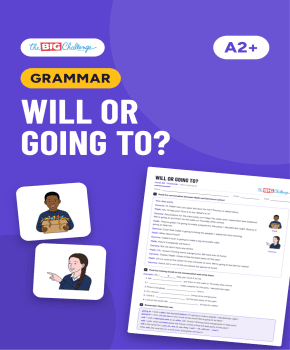
For pupils who speak French: five places where English and French say the same idea in a different way (I am thirteen, a red bike, I like dogs, Monday with a capital letter, my sister's bike). A French girl and an English girl do their language homework together and find the same mistakes in both directions. Pupils read the dialogue, compare the two languages in a chart, tick the right sentence, say French sentences the English way and correct the English girl's French; answer key included.
Documents to download (2)
- Colour version In your teacher account
- Black and white version In your teacher account
Teaching guide
Objective & content
This sheet is written for pupils who speak French. It shows them five places where English and French say the same idea in a different way, so that they stop translating word for word: be for age, hunger and cold (I am thirteen); the adjective before the noun, with no -s (a red bike); no the for things in general (I like dogs); capital letters on days, months and languages (Monday, French); and 's for "whose" (my sister's bike). By the end, pupils can say these five ideas the English way.
Pedagogical guide
Page 1 is the dialogue, with a photo of the two girls. Manon, from France, is staying with Holly in England, and they do their language homework together. Manon reads out I have thirteen years and I have a bike red; Holly's French homework has the mirror mistakes (Je suis treize ans, un rouge vélo). Holly corrects five of Manon's sentences one by one, and pupils write the missing words of four corrections. Page 2 opens with a chart: the English way and the French way, side by side, for the five points. Pupils then tick the right English sentence in five pairs, where the wrong one is a word-for-word copy of French (My brother has fifteen years), complete seven English sentences from their French model (Il a faim, He ... hungry), and correct four lines of Holly's French homework: here they are the experts. Last, they write three sentences about themselves. Exercises 2 and 4 to 6 open with a worked example.
Suggested procedure
- (5 min) Write J'ai treize ans on the board. Ask for the English word for word (I have thirteen years), then the real English.
- (10 min) Pupils read the dialogue in pairs, then do exercise 2.
- (5 min) Page 2: read the chart with the class. Which line is the most difficult for them?
- (12 min) Exercises 4 and 5.
- (8 min) Exercise 6: pupils correct Holly's French and say which line of the chart explains each mistake.
- (5 min) Exercise 7, then check with the answer key on page 3.
Adaptations
[S] For exercise 5, pupils write the number of the chart line (1 to 5) next to each sentence before they complete it.
[A] Pupils add a sixth line to the chart from their own mistakes, and keep the chart in their exercise book.
Materials & prerequisites
One copy of pages 1 and 2 per pupil, in colour or in black and white. Page 3 is the answer key and teacher notes: keep it. Pupils need the present simple, the past simple and the possessive 's. The French sentences on the sheet are its subject, so it does not suit a class that does not speak French.
Curriculum alignment
French collège programme, last two years (2020 text): pupils "develop strategies of passage and transfer from one language to others" and compare how languages work. The 2025 programme also asks for "transferable strategies such as memorising, inference, planning, compensation, checking and self-correction". The sheet follows the six "How to learn English" sheets and is one level above I can read the menu!, which compares the words of the two languages.
Possible adaptations
- Lower levels: Offer segmented listening and additional visual aids.
- Advanced levels: Encourage an oral summary and a debate in English on the theme.
- Large groups: Organise group work with differentiated roles.
🔒 Restricted content
This resource requires a subscription to be viewed.
Unlock the resourceIncluded in the subscription