Explain it to me! 2
A teaching resource designed to energise your English lessons.
Mediation pair work in two rounds. In each round, one pupil has a document (a dog rescue list, then a weather forecast) and the other has a task that needs only part of it: the first pupil must not show the page or read it all out, but explain what the partner needs, and the partner decides. Practises It says that ..., This one is ... / This one has ..., That one is no good, because ... and I think the best one for you is ..., with ages, prices and the weather. 3 pages: Student A, Student B, teacher page with the answer key. About 25 minutes.
Documents to download (1)
- Pair work: Student A, Student B, key In your teacher account
Teaching guide
Objective & content
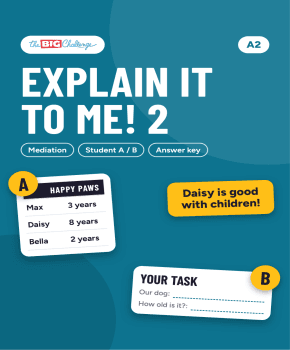
A mediation pair activity in two rounds. In each round, one pupil holds a document and the other holds a task that needs only part of it. In round 1, Student A has a dog rescue list and Student B must choose a dog for a family: a flat with no garden, a sister of 5, nobody at home for five hours and £120. In round 2, Student B has the weekend weather forecast and Student A must choose a time for a beach picnic: school on Friday afternoon, a friend's football on Saturday morning, sun, 20°C or more, no strong wind and an ice cream at the beach café. The pupil with the document must not show it or read it all out: they explain only what their partner needs, and the partner decides. By the end, pupils can pick out useful information and pass it on simply.
Pedagogical guide
Mediation means passing on information to someone who hasn't seen it. Here the gap is not a missing word but a choice: each document holds more than the partner needs, so the explainer has to listen to the task and select. Each page has the rule, a box of four phrases for explaining (It says that ..., This one is ... / This one has ..., That one is no good, because ... and I think the best one for you is ...) and questions to help the pupil who asks. The language is present simple, there is / there are, Wh- questions, too young, too windy, too expensive, ages, prices and the weather. Each task has one best answer, so pairs can check themselves. Page 3 is the teacher page: the idea, four steps, the language and the key with the reasons.
Suggested procedure
One activity of about 25 minutes.
- (3 min) Set up the pairs: copy page 1 (Student A) for half the class and page 2 (Student B) for the other half, and put pupils in A + B pairs, face to face. Nobody shows their page. Read the rule and the phrases box with the class.
- (8 min) Round 1: B reads the task and asks; A explains from the dog rescue list. B writes the dog, its age and the price.
- (8 min) Round 2: A reads the task and asks; B explains from the weather forecast. A writes the day, morning or afternoon, and the temperature.
- (6 min) Pairs swap pages and check, then tell the class: "We chose ... because ...". Check with the key on page 3.
Adaptations
[S] When a pupil is stuck, they may point to the right line of the document once.
[A] After choosing, B explains the plan to a third pupil who hasn't heard anything.
Materials & prerequisites
Print infogap.pdf: page 1 for Student A and page 2 for Student B, one copy per pupil; page 3 is the teacher page. Pupils need a pencil. They should already know numbers, prices in pounds and present simple questions. It goes well after work on animals, pets or the weather, and with the other sheets of the "Explain it to me!" set.
Possible adaptations
- Lower levels: Offer segmented listening and additional visual aids.
- Advanced levels: Encourage an oral summary and a debate in English on the theme.
- Large groups: Organise group work with differentiated roles.
🔒 Restricted content
This resource requires a subscription to be viewed.
Unlock the resourceIncluded in the subscription