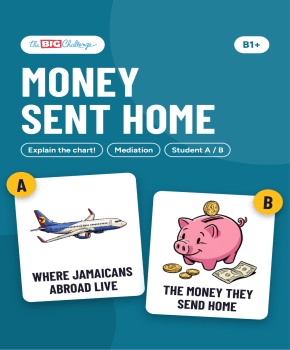
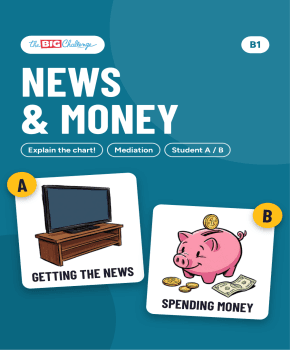
Explain the chart! The Commonwealth in numbers
A teaching resource designed to energise your English lessons.
Mediation pair work with real figures, in two rounds. In round 1, one pupil explains a chart of the Commonwealth's 56 members by region; in round 2, the other explains the final medal table of the Glasgow 2026 Commonwealth Games. Each partner draws the chart they hear and answers questions, comparing with twice as many as, far fewer than and as many as. Three pages: Student A, Student B and a teacher page with the key.
Documents to download (1)
- Pair work: Student A, Student B, key In your teacher account
Teaching guide
Objective & content
A B1+ mediation activity in pairs, where pupils explain real figures to a partner who cannot see them. In round 1, Student A has a chart of the Commonwealth's 56 member countries by region, from 21 in Africa to 3 in Europe, with a note that India alone has more than half of the 2.7 billion people. In round 2, Student B has the total medals of the top five teams at the Glasgow 2026 Commonwealth Games, where India and Scotland won as many medals as each other. Each time, the partner draws the bars on an empty chart and answers questions. By the end, pupils can explain numbers to someone who cannot see them and compare them precisely.
Pedagogical guide
Mediation at B1+ means more than reading numbers aloud: pupils compare them for their partner, with the forms that this level needs, such as twice as many as, almost twice as many, far fewer than, as many as and the second largest number of. The partner checks the explanation by drawing it, so the pair can see at once where the message went wrong. The figures are real: the members by region as the Commonwealth counts them, and the final medal table of the 2026 Games. It is worth saying in class that England and Scotland are separate teams at these Games.
Suggested procedure
- (2 min) Copy page 1 (Student A) for half the class and page 2 (Student B) for the other half. Pairs sit face to face.
- (8 min) Round 1: A explains the chart of the members and the note; B draws the bars and answers the questions.
- (8 min) Round 2: B explains the medal chart and the note; A draws the bars and answers.
- (5 min) Pairs put their charts side by side and check, then discuss which number surprised them most.
Adaptations
[S] The explainer gives the five numbers first, then the comparisons in a second turn.
[A] Pupils find the population of five member countries and write five sentences that compare them.
Materials & prerequisites
Page 1 for half the class, page 2 for the other half; page 3 is for the teacher, with the key. Pupils should know comparatives and superlatives.
Possible adaptations
- Lower levels: Offer segmented listening and additional visual aids.
- Advanced levels: Encourage an oral summary and a debate in English on the theme.
- Large groups: Organise group work with differentiated roles.
🔒 Restricted content
This resource requires a subscription to be viewed.
Unlock the resourceIncluded in the subscription