Natural wonders
A teaching resource designed to energise your English lessons.
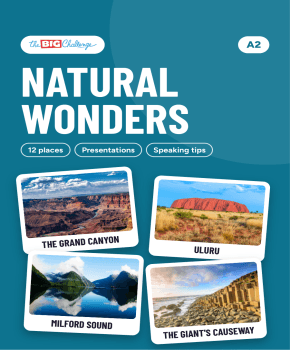
A presentation pack of 12 natural wonders of the English-speaking world: the Grand Canyon, Uluru, Niagara Falls, the Giant's Causeway, the Great Barrier Reef, Yellowstone, Ben Nevis, Milford Sound, the Cliffs of Moher, Moraine Lake, the Twelve Apostles and Loch Ness. Each place is a half page with a photo and the same parts, two places to a page to cut in half: at a glance, how it was made, three things you can do and a surprising fact. Each pupil or group presents a place the class has not read, with superlatives and big numbers. A speaking tips page gives a three-part talk and phrases to compare places, and a listening grid keeps the class listening. 9 pages with a teacher page.
Documents to download (1)
- Fact files, speaking tips, listening grid In your teacher account
Teaching guide
Objective & content
A presentation pack for A2 classes: twelve natural wonders of the English-speaking world (the Grand Canyon, Uluru, Niagara Falls, the Giant's Causeway, the Great Barrier Reef, Yellowstone, Ben Nevis, Milford Sound, the Cliffs of Moher, Moraine Lake, the Twelve Apostles and Loch Ness). Every card has the same parts: at a glance (where it is, how big it is), how it was made, three things you can do there and a surprising fact, with a photo. Two places share a page: print 6 pages and cut them in half. Each pupil or group presents one place to classmates who have not read it. By the end, pupils can describe and compare places with superlatives and big numbers, and pick out information when they listen.
Pedagogical guide
Natural wonders give pupils big numbers and records to talk about, so superlatives and comparatives come naturally (It's the highest mountain in the UK. It's bigger than ...). The other language is you can ... for activities, big numbers and measures (about 446 km long, 1,345 metres high) and the past simple for how each place was made (the river cut the rock, a glacier made the valley). The places come from the USA, Canada, the UK, Ireland, Australia and New Zealand. The speaking tips page gives a three-part talk (My place is ... It's in ... / three things / I'd like to go there because ... Thank you! Any questions?), five useful phrases and five tips, including how to say big numbers. The listening grid asks for the country and one thing heard about each place.
Suggested procedure
One lesson of about 50 minutes.
- (5 min) Show the cover and ask which places pupils know. Cut the place pages in half and give one place to each pupil or group.
- (10 min) Pupils read their card and prepare a one-minute talk with the speaking tips page. They write key words on a card.
- (25 min) Each group presents its place. The class listens and writes the country and one thing about each place in the listening grid.
- (10 min) Pupils answer "Which place would you like to visit? Why?" with "I'd like to visit ... because ..." and the class votes.
Adaptations
[S] Pupils present only the at a glance part and one thing you can do, reading from their key words card.
[A] The class puts the twelve places in order (the highest, the longest, the oldest), or pupils compare their place with a natural wonder in their own country.
Materials & prerequisites
Print factfiles.pdf: the 6 place pages (pages 1 to 6, two places a page, cut in half along the dashed line) so each pupil or group has one place, the speaking tips page (page 7) and the listening grid (page 8) for everyone; page 9 is the teacher page. Pupils should know comparatives and superlatives and big numbers. It goes well with work on geography, travel or the English-speaking world, and with the A2 Famous lives.
Possible adaptations
- Lower levels: Offer segmented listening and additional visual aids.
- Advanced levels: Encourage an oral summary and a debate in English on the theme.
- Large groups: Organise group work with differentiated roles.
🔒 Restricted content
This resource requires a subscription to be viewed.
Unlock the resourceIncluded in the subscription