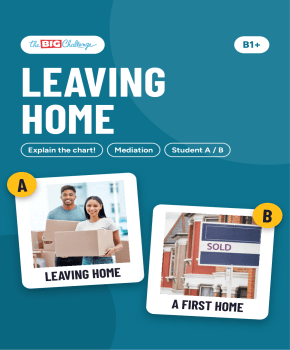
The family meeting
A teaching resource designed to energise your English lessons.
A role-play family meeting for four groups. In each family, a grandparent of 82 lives alone and is finding everyday life harder, and the family must choose: Grandma or Grandpa moves in, moves to a care home, or stays at home with help every day. Each card gives three real facts about growing old in England, the United States, Canada or Australia, from the cost of care homes to unpaid carers, and an invented family's situation. Groups decide and explain their choice with the second conditional, the class agrees or disagrees and fills a listening grid, then compares the four countries. Four cards, a tips page, a listening grid and a teacher page; about 45 minutes.
Documents to download (1)
- Fact files, speaking tips, listening grid In your teacher account
Teaching guide
Objective & content
A B1+ role-play in which each group is one family at a family meeting. In each family, a grandparent of 82 lives alone and is finding everyday life harder, and the family must choose: Grandma or Grandpa moves in, moves to a care home, or stays at home with help coming in every day. Four cards, two to a page, each give a photo, three real facts about growing old in one country and the family's situation: the Harriss in Manchester (England), the Garcías in Phoenix (USA), the Chens in Toronto (Canada) and the Kellys near Brisbane (Australia). By the end, pupils can explain a decision with facts, imagine its consequences with the second conditional, and agree or disagree politely.
Pedagogical guide
The facts on the cards are real and checked: people living alone, the cost of care homes, unpaid carers and homes with several generations, from the Office for National Statistics, Medicare, the Pew Research Center, Statistics Canada, the Ontario government and the Australian Bureau of Statistics. The families and their situations are invented for the game, and each card says so. There is no right answer: money, distance, work and the grandparent's own wishes all count, so groups have to weigh them. The tips page gives the situation, the three choices, a frame for a two-minute speech, the second conditional (If Grandma moved in, we would ...) and the phrases to agree and disagree. The listening grid lets the class compare the four countries: where is it easiest to grow old?
Suggested procedure
- (5 min) Make four groups (or eight, two per family) and give each group one card. Read the situation and the three choices on the tips page together.
- (15 min) Groups read their card, decide, and prepare a two-minute explanation with two facts from the card.
- (15 min) The meetings: each family explains its choice and the others may agree or disagree. The class fills the grid.
- (10 min) Compare the four countries with the grid: where is it easiest to grow old? Then discuss: in which country would you like to grow old, and why?
Adaptations
[S] Groups prepare only three sentences: our choice, one fact, one reason.
[A] Each pupil writes a short email from a grandchild to Grandma or Grandpa, explaining the family's decision kindly and giving two reasons.
Materials & prerequisites
The two card pages, cut in half along the dashed line (one card per group); the tips page and the listening grid for every pupil; the teacher page. Pupils should know the second conditional.
Possible adaptations
- Lower levels: Offer segmented listening and additional visual aids.
- Advanced levels: Encourage an oral summary and a debate in English on the theme.
- Large groups: Organise group work with differentiated roles.
🔒 Restricted content
This resource requires a subscription to be viewed.
Unlock the resourceIncluded in the subscription