Have you ever...?
A teaching resource designed to energise your English lessons.
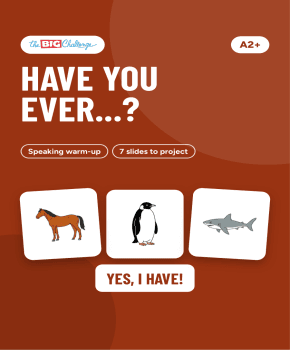
A projectable A2+ speaking warm-up: 36 life experiences on 6 slides, such as riding a horse or falling asleep in a museum. Pupils find a classmate for each one with Have you ever ...?, then ask When? and Where?
Documents to download (1)
- Slide bank In your teacher account
Teaching guide
Objective & content
By the end, A2+ pupils can ask and answer about life experiences with the present perfect and ever / never, then give details in the past simple: Have you ever ridden a horse? Yes, I have. I rode a horse last summer. The bank is 7 projectable slides: a how-to slide, then 6 slides of six experiences each (food and parties, travel, animals, nature and adventure, music and fun, everyday mishaps), each with a picture and a row of useful phrases.
Pedagogical guide
Use it as a five-minute warm-up that gets pupils moving and asking real questions. Finding a different classmate for each experience means pupils ask the same question many times, which fixes the form, and the answers are genuinely new information. The follow-up When? Where? shows the switch from the present perfect (the experience) to the past simple (the details). The slides are interchangeable: show one per lesson.
Suggested procedure
- (1 min) Show the how-to slide and read the example together.
- (3 min) Show one slide and read the six questions together. Pupils walk round and find a different person for each one.
- (1 min) Pupils tell the class what they found out: Lina has held a spider, but Tom has never seen a shark.
Adaptations
- [S] Pupils ask one partner the six questions and only answer Yes, I have. / No, I haven't.
- [A] Pupils ask one more question for each yes (When? Where? Was it fun?), or write five sentences about the class (Nobody has ever ...).
Materials & prerequisites
A projector or screen; the bank is a 16:9 PDF, one slide per page, with no printing needed. Assumes the past participles of common verbs and the past simple.
Possible adaptations
- Lower levels: Offer segmented listening and additional visual aids.
- Advanced levels: Encourage an oral summary and a debate in English on the theme.
- Large groups: Organise group work with differentiated roles.
🔒 Restricted content
This resource requires a subscription to be viewed.
Unlock the resourceIncluded in the subscription