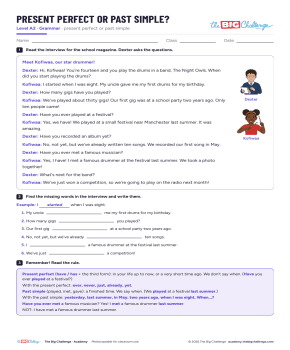
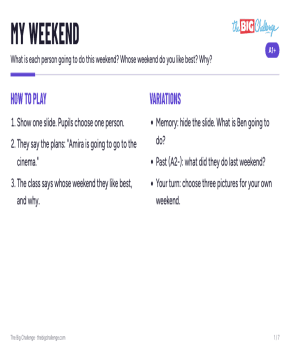
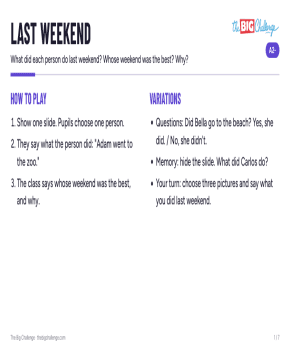
Last weekend
A teaching resource designed to energise your English lessons.
A projectable A2- speaking warm-up: 6 slides of four people with three pictured activities each. Pupils say what each person did last weekend in the past simple and whose weekend was the best.
Documents to download (1)
- Slide bank In your teacher account
Teaching guide
Objective & content
By the end, A2- pupils can say what people did last weekend in the past simple (Adam went to the zoo., He didn't ...) and say whose weekend was the best, and why. The bank is 7 projectable slides: a how-to slide, then 6 slides of four people, each with three pictured and labelled activities such as played tennis, took photos or visited grandparents. It is the past twin of the My weekend bank, with new people and new combinations.
Pedagogical guide
Use it as a five-minute warm-up once the past simple has been introduced. The labels give each verb in the past, regular and common irregular (went, ate, took, made), so pupils practise them in a sentence about a person. The last step adds an opinion with a superlative: I think Bella's weekend was the best because .... Activities come back on several slides in new combinations, so a new slide each lesson recycles the verbs.
Suggested procedure
- (1 min) Show the how-to slide and read the example together.
- (2 min) Show one slide. Pupils choose one person and say what they did: Adam went to the zoo.
- (2 min) The class says whose weekend was the best, and why.
Adaptations
- [S] Questions: Did Bella go to the beach? Pupils answer Yes, she did. or No, she didn't.
- [A] Memory: hide the slide and ask What did Carlos do? Or pupils choose three pictures and say what they did last weekend.
Materials & prerequisites
A projector or screen; the bank is a 16:9 PDF, one slide per page, with no printing needed. Assumes the past simple of common regular and irregular verbs, and the best.
Curriculum alignment
Maps to Cycle 3 "child and close environment" (FR): telling what happened in one's free time.
Possible adaptations
- Lower levels: Offer segmented listening and additional visual aids.
- Advanced levels: Encourage an oral summary and a debate in English on the theme.
- Large groups: Organise group work with differentiated roles.
🔒 Restricted content
This resource requires a subscription to be viewed.
Unlock the resourceIncluded in the subscription