The heritage fund
A teaching resource designed to energise your English lessons.
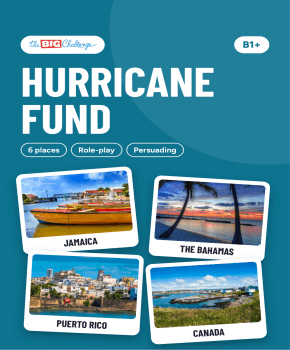
A B1+ role-play in which each group speaks for one famous place at a meeting about a heritage fund: Stonehenge, the Taj Mahal, Sydney Opera House, Elmina Castle, Robben Island and Ellis Island. Each card gives a real photo, three real facts and the place's role in the game. Three projects are on the table (repair it, protect it, tell its story) and there is money for one only, so groups persuade the others with the passive and the second conditional, then vote for a project that is not their own. Six cards, a tips page, a listening grid and a teacher page; about 50 minutes.
Documents to download (1)
- Fact files, speaking tips, listening grid In your teacher account
Teaching guide
Objective & content
A B1+ role-play in which each group speaks for one famous place at a meeting about a heritage fund. Six cards, two to a page, each give a photo, three real facts and the place's role in the game: Stonehenge, beside the busy A303 road, whose tunnel plan was approved in 2023 and cancelled in 2024; the Taj Mahal, whose white marble is turning yellow in Agra's polluted air; Sydney Opera House, which has already paid for ten years of repairs; Elmina Castle in Ghana, a centre of the Atlantic slave trade; Robben Island, where Nelson Mandela spent 18 of his 27 years in prison; and Ellis Island, where about 12 million immigrants arrived. Three projects are on the table (repair it, protect it, tell its story) and there is money for one only. By the end, pupils can present a place, argue for a project, answer a counter-argument and change their mind for good reasons.
Pedagogical guide
The facts on the cards are real and checked; the fund and the project each place defends are invented for the game, and the card says so, so no real body is given an opinion it has not stated. Worth saying in class: three of the places carry a dark page of history (the slave trade at Elmina, the political prison of Robben Island, the immigrants examined at Ellis Island), and project C asks how such a story should be told. The language is the passive (It was built in ..., It must be protected, were saved) and the second conditional (If we chose ..., ... would ...). The tips page gives the three projects, a frame for a two-minute speech and the phrases to persuade, to agree and to disagree politely. The vote has one rule that makes the debate real: each group must vote for a project that is not its own.
Suggested procedure
- (5 min) Make six groups and give each group one card. Read the three projects on the tips page together.
- (15 min) Groups prepare a two-minute speech with the tips page: what our place is, what is happening to it today, which project we want, why it is good for everyone.
- (15 min) The meeting: each place speaks and the class fills the grid. Then open the debate: groups try to win the others over.
- (10 min) The vote: each group votes for one project, but not the one on its card. Count the votes, then discuss: should a country spend money on its past?
Adaptations
[S] Groups prepare only three sentences: what our place is, what is happening to it, what we want.
[A] After the vote, each pupil writes a short news report of the meeting: which project won, and the best argument they heard.
Materials & prerequisites
The three card pages, cut in half along the dashed line (one card per group); the tips page and the listening grid for every pupil; the teacher page. Pupils should know the passive and the second conditional.
Possible adaptations
- Lower levels: Offer segmented listening and additional visual aids.
- Advanced levels: Encourage an oral summary and a debate in English on the theme.
- Large groups: Organise group work with differentiated roles.
🔒 Restricted content
This resource requires a subscription to be viewed.
Unlock the resourceIncluded in the subscription