Life in the UK
Interactive exercises to consolidate your students’ learning.
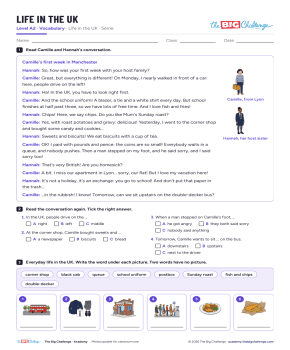
Driving on the left, school uniforms, queues and saying sorry: Camille, a French exchange pupil in Manchester, tells her host sister about her first week and learns the British words for fries, candy and cookies. Pupils name everyday British things, match meanings and American with British words, and finish with a crossword; answer key included.
Documents to download (2)
- Colour version In your teacher account
- Black and white version In your teacher account
Teaching guide
Objective & content
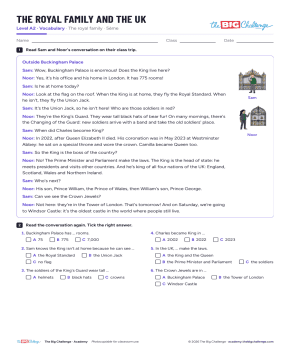
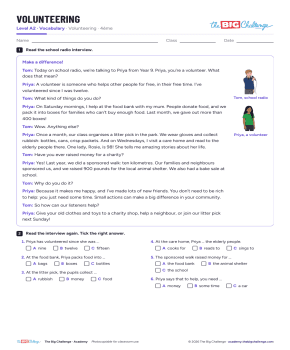
Camille, a French exchange pupil in Manchester, tells her host sister Hannah about her first week: traffic on the left, the school uniform, the Sunday roast, queues and saying sorry. Camille uses the American words she knows from films, and Hannah gives her the British ones. Pupils learn to talk about everyday life in the UK and compare it with France. After four multiple-choice questions on the conversation, they name six British things from a box of eight, match eight words with their meanings, complete eight sentences from a word box and match six American words with the British words Hannah uses (fries, chips). The last and hardest task is a crossword with clues and no word list.
Pedagogical guide
The conversation carries the words of the topic, so pupils meet each one in context before working on it. The British or American task tests only the pairs that Hannah corrects in the conversation, and the crossword clues come back to the conversation too. The facts are true to life: people drive on the left, most secondary pupils wear a uniform, there are 100 pence in a pound. The grammar stays on the A2- floor (past simple, the present continuous for the future, have to, can), and no task tests grammar.
Suggested procedure
- (5 min) Ask pupils what surprised them on a trip abroad, or what they think is different in the UK.
- (10 min) Pupils read the conversation and tick the four answers; check together.
- (8 min) Pupils name the British things, then match the words with their meanings.
- (8 min) Pupils complete the sentences; remind them that two words are extra.
- (5 min) Pupils match the American and British words.
- (12 min) Pupils do the crossword; check with the answer key on pages 4 and 5.
Adaptations
[S] Read the conversation aloud in two voices, then pupils underline the words Hannah corrects before the British or American task.
[A] Pupils write three things that are different in France ("In France, we drive on the right"). To take it further, they prepare a "welcome to France" guide for a British exchange pupil.
Materials & prerequisites
One copy of the three pupil pages per pupil, in colour or in black and white. Pages 4 and 5 are the answer key: keep them. Pupils should know the past simple of common verbs.
Possible adaptations
- Lower levels: Offer segmented listening and additional visual aids.
- Advanced levels: Encourage an oral summary and a debate in English on the theme.
- Large groups: Organise group work with differentiated roles.
🔒 Restricted content
This resource requires a subscription to be viewed.
Unlock the resourceIncluded in the subscription