Reading B1+: What Can Magic Tricks Teach Us About the Brain?
Interactive exercises to consolidate your students’ learning.
A B1+ reading about magic and attention: the gorilla nobody saw, and a ball trick that fools the brain, not the eyes. One text with a word box, ten questions and a pair speaking task, plus an answer key; 30 to 40 minutes.
Documents to download (2)
- Reading comprehension In your teacher account
- Reading comprehension (black and white) In your teacher account
Teaching guide
Objective & content
A B1+ reading about what magicians know about the brain. The text opens with a coin that disappears in front of you, then explains that the trick is not in your eyes but in your brain, which pays attention to only a few things at a time. It tells two famous experiments: at Harvard University in 1999, about half the people counting basketball passes in a video didn't see a woman in a gorilla suit walk through the game; in 2006, a magician who was also a psychologist made a ball "disappear" in the air just by looking up, and cameras showed that people's eyes never followed it. The text ends with a tip: if you want to see how a trick is done, don't look where the magician is looking! By the end, pupils can follow a short popular-science text, find the results of an experiment, and explain how a trick works. It is part of the Reading B1+ set: six one-text readings with the same layout.
Pedagogical guide
The sheet has one text of about 350 words at B1+, with no sentence longer than 20 words, and a word box with six words explained in English (magician, coin, fool, ignore, pass, expect). The ten questions go from finding information to explaining it: three choices or true or false first, then "Why do you think so many people didn't see the gorilla?" and "Why does the text say 'don't look where the magician is looking'?" The text uses the passive (was shown, were asked, were fooled) and the B1+ linkers while and even though, so it works well after a lesson on the passive or on linkers. In the speaking task, pupils show or explain a simple magic trick, with sentence starters such as "While you are watching ..., ..." Both experiments are real and published. You can show the original gorilla video (search for "selective attention test") after question 4: pupils who read the text first will see the gorilla, and that is the point.
Suggested procedure
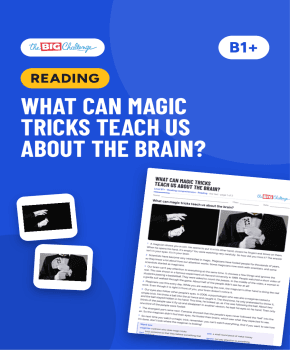
- (5 min) Warm-up: show the two photos and ask "What is the magician doing? Can you see the trick?" If you know a simple coin trick, do it now.
- (10 min) Pupils read the text alone. They can use the word box.
- (10 min) Pupils answer questions 1 to 10, then check in pairs. Correct together with the key; for 9 and 10, take two or three answers.
- (10 to 15 min) Speaking task: in pairs, pupils show or explain a simple trick they know, or describe one they have seen, with the sentence starters. A few pairs present to the class.
Adaptations
[S] Go through the word box first and act out "pass" and "fool". Pupils can answer questions 1 to 8 only, and describe a trick in three steps with "First, ... Then, ... Finally, ..."
[A] Pupils find the passive sentences in the text and rewrite two of them in the active. They can also write the instructions for a trick for a younger pupil, using while and even though.
Materials & prerequisites
The sheet in colour or low ink (the low-ink version has no pictures), one copy per pupil: pages 1 and 2 are for pupils, page 3 is the answer key. A screen to show the photos for the warm-up. A coin or a pack of cards if you want to try a trick. Pupils should know the past simple and have met the passive.
Possible adaptations
- Lower levels: Offer segmented listening and additional visual aids.
- Advanced levels: Encourage an oral summary and a debate in English on the theme.
- Large groups: Organise group work with differentiated roles.
🔒 Restricted content
This resource requires a subscription to be viewed.
Unlock the resourceIncluded in the subscription