Meeting Someone New
A teaching resource designed to energise your English lessons.
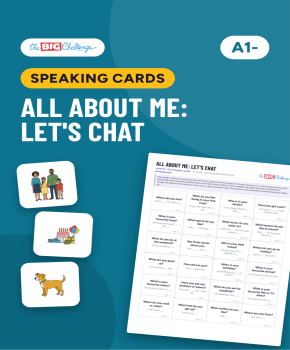
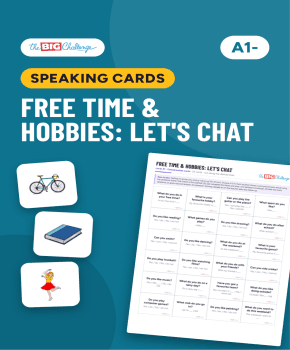
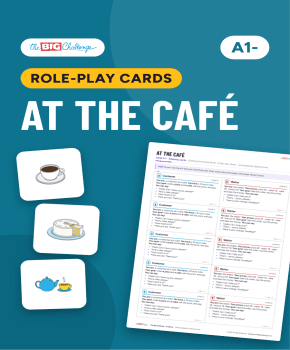
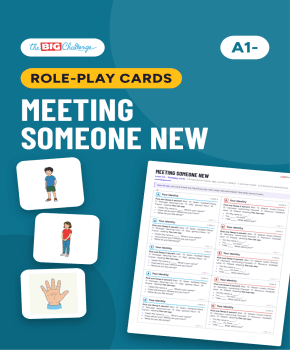
A1 pair roleplay: two students with secret identities meet and find out each other's name, age, country and hobby. Self-contained A/B cut-out cards with per-card phrases and [S]/[A] variants. Prints 5 sets per A4.
Documents to download (2)
- Roleplay cards In your teacher account
- Roleplay cards (black and white) In your teacher account
Teaching guide
Objective & content
By the end, A1 students can meet a new person and exchange basic personal information. This resource is a pair (then mingle) speaking activity: two self-contained cut-out role cards, each offering a choice of secret identities (name, age, country, hobby), plus [S]/[A] variants. Prints 5 sets per A4 page.
Pedagogical guide
Roleplay cards work well for introductions because the secret-identity format gives every pair a genuine information gap, even in a whole-class mingle. This card set targets introduction functional language (what's your name?, how old are you?, where are you from?) and pairs naturally with a countries or free-time lesson. Use it once students can form basic wh-questions and to be statements.
Suggested procedure
- (2 min) Distribute one Card A and one Card B per pair; each student secretly picks one identity.
- (1 min) Set the goal: find out the partner's name, age, country and hobby.
- (8–10 min) Pairs exchange questions, then swap and mingle to meet new partners.
- (2 min) Quick whole-class check: did students exchange all four pieces of information?
Adaptations
- [S] Pick one identity; answers stay on the card; ask two questions only; no timer.
- [A] Cover the "You can say" lines and improvise; add two more questions (favourite food, pets); bonus: pick a new identity and meet a new partner across the room.
Materials & prerequisites
Print the cards sheet (A4, 5 sets per sheet) and cut into cards; one set per pair. Assumes basic wh-questions and to be statements.
Curriculum alignment
Maps to Cycle 3 "child and close environment" (FR 6e) — introducing oneself and others.
Possible adaptations
- Lower levels: Offer segmented listening and additional visual aids.
- Advanced levels: Encourage an oral summary and a debate in English on the theme.
- Large groups: Organise group work with differentiated roles.
🔒 Restricted content
This resource requires a subscription to be viewed.
Unlock the resourceIncluded in the subscription