Reading A2: The Oldest Message in a Bottle
Interactive exercises to consolidate your students’ learning.
An A2 reading about a true find: in 2018, a woman walking on a beach in Australia picked up an old bottle, and inside was a note thrown into the sea from a German ship in 1886. One text with a word box, ten questions and a pair task, our message in a bottle, plus an answer key; 30 to 40 minutes.
Documents to download (2)
- Reading comprehension In your teacher account
- Reading comprehension (black and white) In your teacher account
Teaching guide
Objective & content
An A2 reading about the oldest message in a bottle ever found. In January 2018, Tonya Illman was walking on a beach in Western Australia when she saw an old bottle in the sand and picked it up for her bookshelf. Inside was a damp paper, rolled up and tied with string: a printed form in German. Experts at a museum in Perth found the answer in Germany: the captain of a German ship, Paula, threw the bottle into the sea on 12 June 1886, as part of a study of the sea's currents, and wrote about it in the ship's diary. The bottle was almost 132 years old. The text ends with an invitation: if you find an old bottle on a beach, look inside. By the end, pupils can follow a short true story, find facts in a text, and write a short message of their own. It is part of the Reading A2 set: one-text readings with the same layout.
Pedagogical guide
The sheet has one text of about 270 words at A2, with short sentences of 13 words or fewer, and a word box with six words explained in English (damp, tip out, form, research, current, lend). The ten questions go from finding information to giving an opinion: three choices, true or false and one gap to complete first, then "How did the experts know that the bottle was from 1886? Explain using the text." and "If you sent a message in a bottle, what would you write?" The story is told in the past simple, with many irregular verbs (saw, took, found, threw, wrote); question 10 brings one "would". The speaking task turns reading into writing and speaking: in pairs, pupils write their own message for a bottle, then swap with another pair and answer it. Every fact comes from the Guinness World Records entry and news reports of the find.
Suggested procedure
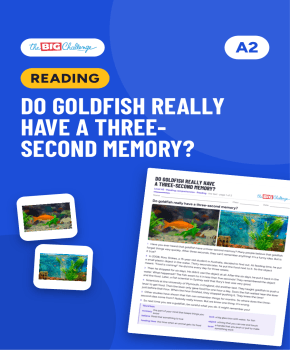
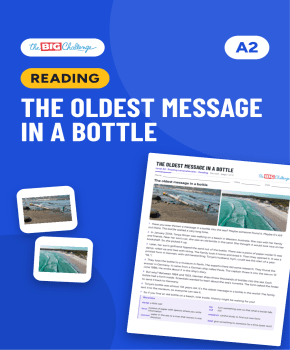
- (5 min) Warm-up: show the photos and ask "What would you do if you found this bottle?"
- (10 min) Pupils read the text alone. They can use the word box.
- (10 min) Pupils answer questions 1 to 10, then check in pairs. Correct together with the key; for 9 and 10, take two or three answers.
- (10 to 15 min) Speaking task: in pairs, pupils write a short message for a bottle (who they are, where they live, one question for the finder), with "Hello! My name is ...", "I live in ..." and "Please write to me and tell me ...". They swap messages with another pair, read the one they got to the class and answer its question.
Adaptations
[S] Go through the word box first, with the photos. Before question 9, read paragraph 4 again together. Pupils can answer questions 1 to 8 only, and write a message of two sentences.
[A] Pupils write the captain's entry in the ship's diary for 12 June 1886, in the past simple. They can also find the ship's route on a map: from Wales to the island of Sulawesi, in today's Indonesia.
Materials & prerequisites
The sheet in colour or low ink (the low-ink version has no pictures), one copy per pupil: pages 1 and 2 are for pupils, page 3 is the answer key. A screen to show the photos for the warm-up. Paper for the messages. Pupils should know the past simple, regular and irregular.
Possible adaptations
- Lower levels: Offer segmented listening and additional visual aids.
- Advanced levels: Encourage an oral summary and a debate in English on the theme.
- Large groups: Organise group work with differentiated roles.
🔒 Restricted content
This resource requires a subscription to be viewed.
Unlock the resourceIncluded in the subscription