Past simple: irregular verbs
Interactive exercises to consolidate your students’ learning.
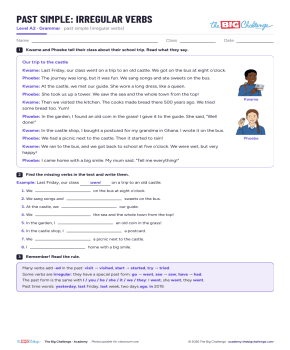
The past simple of common irregular verbs (went, saw, had, bought) next to regular verbs, seen through Kwame and Phoebe's story of a school trip to a castle. Pupils find the missing verbs, read the rule, learn a table of eighteen irregular verbs, circle the right verbs in a holiday message, change today into yesterday and find a mystery word; answer key included.
Documents to download (2)
- Colour version In your teacher account
- Black and white version In your teacher account
Teaching guide
Objective & content
This grammar sheet teaches the past simple of common irregular verbs (went, saw, had, made, took, got, came, bought) next to regular verbs in -ed, in positive sentences with yesterday, last Friday, two days ago and in 2019. Pupils read what Kwame and Phoebe tell their class about a school trip to a castle, find the missing verbs and read the rule, given in a box. By the end, they can use eighteen common irregular past forms and tell a friend about a day out.
Pedagogical guide
Page 1 is the text, with a picture of Kwame and of Phoebe: the class went by bus to an old castle, met a guide in a long dress like a queen, saw the sea from a tower, and Phoebe found an old coin in the garden. Pupils find eight missing verbs in sentences from the text. Then they read the rule, given in a box in short lines: many verbs add -ed, some are irregular and have a special past form, the past form is the same with every person, and past time words. Page 2 has a table of eighteen irregular verbs to learn (go, went; buy, bought; wear, wore), Yusuf's holiday message to his grandma with seven verbs to circle, and eight sentences to change from today to yesterday. Page 3 has twelve sentences with the verb in brackets to write in the past, some regular and some irregular, then a mystery word: pupils write seven past forms in the boxes and the shaded letters spell a word. Every exercise opens with a worked example, except the table and the mystery word. There are no questions or negatives on the sheet.
Suggested procedure
- (5 min) Tell the class about a day out ("Last Sunday, I went to the sea and I saw a dolphin") and write the verbs on the board.
- (10 min) Read the text aloud; pupils find the missing verbs.
- (5 min) Read the rule in the box with the class; pupils find the irregular verbs in the text.
- (10 min) Page 2: read the table together, then Yusuf's message and today and yesterday.
- (10 min) Page 3: the verbs in brackets, then the mystery word.
- (5 min) Check with the answer key on page 4.
Adaptations
[S] Pupils read the text aloud in pairs, one as Kwame and one as Phoebe, before the tasks.
[A] Pupils write four sentences about a school trip they remember.
Materials & prerequisites
One copy of pages 1 to 3 per pupil. Page 4 is the answer key and teacher notes: keep it. Pupils need the past simple of regular verbs (-ed), was and were, and the words for food, school and holidays. To take it further, pupils test each other on the table: one says go, the other says went.
Possible adaptations
- Lower levels: Offer segmented listening and additional visual aids.
- Advanced levels: Encourage an oral summary and a debate in English on the theme.
- Large groups: Organise group work with differentiated roles.
🔒 Restricted content
This resource requires a subscription to be viewed.
Unlock the resourceIncluded in the subscription